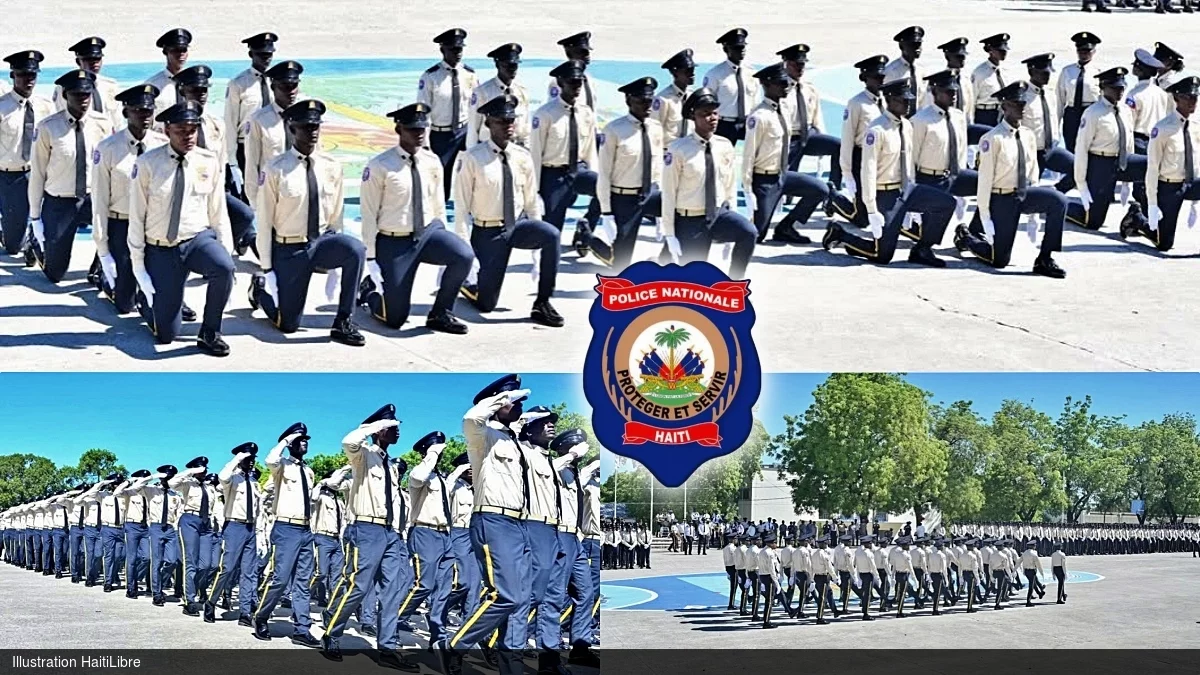
On October 30, 2026, a landmark graduation ceremony unfolded at Haiti’s National Police Academy along Route des Frères, marking the formal induction of 1,189 newly trained law enforcement personnel as the 37th cohort of the Haitian National Police (PNH). Dubbed the “Dessalines” promotion, this group represents the third intake under the government’s P4000+ security expansion program, comprising 947 male and 242 female officers, with women making up 20.3% of the graduating class.
Presiding over the event was Haitian Prime Minister Alix Didier Fils-Aimé, who also serves as President of the Superior Council of the National Police (CSPN). The gathering drew a broad cross-section of stakeholders, including cabinet members, diplomatic and consular corps representatives, senior leadership of Haiti’s security forces, and prominent public figures. In his keynote address, Fils-Aimé first paid solemn tribute to fallen police officers, soldiers, and public safety personnel who lost their lives while on duty, alongside honoring the four Salvadoran service members who went missing in the Santo region.
Directing his remarks to the newly commissioned officers, the prime minister urged them to uphold the core values of honor, unwavering discipline, courage, and uncompromising integrity in their service to the Haitian nation. He emphasized that the PNH uniform is not merely a marker of occupation, but a sacred pledge to the homeland and a binding commitment to prioritize the safety and well-being of ordinary citizens as the central pillar of all their operational work. Fils-Aimé further reaffirmed his administration’s unshakable resolve to restore full state authority across every corner of Haitian territory, through targeted investments to boost the operational capabilities of all security branches, reinforce border oversight, and escalate crackdowns on systemic corruption and the illicit cross-border trade of firearms. In a Creole-language remark that underscored the administration’s policy priority, he stated, “A state that does not control its borders is a state in weakness”, adding that lasting national security can only be achieved through robust, well-governed state institutions and decisive, consistent government action.
The U.S. Embassy in Port-au-Prince issued an official statement extending formal congratulations to the graduating cohort, noting that the latest intake pushes the total number of officers trained and deployed under the U.S.-funded P4000 program to over 3,200. Backed by more than $25 million in allocated funding from the U.S. Department of State’s Bureau of International Narcotics and Law Enforcement Affairs (INL), the P4000 initiative is on track to meet its core target of recruiting, training, and fully equipping 4,000 new Haitian police officers by the spring of 2027. Notably, the program has compressed a training output that would historically take the National Police Academy seven years to complete into just 16 months, drastically accelerating the expansion of Haiti’s law enforcement ranks.
All officers trained under the P4000 program are deployed directly to local communities immediately after graduation, where they work alongside specialized PNH units, the Armed Forces of Haiti (FAd’H), and the UN-authorized Gang Suppression Force (GSF) to dismantle violent criminal gang networks, maintain full administrative control over recently liberated territories, secure critical public infrastructure, and keep major transportation corridors open and safe for civilian use. To guarantee the integrity of the new law enforcement workforce, the program uses advanced retinal lie detection technology to screen all candidates for existing or past ties to criminal gangs. It also integrates mandatory, intensive training modules on professional ethics, responsible leadership, and international human rights standards into its core curriculum. U.S. officials have emphasized that this bilateral security assistance is fully aligned with Haitian-led national security priorities, designed to foster long-term institutional autonomy for the PNH, dismantle violent criminal networks that have destabilized the country, and reinforce broader regional security across the Caribbean.
37th Promotion : Graduation of 1,189 new police officers