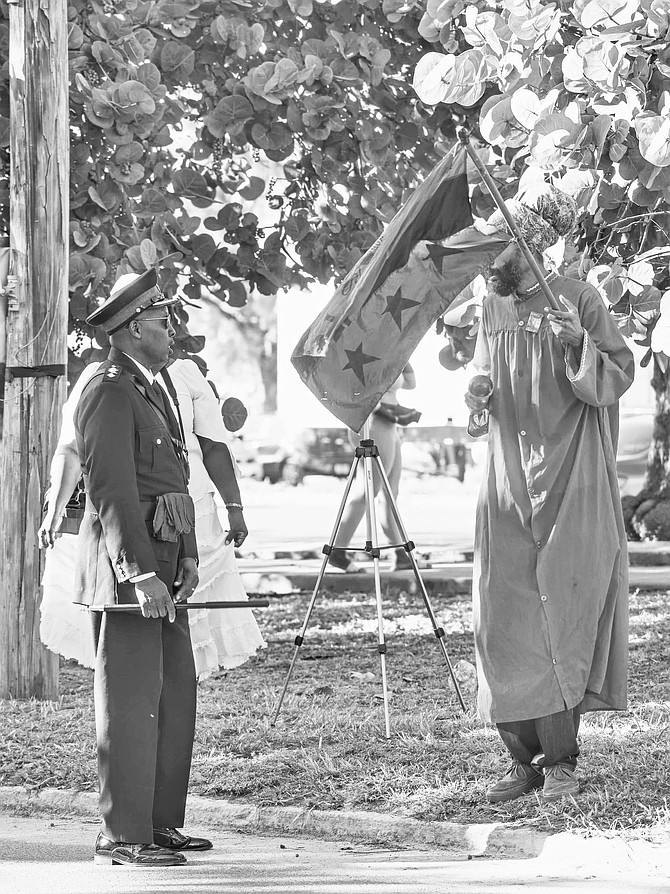
During King Charles III’s official appearance at a youth-focused rally at Nassau’s Clifford Park, a group of Rastafarian demonstrators and their allies faced repeated police directives to relocate, with participants alleging law enforcement intentionally pushed them to low-visibility spots to muffle their calls for transatlantic slavery reparations, a formal British state apology, and voluntary repatriation pathways for people of African descent. The demonstration, organized by the Ethiopia Africa Black International Congress (EABIC) Bahamas branch, brought together Rastafarian elders, priests, and civilian supporters, who beat traditional drums, waved red-black-green Rastafari flags, and held hand-painted placards — one of which read “REGRET IS NOT ENOUGH WE NEED A FULL APOLOGY” — as they chanted their demands along the city’s waterfront. 61-year-old Rastafarian elder Phillip Gibson, who has practiced the faith since age 13, told local reporters that officers repeatedly guided the group away from high-foot-traffic areas near the event, moving them first from the historic old cannons across Marcus Bethel Way further down Western Esplanade after EABIC Bahamas leader High Priest Richmond McKinney negotiated initial protest parameters with law enforcement. Uniformed officers remained stationed in close proximity to the assembled crowd throughout the action, approaching demonstration organizers multiple times with additional relocation orders even as drumming and chanting continued uninterrupted. EABIC Bahamas vice-chairman Priest Ethelbert Diamond Harrison, 57, pushed back against the movement directives, noting that general members of the public were freely permitted to gather along the rally’s viewing routes. “We are the public, too — the event was advertised as open to all, so why are we being singled out to move?” he stated, adding that he believed the repeated relocation orders stemmed from top-down command rather than independent decisions by on-duty officers. McKinney confirmed that the group had secured an official protest permit after a respectful pre-event meeting with Royal Bahamas Police Commissioner Shanta Knowles, framing the first relocation as an initial misunderstanding of permitted demonstration zones, but said subsequent repeated police interventions eventually led the group to wrap up their action roughly one hour after King Charles’s motorcade passed their position en route to Clifford Park. He added that the pattern of police oversight during the protest reflected longstanding systemic marginalization of the Rastafarian community in the Bahamas. “We recognize that officers have a job to do, but we ask them to remember we are all equal members of this society,” McKinney said, noting the group hoped to open more constructive, collaborative dialogue with authorities moving forward. Gibson emphasized that the group’s red, black, and green banners symbolized the blood of African ancestors, Black global communities, and the fertile land of their African homelands, a deliberate contrast to the red, white, and blue Union Jack representing the British monarchy. “That man is not our king,” he said of King Charles. “Our only goals are freedom, collective redemption, and the right to voluntary international repatriation — we want no formal ties to the British monarchy.” The EABIC submitted a six-page formal petition directly to King Charles during his visit, laying out three core demands: a full, unreserved formal apology for the British Crown’s role in the transatlantic chattel slave trade, targeted reparatory compensation for descendant communities, and formal multi-party negotiations between the Rastafarian community, Caribbean national governments, African national governments, and British state institutions to advance these priorities, with a written formal response from British authorities outlining plans for further engagement. The protest drew cross-community support beyond the Rastafarian faith: 68-year-old Sharon Purser-Cooper, a 41-year veteran public school educator in the Bahamas and self-identified Christian, joined the demonstration even as she noted she did not intend to relocate permanently to Africa. “I respect my Rastafarian siblings deeply, and while I hope to visit the African homeland one day, my home is here in the Bahamas, and the reparations we demand should go toward building up our local healthcare, education, agriculture, and public infrastructure for all of us, not just be distributed as lump-sum individual payouts,” she said. “We are not begging for charity — we are demanding what is legally and morally owed to us.” 21-year-old University of The Bahamas journalism student Jashai Burrows also joined the action, saying her frustration with pre-visit preparations — including disruptive road construction projects and school policies that encouraged public and private K-12 students to attend the royal youth rally — pushed her to participate. “It is deeply disturbing to me that we are forcing our children to travel to a rally to celebrate a head of state whose country built its wealth on a system that oppressed and brutalized our ancestors for centuries,” Burrows said, adding that the heavy police presence surrounding the demonstration left her feeling targeted. “It feels like they are scared of our voices, scared of the anger we have carried for generations over this unaddressed harm.” She noted she hoped the protest would at minimum force public and British authorities to acknowledge the legitimacy of the community’s demands. McKinney added that the demonstration was not only directed at the visiting monarch, but also intended to raise broader public awareness among Bahamians of the Rastafarian community’s decades-long fight for restorative justice. The group has announced plans for sustained further action, with a follow-up demonstration scheduled for 3:30 p.m. at the Registrar General’s Office on Shirley Street. “Even after the King leaves our shores, we will keep protesting until every one of our demands is met,” Harrison confirmed. Prior to the royal tour, Buckingham Palace released a public statement noting that King Charles would not avoid addressing what he has previously described as the darkest chapters of British history, but explicitly ruled out issuing a formal apology for the transatlantic slave trade, while the UK national government has repeatedly stated it will not allocate public funds to pay colonial reparations. As Prince of Wales, the then-future King Charles spoke publicly of his “personal sorrow” over the intergenerational harm caused by slavery at the 2022 Commonwealth Heads of Government Meeting in Rwanda, and at the 2024 summit in Samoa he acknowledged that “the most painful aspects of our past continue to resonate across Commonwealth communities today,” but stopped short of offering any formal apology or policy commitment to reparatory action.