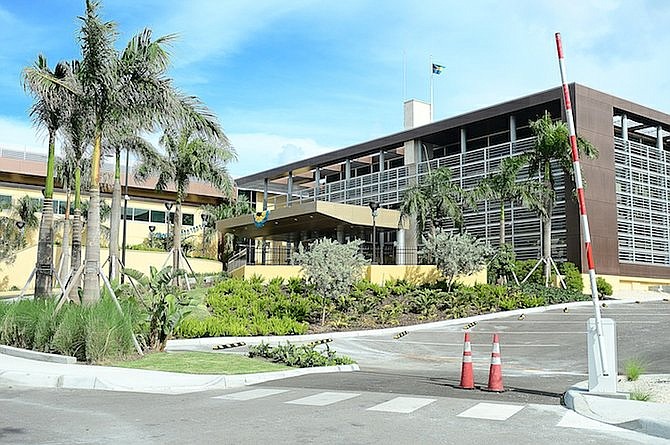
Two months after its top leader publicly pledged the institution would not challenge a landmark court ruling against it, the Public Hospitals Authority (PHA) has reversed course and launched an appeal against a Supreme Court finding that Princess Margaret Hospital was negligent in the 2022 death of a newborn girl.
The PHA and co-defendant Dr. Agatha Foulkes-Mackey, an obstetrics and gynaecology registrar at the facility, submitted separate notices of appeal to the higher court on September 8. Both appellants center their challenge on the argument that acting Justice Raynard Rigby, KC, failed to prove a direct causal link between the 27-minute gap in fetal monitoring during labor and the fatal brain injury that killed baby Elizabeth Lundy.
For Dr. Foulkes-Mackey specifically, the appeal argues the lower court wrongfully imposed personal liability on her, a finding that directly contradicts Justice Rigby’s own conclusions. The original judgment explicitly noted that Dr. Foulkes-Mackey and a second clinician recognized the emergency and took all appropriate steps to address it, finding “no fault in their actions.”
The original ruling was delivered on July 28 in a lawsuit brought by the baby’s mother, Widline Guillaume. Baby Elizabeth was born on August 2, 2022, and died just two hours after birth, prompting Guillaume to file a wrongful death claim against the hospital and the clinical team involved. Justice Rigby ruled in Guillaume’s favor, finding that Princess Margaret Hospital and Dr. Foulkes-Mackey failed to meet the required standard of care when they paused monitoring of Guillaume and her unborn child between 4:10 a.m. and 4:37 a.m. The gap occurred while the patient waited for the results of a pre-surgery COVID-19 test ahead of an emergency caesarean section. The judge awarded Guillaume general and special damages, with the exact amount to be determined at a future hearing, and ordered the defendants to cover her legal fees.
The day after the original ruling, PHA’s then-managing director Aubynette Rolle told local outlet The Tribune that the authority had no intention of extending the legal battle or forcing the grieving family to relive the trauma of their baby’s death. “At this moment has no intentions of going back against the ruling,” Rolle stated at the time, adding that the PHA would accept all financial responsibilities tied to the decision.
That public commitment has now been abandoned. The PHA’s appeal, submitted through the Office of the Attorney General, asks the Court of Appeal to overturn the original ruling in full, amend the judgment, issue a new ruling in favor of the defendants, and order Guillaume to cover the PHA’s appeal legal costs.
Beyond the lack of causal connection, the PHA’s appeal outlines multiple alleged errors in Justice Rigby’s handling of the case. It argues the judge misapplied the legal burden of proof, which rests entirely on the claimant Guillaume to prove negligence. The lower court, the appeal claims, improperly highlighted evidence that was never introduced during the trial and referenced critical witnesses who were never called to testify. The PHA also takes issue with the judge’s decision to admit expert testimony that contradicted documented primary facts, when the clinician who recorded those original facts never testified during the proceedings.
The PHA further notes that the original judgment itself included multiple findings that undermine the negligence conclusion: the baby’s Apgar scores (a standard measure of newborn health) of 7 and 8 at one and five minutes after birth accurately reflected her condition at delivery; clinical staff acted immediately once the emergency caesarean was approved; pre-labor cardiotocography (CTG) readings showed no distress for either mother or baby; and there was no unreasonable delay in the delivery itself. Given these findings, the PHA argues the original ruling of negligence cannot be supported by the evidence presented at trial.
For her part, Dr. Foulkes-Mackey, represented by law firm Cheryl T Whyms & Co, is asking the Court of Appeal to strike all findings of liability against her, dismiss the claim entirely, and order Guillaume to pay her legal costs. In the alternative, she requests a new trial before a different judge.
Her appeal emphasizes that Justice Rigby never identified any specific action or inaction by Dr. Foulkes-Mackey that fell below the standard of care expected from a reasonably competent obstetrics and gynaecology registrar. The judge did not find that she removed the CTG monitor, was assigned responsibility for monitoring during the pre-surgery wait, instructed midwives not to conduct monitoring, knew monitoring was not occurring, or controlled hospital equipment, staffing, or operating room scheduling. Dr. Foulkes-Mackey also argues that Justice Rigby imposed collective liability on all defendants without clarifying which party owed the patient a duty of care or breached that duty, holding her personally responsible for a monitoring failure that the judge himself attributed to the hospital and the attending midwife. She adds that the claim of a monitoring lapse was never formally plead against her as an individual defendant – the original claim focused on delays in assessment and delivery, so she never received fair notice of the monitoring allegation or a chance to defend herself against it.
Dr. Foulkes-Mackey’s appeal also challenges the medical conclusions of the original ruling. It notes that fetal monitoring is a diagnostic tool, and the absence of monitoring cannot itself cause oxygen deprivation to a fetus. Justice Rigby never determined when the baby’s condition declined, what a 27-minute monitoring session would have detected, or whether any clinical intervention made possible by earlier monitoring would have saved the baby’s life. The baby was born alive and experienced fatal distress during transfer after delivery, and no evidence presented at trial was able to definitively explain the cause of the sudden deterioration, the appeal adds. Dr. Foulkes-Mackey points out that Justice Rigby explicitly stated he did not need to determine what caused the baby’s death – a step she argues was a legal requirement before he could find any defendant liable.
The appeal also takes issue with the judge’s conclusion that perinatal asphyxia was the probable cause of death. Justice Rigby rejected expert testimony from Dr. Ward that suggested an undiagnosed congenital heart condition could have been responsible, largely because the mother had a normal cardiovascular exam. Dr. Foulkes-Mackey notes that no expert evidence presented at trial supported the claim that a normal maternal exam rules out congenital heart disease in a fetus. She also challenges the judge’s reliance on the death certificate, pointing out that the doctor who signed the certificate, the treating paediatrician, and the attending nurse all never testified, no paediatric medical expert was called to support the cause of death finding, and no autopsy was conducted to confirm the cause of death. Both medical experts who testified at trial agreed that the lack of an autopsy made determining the actual cause of death significantly more difficult, the appeal adds.
To date, no hearing date has been scheduled for the appeal before the Court of Appeal.