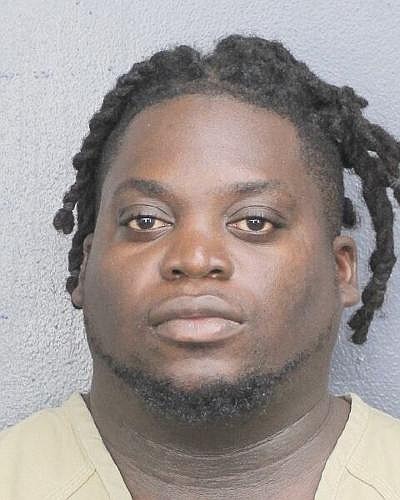
A Bahamian boat captain, Malcolm Goodman, who was at the center of a high-profile drug arrest controversy earlier this year involving a vessel co-owned by former Bahamian National Security Minister Marvin Dames, has been sentenced to six years in a Florida federal prison — a term far shorter than the maximum penalty allowed by law and less than what federal prosecutors had initially requested.
United States District Judge Melissa Damian handed down the sentence Wednesday, following Goodman’s guilty plea to one count of possession with intent to distribute cocaine. The 31-year-old’s sentence fell below the 9-to-11-year range recommended by both prosecution and defense under federal sentencing guidelines. While the offense carries a mandatory minimum 10-year sentence and a maximum of life imprisonment, Goodman’s plea agreement qualified him for a reduced sentence under a federal provision that allows leniency for eligible offenders.
Goodman’s conviction caps months of court proceedings and public debate over his business ties to Dames, a former Deputy Commissioner of Police who served as national security minister in the previous Minnis administration of the Bahamas. Goodman was first taken into custody on February 11, when U.S. Coast Guard officers intercepted his 45-foot vessel, the M/V Reel Xperience, roughly four miles off the coast of Fort Lauderdale, Florida. Goodman was the only person on board; the vessel had departed from New Providence, and he told authorities he had been at sea for approximately seven hours.
According to a sworn affidavit from Jose Alvarez, a taskforce officer with the U.S. Department of Homeland Security, a routine customs search turned up brick-shaped packages of cocaine stashed in the vessel’s common area and a stateroom. The packages, which totaled roughly 200 kilograms and were wrapped in cellophane, were visible without requiring an extensive search. Officers also found approximately 248 bottles of cough syrup stored in a plastic bin. Authorities have stated that Goodman voluntarily admitted responsibility for the drugs before being read his Miranda rights, and later declined to answer questions without his attorney present.
Goodman initially entered a plea of not guilty to two charges: possession with intent to distribute a controlled substance, and importation of a controlled substance. After months of plea negotiations, however, he struck an agreement with prosecutors and changed his plea to guilty on July 15. As part of the deal, prosecutors agreed to drop the importation charge. The agreement also required Goodman to cooperate fully with authorities, disclose full details of the offense, and assist in asset forfeiture proceedings for property gained through illegal activity.
Ahead of sentencing, Goodman’s defense attorney, Jay Allen White, pushed Judge Damian to issue a sentence well below the recommended guidelines range, arguing that Goodman had turned to drug trafficking out of financial desperation rather than long-term criminal ambition. In court filings, White explained that his client had accumulated significant debt while trying to support his young son and grandmother. He also noted that aspects of the operation suggested Goodman was not an experienced drug trafficker: the cocaine was left in plain sight, he did not attempt to conceal the vessel’s movements, and he made no effort to evade law enforcement. White added that Goodman had not received any advance payment for transporting the drugs, and had only agreed to the trip based on a promise of payment after delivery.
The defense submitted 16 character references from family members, friends, religious leaders, and former colleagues, all of whom described Goodman as a hardworking father and experienced maritime professional with no prior criminal record. The nature of Goodman’s business connection to Dames became a major point of public controversy following his arrest. In a September sentencing submission, White revealed that Goodman had invested $20,000 of his own savings in 2023 to acquire a 30% stake in Reel Xperience Boat Charters LLC, the company that co-owned the vessel alongside Dames.
This account contradicts Dames’ earlier public statements, in which he described Goodman as primarily an employee that he and his wife had helped establish professionally. Dames has previously said the business arrangement did not begin until 2024, and has maintained that neither he nor his wife had any knowledge of, participation in, or benefit from Goodman’s criminal activity. He has also stated that they never authorized or approved any unlawful conduct, and would cooperate fully with any official investigation. Back in April, Dames noted that he had not been questioned in connection with the case, and compared the situation to allowing an employee to use your vehicle without knowing they are transporting illegal items. Dames and his wife had also moved to recover the vessel, on which they were still repaying a large outstanding loan. In response, U.S. prosecutors later notified the court that they would no longer seek permanent forfeiture of the vessel.
The case drew significant political attention in the Bahamas because Dames was running as the Free National Movement’s candidate for Mount Moriah at the time of Goodman’s arrest. To date, Dames has consistently denied any involvement in the drug trafficking operation, and no charges have been filed against him in connection with this case.