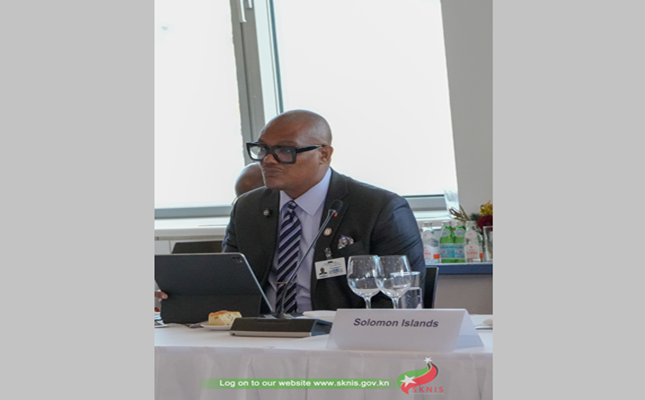
On the sidelines of the 81st United Nations General Assembly in New York on September 24, 2026, a high-level working lunch for members of the Alliance of Small Island States (AOSIS) brought together key global stakeholders to address the cascading threats facing Small Island Developing States (SIDS). Co-hosted by German Foreign Minister Dr. Johann Wadephul and Palauan Minister of State Gustav N. Aitaro, the gathering became a platform for SIDS leaders to amplify their urgent call for systemic international support.
Speaking on behalf of Saint Kitts and Nevis, Acting Prime Minister Dr. Geoffrey Hanley delivered a stark wake-up call to the global community: the overlapping vulnerabilities SIDS face can no longer be treated as isolated, regional challenges. He emphasized that for small island nations like Saint Kitts and Nevis, climate change, energy insecurity, and economic fragility are not separate issues — they are deeply interconnected threats that undermine every pillar of national stability.
“For us, resilience is therefore not simply an environmental objective. It is an economic and national security imperative,” Hanley told attendees.
Discussions at the working lunch centered on three core priorities: evolving international climate policy, collective resilience building, regional security cooperation, and growing energy vulnerabilities amplified by geopolitical tensions disrupting the Strait of Hormuz. Hanley highlighted how even minor disruptions to global energy markets and international supply chains trigger immediate, disproportionate harm to small island economies, pushing up the cost of fuel, transportation, and imported food overnight, eroding limited fiscal buffers and deepening existing inequalities.
To counter these risks, Hanley outlined a clear path forward: the international community must expand SIDS’ access to low-cost climate finance, accelerate the transfer of renewable energy technology, and invest in climate-resilient infrastructure that can withstand extreme weather events and market shocks. Only through these targeted actions can SIDS shift from a perpetual state of crisis response to long-term, sustainable development.
“Our objective should be clear: to move from vulnerability to resilience through stronger partnerships, greater access to finance and technology, diversified energy systems, and a stronger collective voice for SIDS,” Hanley said.
He closed by reaffirming Saint Kitts and Nevis’ unwavering commitment to collaborating with Caribbean neighbors, fellow SIDS across the globe, and the broader international community to advance practical, actionable solutions that strengthen the resilience and advance the sustainable development of all small island states. This call comes as SIDS face intensifying climate impacts, from rising sea levels that threaten territorial integrity to more frequent extreme weather events that destroy critical infrastructure, alongside growing global economic and geopolitical volatility that disproportionately impacts low-lying, trade-dependent small economies.