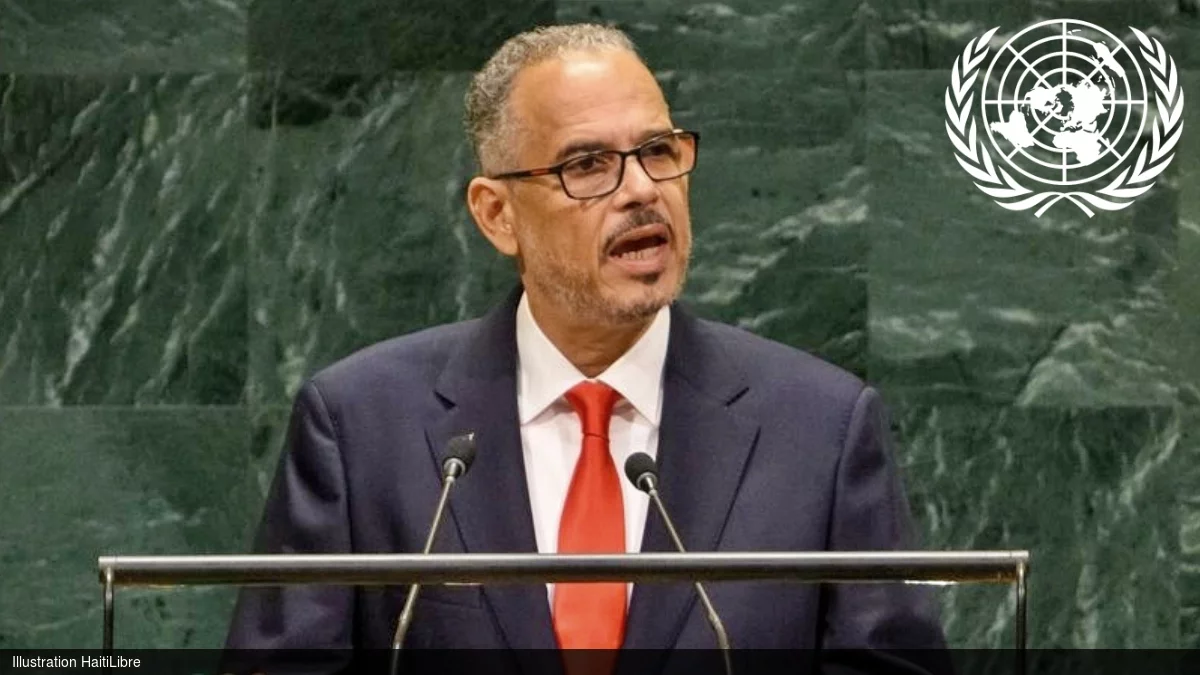
In a pre-recorded address delivered to the 81st United Nations General Assembly on September 25, 2026, Haitian Prime Minister Alix Didier Fils-Aimé laid out a balanced, two-pronged strategy to lift his crisis-battered nation out of ongoing instability, stressing that Haiti does not demand global rescue — it requests international support to help Haitians save themselves.
Opening his speech, Fils-Aimé extended formal gratitude to the country’s global and regional partners, including the United Nations, United States, Canada, France, Mexico, the Caribbean Community (CARICOM), Organization of American States (OAS), and European Union for their existing assistance. He then pressed the international community to accelerate the full deployment of the UN-backed Gang Suppression Force (GSF), a multinational security mission authorized by the Security Council in September 2025 that was designed to replace the underperforming Kenya-led multinational mission that never reached its targeted troop strength.
The prime minister’s vision of Haiti taking full control of its own destiny stands in stark contrast to the grim on-the-ground reality currently facing the Caribbean nation. Gangs currently hold sway over the vast majority of the capital Port-au-Prince and its critical transport routes, and violence that was once concentrated in the capital is now spreading to previously peaceful regions across the country. While limited security operations in Port-au-Prince have yielded minor incremental gains, they have failed to break the pervasive hold criminal groups have on the capital. Instead, increased pressure in the capital has pushed many gang factions into remote areas where state presence is even weaker, shifting the center of violence rather than eliminating it.
For Fils-Aimé, the long-term path to stability hinges on building up Haiti’s domestic security forces to allow the country to eventually take full ownership of its security. To date, more than 2,000 new Haitian police officers have completed training, a number the prime minister says he aims to double in the near term. The Haitian national army has also added 1,500 new recruits, and the government has unveiled plans to train an additional 15,000 soldiers over the next three years. “Haiti’s long-term security must rely on the capabilities of the Haitian state,” Fils-Aimé emphasized. Alongside building domestic capacity, the prime minister called for a renewal of the GSF’s mandate, noting that the mission remains drastically understaffed, far from its authorized maximum strength of 5,500 police and military personnel. “A mandate is not enough. We need personnel. We need resources. We need the determination to see this through,” he told the assembly.
Beyond domestic security efforts, Fils-Aimé also targeted the transnational networks that fuel gang violence, noting that nearly all weapons used by criminal groups are smuggled into Haiti despite an existing international arms embargo. “The weapons that kill Haitians […] are not produced in Haiti,” he reminded delegates, urging global partners to coordinate to dismantle the illicit supply networks that arm criminal factions.
Security gains are intended to clear the way for a return to constitutional democratic rule, the prime minister added. Haiti has not held national elections since 2016, and the first round of presidential and legislative elections is currently scheduled for December 13 this year, contingent on sufficient improvements to the security situation. Fils-Aimé confirmed that the current transitional administration will end with a democratic vote at the ballot box. To strengthen the rule of law alongside elections, the government has already established two specialized judicial centers, and new penal and criminal procedure codes are set to take effect on January 1, 2027. Security, judicial reform, and democratic elections form the three core pillars of the government’s plan to rebuild functional state institutions, he explained.
On the economic and humanitarian front, Fils-Aimé outlined a goal to shift Haiti’s economic model from reliance on international aid to sustainable foreign investment and equitable partnership. Even as the government pursues this long-term goal, the country faces an immediate acute humanitarian crisis: an estimated 6.4 million Haitians — more than half the country’s population — require life-saving humanitarian assistance, and nearly 1.5 million people have been displaced by gang violence.
Closing his address, Fils-Aimé framed the current moment as a defining test for Haiti more than two centuries after it gained independence. “We have proven to the world that freedom is possible,” he said. “Haiti must now demonstrate its capacity to reclaim its own territory.” The core of the challenge, as presented to the UN General Assembly, is building a self-sufficient Haitian state even as the country relies on immediate international support to survive.