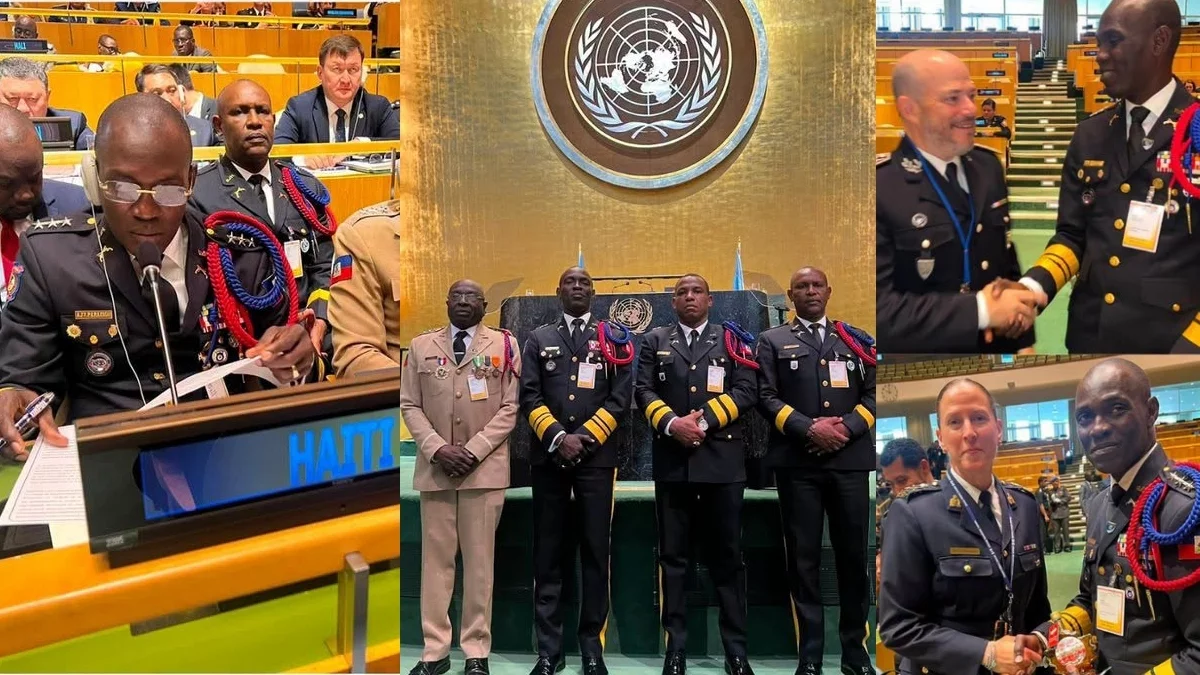
On the sidelines of the 5th United Nations Police Chiefs’ Summit (UNCOPS 2026) held in New York, Haiti’s top security leadership has delivered a urgent call for coordinated multilateral action to confront the cascading security crisis destabilizing the Caribbean nation and the broader region.
Leading the Haitian delegation to the September 2026 summit was Public Security Minister Patrick Pélissier, with senior security figures joining the delegation including Acting Commander-in-Chief of the Haitian National Police (PNH) Vladimir Paraison, Armed Forces of Haiti (FAd’H) Commander-in-Chief Lieutenant General Derby Guerrier, PNH Chief Inspector General Frédéric Leconte, and Presidential Security Coordinator Inspector General Jacques Joël Orival.
In his keynote address to the assembly, Paraison spoke on behalf of Haiti, framing the country’s ongoing security fight as a sovereign mission to reclaim full control of its national security landscape. He opened by outlining the foundational threat driving Haiti’s instability: transnational regional drug trafficking that has eroded governance and fractured stability across the island, with Haiti bearing the brunt of the crisis.
To counter this threat, Paraison argued for a fundamental shift in Haiti’s security strategy, emphasizing that outdated, isolated operational models are no longer sufficient. He called for investment in cutting-edge technological infrastructure for border management, including purpose-built maritime vessels equipped with advanced real-time intelligence capabilities that allow for rapid information sharing and coordinated interception operations between frontline units and command decision-makers.
Paraison stressed that the era of unilateral police action has passed, pointing to the UNCOPS platform as a critical framework for regional security collaboration. This multilateral space, he noted, enables strategic pooling of critical human, logistical, and technological resources across regional police forces — a synergy that is non-negotiable for defeating transnational criminal networks.
A core point of Paraison’s address centered on the systemic imbalance fueling Haiti’s crisis: while Haiti abides by international arms controls and lacks a domestic defense industry, criminal gangs operating across its territory benefit from a steady, unimpeded flow of advanced heavy weaponry. He emphasized that the bravery of Haitian security forces on the front lines cannot alone resolve a crisis whose roots stretch far beyond Haiti’s national borders. Unchecked arms smuggling, he said, continues to fuel terrorist activity and prevent any path to lasting stability, requiring urgent multilateral commitment to close cross-border trafficking routes.
In a striking rebuke of diluted framing of the crisis, Paraison called on the international community to abandon language that minimizes the severity of the threat facing Haiti. The armed groups operating in the country are not merely loose collections of delinquents, he argued: through their brutal tactics and deliberate campaign of civilian terror, they qualify as full-fledged terrorist organizations. What Haiti is confronting today, he added, is not isolated street crime, but the expanding reach of a global hybrid criminal network. This network, fueled by the dangerous convergence of arms trafficking, drug smuggling, and money laundering, poses a threat not only to Haiti’s national stability but to the entire Caribbean region’s security.
To embed this priority in global governance, Paraison urged that United Nations Police priorities be systematically integrated into the core agenda of all major international forums focused on peace and global security. Only through robust, coordinated collective action, he said, can the international community build a more secure global order.
Paraison concluded his address by reiterating Haiti’s deep gratitude to the international community, and specifically the United Nations, for ongoing support through the Global Security Fund (GSF) in Haiti’s relentless campaign against criminal networks. Even as it welcomes international partnership, he reaffirmed, the Haitian government maintains that national security remains the primary sovereign responsibility of Haitian state institutions. Mandated by the Haitian Constitution, the Haitian National Police and Armed Forces of Haiti are working tirelessly to restore peace, public order, and freedom of movement for all Haitian citizens, and the country remains confident that it will ultimately succeed in this mission.
“Let us work towards a secure world, a better Haiti,” Paraison said, closing his address.