A landmark cross-border cultural preservation effort is underway in The Bahamas, as the United States commits $245,000 to restore Fort Montagu — one of the Caribbean nation’s oldest remaining military installations — with targeted conservation work focused on the site’s corroded historic cannons.
The funding comes from two U.S.-backed initiatives: the Ambassadors Fund for Cultural Preservation and the Freedom 250 Initiative. U.S. Ambassador to The Bahamas Herschel Walker confirmed that this grant marks the second-largest U.S. investment in Bahamian cultural heritage protection to date, bringing total American support for such projects across the country to more than $750,000.
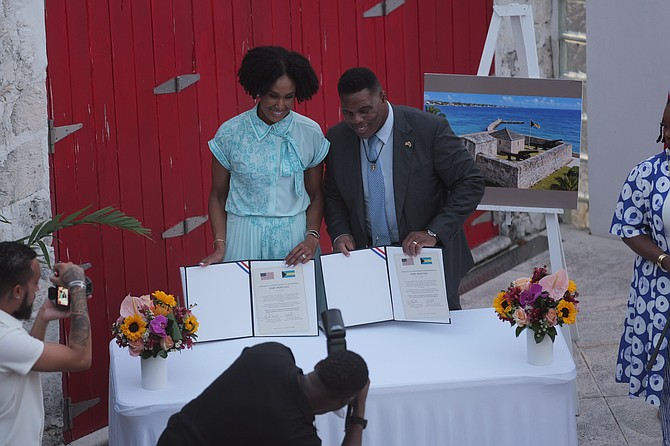
Senior officials from both nations gathered at the National Art Gallery of The Bahamas this week to formally launch the restoration project, a step Walker framed as more than just a construction effort. “Fort Montagu has stood there for nearly three centuries,” Walker noted, emphasizing that conserving the fort means safeguarding a core chapter of the Bahamian national story. He added that the collaborative venture also serves as a powerful example of what shared commitment between the two neighboring countries can deliver.
Completed in 1741, the coastal fort has faced decades of damage from its harsh seaside environment. Dr. Michael Pateman, executive chairman of The Bahamas’ Antiquities, Monuments and Museums Corporation, explained that the work will include critical repairs to the fort’s roof alongside urgent interventions for its 18th-century cannons. “Salt, moisture, and the coastal environment have caused serious corrosion,” Pateman said, adding that the cannons have reached a point where immediate action is required to stop irreversible damage.
To address the corrosion, conservation specialists will use electrolytic reduction, a specialized technique designed to leach destructive chlorides and salt deposits out of the metal. According to Pateman, the full process is expected to take roughly 12 months, but it provides the most reliable path to preserving the cannons intact for future generations to study and experience.
Leslia Miller-Brice, The Bahamas’ Minister of Culture, Arts and Heritage, highlighted that the project draws on professional expertise from three nations: The Bahamas, the United States, and the Dominican Republic. Beyond repairing the physical structure of the fort, Miller-Brice emphasized that the initiative is focused on protecting the collective history and national identity tied to the site.
“Fort Montagu is still standing, and tonight, The Bahamas and the United States are connected once again through this historic site, not through conflict, but through friendship, collaboration, and a shared commitment to preservation,” Miller-Brice said. “We are preserving memory. We are preserving identity. We are preserving a place where history happened.”
A core goal of the project, she added, is to make local history accessible to young Bahamians, pushing back against the idea that meaningful historical events only occurred in far-flung places covered in textbooks. “I want our young people, especially, to understand that history did not only happen in distant places in textbooks,” she said. “History happened here, on our shores, in this harbor, on Bahamian soil.”