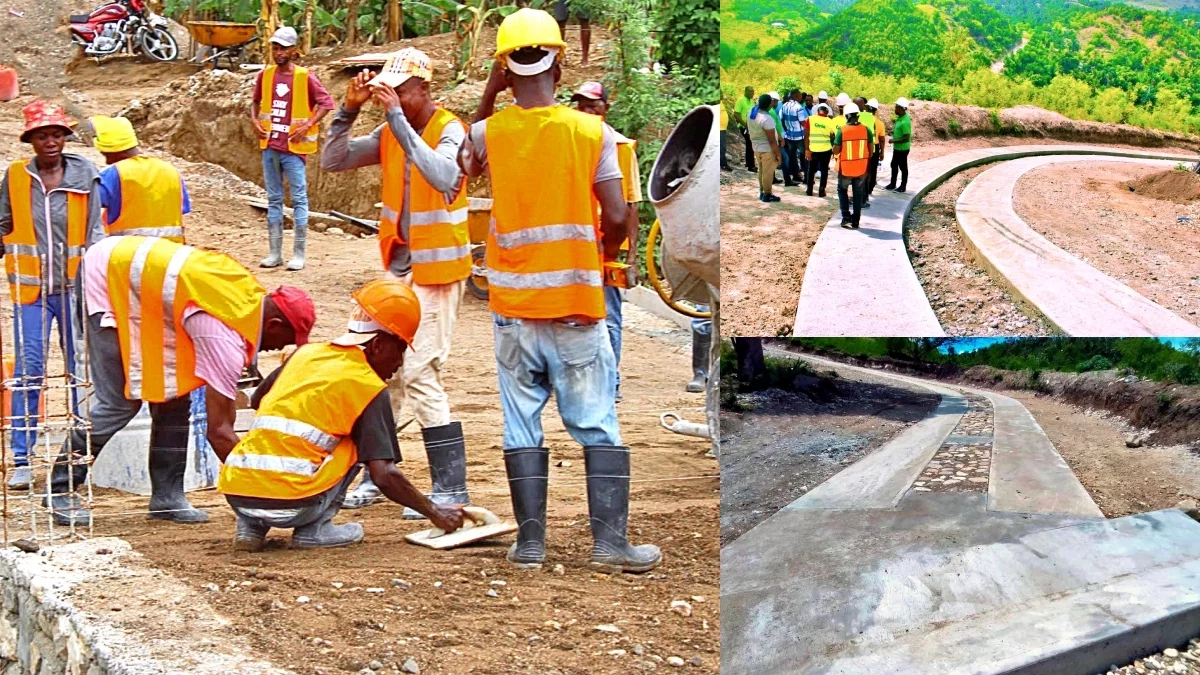
Against a backdrop of persistent challenges to Haitian agricultural productivity and rural mobility, a critical infrastructure upgrade is underway in the commune of Arnaud, Nippes Department. Led by Haiti’s Ministry of Agriculture through the Resilient Agriculture for Food Security Project (known locally as PARSA), the rehabilitation of the Arnaud rural road seeks to address longstanding barriers that have held back local farming communities and restricted access to essential commercial hubs.
The project focuses on a key 800-meter stretch of road that links Carrefour Azor to Chalumeau, passing through Morne Katina. A series of targeted infrastructure improvements are being carried out to transform this once unreliable route: 200 linear meters of reinforced concrete wheel tracks are being laid to strengthen the road surface, a 59.28-meter ford crossing is being constructed to simplify river passage, an 84-meter protective low wall is being built to prevent erosion, and full re-profiling of the existing 800-meter track is underway to smooth passage. Notably, drainage ditch work across the entire project site has already been finalized, addressing one of the route’s most persistent pre-rehabilitation flaws.
Before construction began, this road was a source of constant difficulty for local residents and producers, particularly during the annual rainy season. Decay of the original road surface, paired with the insufficient original drainage system, led to widespread mud buildup and long-lasting stagnant puddles. By the height of wet seasons, passage for motorcycles—the primary form of rural transport in much of Haiti—became extremely challenging, and in some segments, entirely impossible. Previously, the route also forced travelers and produce transporters to cross the Grande Rivière des Nippes, a dangerous and time-consuming obstacle that disrupted travel and put shipments at risk.
Once completed, the upgraded road will serve as a reliable vital link between local farming communities and the region’s key commercial outlets, most notably Gros-Bassin, the Nippes Department’s primary regional market. By eliminating the travel delays and damage to harvests caused by poor road conditions, the project directly targets one of the most costly issues facing local smallholder farmers: post-harvest loss. Producers will be able to move their crops to market faster and in better condition, while residents will gain more consistent access to essential goods and services supplied from urban centers.
Beyond immediate mobility gains, the rehabilitation project is a core investment in the long-term resilience of Haiti’s agricultural sector. The new infrastructure is designed to withstand heavy rainfall and extreme weather events, reducing the need for frequent repairs and ensuring consistent access even during wet seasons. By closing the infrastructure gap between isolated production zones and formal commercial distribution networks, the project creates new economic opportunities for farming households that previously struggled to get their products to buyers at competitive prices.
The Arnaud road project is just one component of PARSA’s broader ongoing work across Haiti. The initiative’s overarching goal is to expand and upgrade rural infrastructure across the country, strengthen the ability of farming communities to adapt to climate and economic shocks, and improve conditions for both agricultural production and post-harvest marketing. These targeted infrastructure investments are framed as long-term strategies to boost food security across rural Haiti by cutting waste, connecting producers to markets, and supporting sustainable local economic growth.