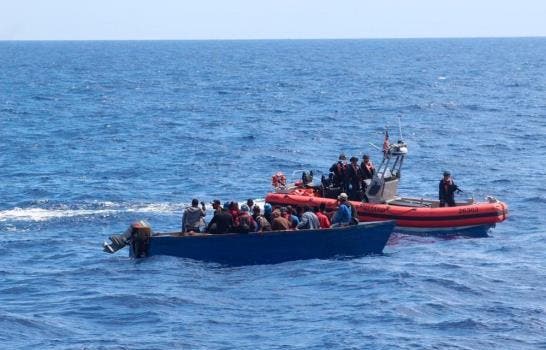
In a routine interdiction operation targeting irregular maritime migration, the United States Coast Guard completed the repatriation of 51 migrants — 34 Dominican nationals and 17 Haitian nationals — to the Dominican Republic on Tuesday. The operation was launched after a U.S. Customs and Border Protection surveillance aircraft spotted an dangerously overloaded vessel drifting in waters off the coast of Aguadilla, a coastal city in northwestern Puerto Rico. Immediately following the detection alert, the Coast Guard dispatched a surface cutter and an air rescue helicopter to intercept the unseaworthy craft before it could reach Puerto Rican territory.
Once the vessel was intercepted, authorities conducted a full on-board accounting of all passengers. Of the 34 Dominican citizens on board, 30 were adult men, two were adult women, and two were unaccompanied minors. The 17 Haitian migrants included 15 adult men and two adult women. Following standard repatriation protocols, all adult migrants were transferred directly to personnel from the Dominican Republic Navy for processing. The two Dominican minors, meanwhile, were placed into the temporary care of the National Council for Children and Adolescents (CONANI), the Dominican government’s lead agency for child and adolescent welfare.
Matthew Pinhey, a commander with the U.S. Coast Guard, emphasized that the successful operation was only possible through close, coordinated collaboration between multiple stakeholders. These included U.S. federal law enforcement and border agencies, local Puerto Rican authorities, and the Dominican Republic Navy, all of which work together continuously to curb irregular migration flows through the Mona Passage. That narrow body of water, which separates the island of Hispaniola — home to the Dominican Republic and Haiti — from Puerto Rico, has long been the primary transit route for migrants attempting to reach Puerto Rico, a U.S. territory, from Hispaniola.
Pinhey also issued a stark public warning about the extreme risks of these unauthorized crossings. Migrants seeking to reach Puerto Rico almost always travel on overloaded, poorly maintained vessels that are not fit for open ocean travel, and rarely carry sufficient life-saving equipment for all passengers. Unpredictable currents and variable weather in the Mona Passage make the crossing even more dangerous, turning many attempted journeys into fatal tragedies for migrants and smugglers alike.