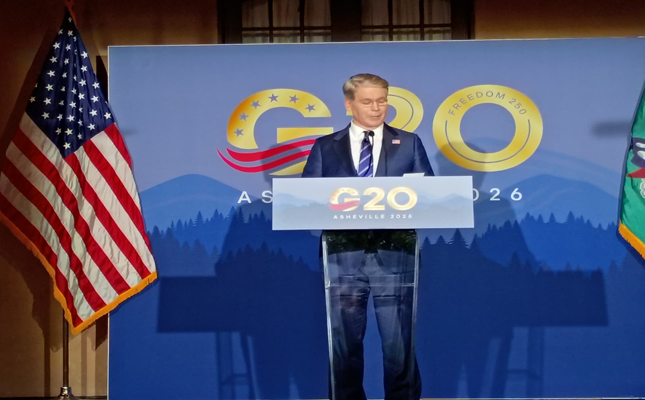
As top financial policymakers from the world’s 20 largest economies gather in Asheville, North Carolina for the annual G20 Finance Ministers and Central Bank Governors Meeting, the rapidly escalating military and diplomatic conflict between the United States and Iran has emerged as the defining issue overshadowing all scheduled deliberations. The renewed outbreak of hostilities in the strategic Middle East region has sent global energy markets into volatility, stoking renewed fears of sustained inflation, stalled growth, and severe economic strain on vulnerable small economies across the Caribbean and beyond.
The current crisis traces back to six months of escalating tensions, which reignited after the U.S. accused Iran of plotting offensive attacks and mine placements in the Strait of Hormuz — the world’s most critical chokepoint for global oil shipments, through which roughly 20% of global oil supply transits daily. Iran has responded with proportional strikes, pushing the region into open conflict and creating unprecedented uncertainty for energy markets. Already, international benchmark oil prices have climbed sharply, renewing pressure on fuel costs that have yet to fully stabilize after years of post-pandemic volatility.
Washington has doubled down on its maximum pressure campaign against Tehran, ramping up existing economic sanctions and pushing for global financial institutions and sovereign governments to fully sever all commercial and financial ties with Iran. The Donald Trump administration has issued explicit threats to impose additional secondary sanctions on any bank, company, or state entity found to be violating existing restrictions or continuing commercial activity with the Iranian regime. During the meeting’s opening plenary session, U.S. Treasury Secretary Scott Bessent publicly thanked the European Union and European Central Bank for what he called their unwavering support for Washington’s economic pressure campaign against Iran.
For small island developing states that rely almost entirely on imported fossil fuels to meet domestic energy needs, the spike in global oil prices has already triggered a severe cost-of-living crisis. The Federation of St. Kitts and Nevis, a two-island Caribbean nation with no domestic oil production, offers a clear snapshot of the spillover harms facing small open economies.
Local authorities on both St. Kitts and Nevis have been scrambling to mitigate the damage to household budgets since energy prices began rising earlier this year. On Nevis, the island administration passed its annual budget before the conflict escalated, leaving little room to absorb unexpected energy cost increases. In response to growing public outcry over surging electricity bills, the government introduced targeted relief in June 2026: while it was forced to reimpose a fuel surcharge on residential users to offset rising generation costs, it capped the surcharge at 69 cents per unit — 10 cents lower than the standard 79-cent rate.
Nevis Premier Mark Brantley told reporters recently that public feedback on the relief measures has been divided, but the vast majority of residents report feeling significant financial strain. “Everywhere we go, people are complaining that the cost [of electricity] has significantly increased for most of them,” Brantley said. “Interestingly, in a very few cases, they’ve said they have not noticed any increase or any significant increase. But for the majority of persons, they have indicated that they’ve seen a significant increase.” Brantley has called on local residents to reduce energy consumption while the government monitors ongoing developments in global energy markets.
Across the federation on St. Kitts, the federal government has also rolled out its own suite of support measures for households and businesses reeling from higher fuel and power costs.
Against this backdrop, the policy discussions unfolding in Asheville carry weight far beyond the world’s major economic powers. Decisions that G20 policymakers reach on energy security, coordinated inflation control, sanctions enforcement, and global financial stability will have direct, immediate implications for small import-dependent economies like St. Kitts and Nevis that are already teetering under the weight of rising energy costs. The three-day meeting is scheduled to adjourn on Tuesday evening, with policymakers expected to release a joint closing statement outlining their collective approach to addressing geopolitical and economic risks.