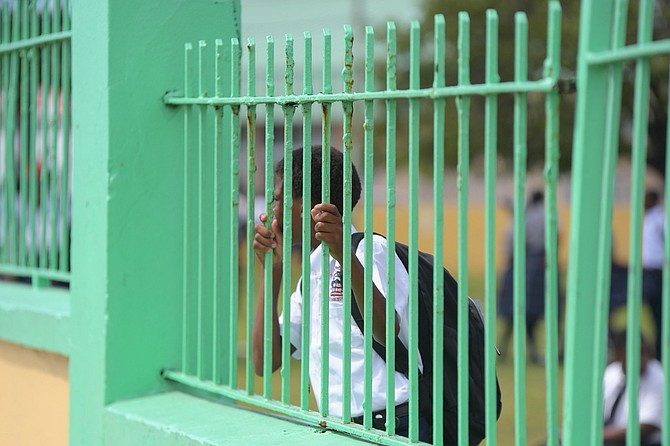
The 2025 new school term in The Bahamas got off to a chaotic start this week, as more than 90 percent of members of the Bahamas Educators Managerial Union (BEMU) launched rare industrial action that forced early dismissal for 40,000 public school students across the archipelago. Only hours after the strike began, the Supreme Court granted an emergency interim injunction ordering all union members back to work and blocking further protest action.
The legal order, issued by Justice Darron Ellis at the request of the country’s Minister of Education and Attorney General, applies to BEMU, its leadership, and all participating members. Beyond mandating an immediate return to scheduled workplaces, the injunction prohibits BEMU members from taking uncertified sick leave and bars union officials from encouraging, pressuring, or inciting other Ministry of Education employees to skip work. Both sides are scheduled to reappear before Justice Ellis at 10 a.m. today, and the union retains the right to petition for the interim order to be modified or overturned.
The industrial action followed months of unresolved grievances that BEMU has raised against the government. Union president Stephen McPhee confirmed that BEMU officially activated its legally authorized strike certificate on the day of the action, after a membership vote held during an emergency Monday meeting. Of more than 200 online voting participants, just 14 opposed the strike, while more than 200 backed it. BEMU counts over 500 members across the country’s public education system, including school principals, vice principals, district superintendents, examination coordinators, and technical education administrators.
McPhee emphasized that the union had attempted to negotiate with the government for roughly five months to resolve its core demands. The union’s grievances include unresolved promotion cases dating back as far as 2016 and 2018, widespread unfilled administrative vacancies across the nation’s 161 public schools, and an expired collective industrial agreement that lapsed in June 2025. BEMU submitted a draft proposal for a new agreement months ago, but has yet to receive a counterproposal from the government.
Many of the promotion disputes center on administrators who have been performing the duties of higher-level roles for years without receiving formal appointments or the corresponding pay increases. McPhee specifically called out the $58.33 monthly pay increase that promoted members are legally owed, noting that many have been denied this incremental raise despite already carrying out the responsibilities of the higher role. The union has also challenged what it calls “unconstitutional postings,” where members are assigned to higher roles without formal approval from the Public Service Commission. While the government recently promoted 36 administrators, McPhee questioned why long-pending cases for promotions from 2016 and 2018 remain unaddressed, leaving senior staff working under newly promoted juniors.
After the union’s demands were not addressed, the next scheduled meeting between BEMU and government negotiators was not set until September 14, a timeline McPhee said the union could not accept. “We have begged, we have pleaded,” McPhee said in comments Wednesday. “As of this day, we have invoked our right… We are asking you to come to sit and to listen to us… on how we can resolve these most pressing matters.” He rejected claims the action was an unapproved sick-out, noting the strike certificate was formally issued by the Ministry of Labour, Public Service and National Insurance, making the action legal prior to the court injunction.
Education Minister Chester Cooper characterized the strike as “precipitous, disruptive and disappointing,” pushing back against the union’s claim that the government had refused to engage. Cooper confirmed he met with McPhee in August, and the union president subsequently held a two-hour negotiating session with the Ministry of Education’s permanent secretary and director. He noted that BEMU submitted its full list of demands on August 24, and he had requested time to coordinate with the Public Service Commission and other government agencies, with talks set to resume on September 14. “Some of them are legacy issues,” Cooper said. “Therefore, in my considered view, and any reasonable person’s considered view, waiting another two weeks to come back to the table with resolution would be reasonable.” He added that it was “counterintuitive” for administrators to walk off the job at a time when the system already faces a shortage of administrative staff, as the country works to restore normalcy to school operations.
Initially, the Ministry of Education activated its contingency plan to keep schools open despite the absence of most administrators, with Cooper confirming most of the nation’s 161 public schools remained operational through the morning. By noon, however, the ministry was forced to dismiss all students across New Providence, Grand Bahama, and the outlying Family Islands, notifying parents and guardians to pick up their children immediately and wait for further updates on when schools would reopen.
Prior to the court injunction, the government’s Labour Relations Unit had stepped in to mediate the dispute, with talks running past 1 a.m. Wednesday that secured a planned meeting between BEMU leadership and Minister Cooper on Wednesday. McPhee praised LRU chief negotiator Bernard Evans for his mediation efforts, but noted that any deal reached would need to be put to a vote of the full union membership before industrial action could end. The interim injunction has now paused all strike activity ahead of further court proceedings.
In a separate and parallel development, the Bahamas Union of Teachers (BUT) is also considering its own industrial action over an ongoing salary dispute with the government. The union’s latest voting shows that 80.5 percent of responding members rejected the government’s most recent salary counterproposal, and 84.8 percent have authorized strike action if the union’s deadline for a deal passes without an agreement. That deadline is set for midnight tonight.