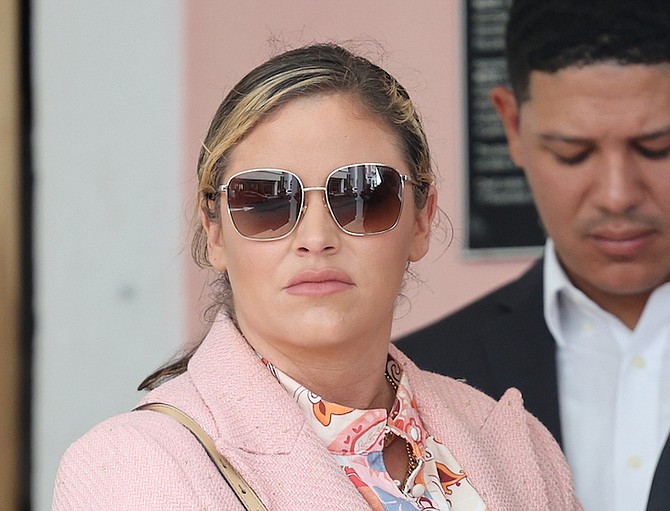
A high-profile legal proceeding unfolded this week in the Bahamas, where former Georgia beauty queen Lindsay Shiver returned to a Bahamian court to fight prosecutors’ bid to revoke her bail. Shiver, who faces a conspiracy to commit murder charge alongside two local men, Terrance Bethel and Faron Newbold Jr., is accused of plotting to kill her husband Robert Shiver back in July 2023, and prosecutors argue she has repeatedly violated the strict terms of her pre-trial release.
The hearing, held before Senior Justice Cheryl Grant-Thompson, centered on persistent issues with Shiver’s court-ordered electronic monitoring equipment, which is a core requirement of her bail agreement that allowed her to return to the United States to await trial. A representative from Migrafil, the private monitoring firm contracted to oversee Shiver’s location tracking, took the stand to outline the long-running issues the company has faced with her monitoring devices.
The witness testified that multiple monitoring devices assigned to Shiver experienced malfunctions over the course of several months. According to their testimony, problems with Shiver’s monitoring can be traced back to December of last year, when Shiver notified the company that she could not attend a scheduled device servicing appointment at the firm’s designated service location in Miami, Florida. The witness confirmed that Migrafil offered to replace Shiver’s malfunctioning device back in December, but Shiver declined to travel to Miami at that time.
Defense attorney Terrel Butler pushed back against prosecutors’ claims that Shiver deliberately violated her bail terms, arguing that equipment malfunctions are a common issue in the electronic monitoring industry, and that technical failures do not equal intentional non-compliance. Butler explained that Shiver was unable to travel to Miami for the December servicing appointment because she had a separate pre-scheduled court matter in the United States that barred her from making the long trip. By May of this year, the Migrafil representative confirmed the company had made three separate attempts to arrange device servicing, but all fell through before a replacement was finally completed.
Butler also told the court that Shiver was unable to check in with the monitoring company in May because she was suffering from an illness. When the replacement eventually took place, the swap was conducted inside a vehicle in a U.S. post office parking lot, a far cry from the designated Miami location. The defense added that even for this ad-hoc appointment, Shiver had to drive more than five hours to reach the meeting spot while sick with a summer flu. The Migrafil witness acknowledged they could not confirm Shiver had made any deliberate attempt to evade monitoring, and also could not say whether the mobile service provider responsible for the swap could have arranged a closer meeting location for Shiver.
This is not the first time Shiver has faced threats to her bail. Earlier in 2024, she briefly lost her pre-trial release after prosecutors alleged she had repeatedly left the state of Alabama in violation of a court-ordered travel restriction. The current conspiracy charge stems from an alleged plot to kill Robert Shiver on July 16, 2023. Authorities have said they first uncovered the alleged plot after seizing a mobile phone during a separate, unrelated criminal investigation on Guana Cay. Shiver was granted bail last year and allowed to return to the U.S. under strict monitoring conditions, a decision that has been contested by prosecutors throughout the pre-trial process. Karine MacVean represented the prosecution in this week’s hearing.