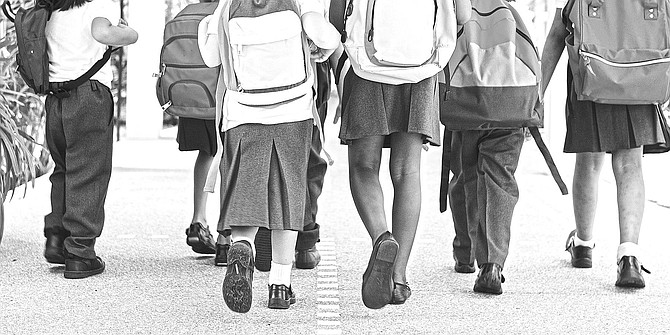
As the new academic year approaches, the Bahamas is witnessing a marked rise in demand for government-backed school uniform assistance, with more than 1,400 low-income households across New Providence and Grand Bahama already applying for support this cycle. Social Services Minister Barbara Cartwright confirmed the uptick in applications, noting that the increased benefit rolled out by the current Davis administration has directly contributed to higher participation in the long-running support programme.
While official data puts the total number of submitted applications from the two major islands at 1,409, government spokespersons did not release comparable figures from the 2023 academic cycle, leaving the exact scale of the increase unquantified for public analysis. The administration announced a universal $50 per-child benefit increase across all education tiers last month, a policy adjustment designed to address longstanding gaps between previous aid amounts and the actual cost of school attire.
Under the revised funding structure, pre-school families now receive up to $170 in assistance, up from $120 last year. Primary and junior school students qualify for a maximum benefit of $200, an increase from the previous $150 cap, while high school students now can access up to $230 in support, up from $180. Cartwright explained that the revision was necessary because the old benefit levels often fell short of covering the full cost of multiple uniforms required for a full school year, leaving some families struggling to prepare their children for classes.
“Originally, the assistance was only able to cover a certain amount of school uniforms, and so that’s hence the reason for the increase, and we have seen an uptick,” Cartwright said in a statement to local media. “At least, there won’t be an excuse why your child cannot go to school.”
The School Uniform Assistance Programme is open to eligible households that meet income requirements for families with children enrolled in government-run schools. It also extends to students attending private institutions on full needs-based scholarships, as well as households that have lost income or property due to qualifying shocks including hurricanes, flooding, and residential fires. All approved applicants receive their benefits via digital gift cards distributed through the Ministry of Social Services’ Digital Wallet platform, which can be redeemed at authorized local uniform and footwear retailers to ensure funds are used for their intended purpose. Support is limited to one allocation per child per academic year.
As part of the Department of Social Services’ broader social safety net framework, the programme has operated for decades, with demand shifting alongside economic conditions. Public records from the Auditor General show that at the peak of COVID-19-related economic disruption in June 2020, total spending on the programme reached $23,615, a dramatic jump from just $3,416 spent in the same month in 2019, reflecting rising need amid widespread job losses and income instability. Cartwright emphasized that this year’s benefit adjustment is intended to bring programme funding in line with current cost-of-living realities, ensuring families can fully cover the cost of outfitting their children for the new school term.