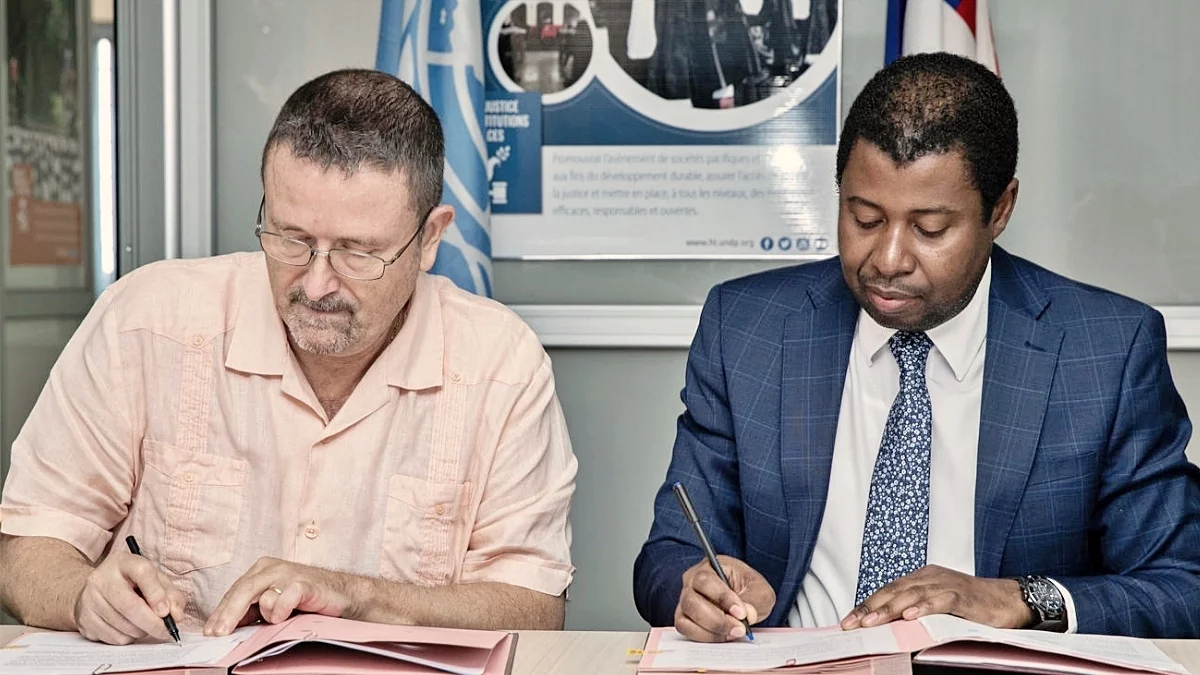
Against a backdrop of surging armed violence that has displaced hundreds of thousands of Haitians and left deep trauma across affected communities, the United Nations Development Programme (UNDP) and Haiti’s State University (UEH) formalized a new partnership on July 31, 2026, to expand critical mental health and psychosocial support for displaced people and host communities in the Port-au-Prince metropolitan area. The two institutions signed a formal Memorandum of Understanding (MoU) to launch the initiative, which operates under the umbrella of the South Korea-funded Rekonekte project.
Decades of escalating gang violence in Haiti has turned everyday life upside down for millions of residents, forcing more than 300,000 people to abandon their homes to seek safety in displacement camps or informal host communities across the Port-au-Prince region. While international attention has often focused on addressing immediate material needs like food, shelter, and medical care, leaders from both institutions note that unaddressed psychosocial trauma from violence and forced displacement has emerged as a silent crisis affecting all demographics, from young children to older adults.
Under the terms of the new partnership, UEH will leverage its decades of academic expertise in psychology, social work, and community engagement to design and deliver locally rooted support services, while also building long-term national capacity for mental health care across the country. Ronald Jean-Jacques, the initiative’s coordinator at UEH, outlined the project’s scope during a virtual presentation, explaining that all programming will follow a evidence-based protocol already tested and proven effective by UEH teams across Haiti. Services will be delivered by a trained team of psychologists, social workers, and on-the-ground field supervisors, with direct outreach to displacement camps in the Port-au-Prince metropolitan area.
Jean-Jacques emphasized that the project’s core mission goes beyond traditional clinical care: it aims to create safe, welcoming spaces where displaced people can process their trauma, rebuild a sense of self-worth, and kickstart personal and collective healing. Programming will take diverse, accessible forms to meet communities where they are, including peer discussion groups, targeted trauma rehabilitation sessions, creative sociocultural activities that leverage storytelling, art, music, dance, and nature connection, all designed to help survivors understand their trauma and build practical coping skills for long-term mental well-being. “When we went into the field, the people clearly shared their needs with us,” Jean-Jacques said. “Beyond material assistance, they expressed the urgent need for psychosocial support to cope with the trauma caused by violence and forced displacement.”
Xavier Michon, UNDP’s Resident Representative in Haiti, framed the partnership as a deliberate rejection of fatalism about Haiti’s crisis, rooted in the organization’s core belief that progress is possible even amid unprecedented challenges. “We refuse to accept this as inevitable. We refuse to believe that there is no way out for Haiti. We are convinced that, despite the challenges, it is possible to move forward,” Michon said.
He also highlighted the unique dual value of the university-led partnership: the model gives emerging psychology students at UEH the chance to gain hands-on field experience serving their own communities, while building a sustainable local workforce for future mental health programming. For UNDP, the initiative will also serve as a critical learning opportunity to inform larger-scale recovery and reintegration programs for violence-affected populations across Haiti. Michon stressed that the project is just a first, vital step rather than a full solution to Haiti’s overlapping crises, noting “It is only a beginning, but it is an important one. We will dedicate our full commitment to it as an organization, and I know that we will do it together.”
UEH Rector Dieuseul Prédélus reaffirmed the university’s longstanding commitment to placing academic expertise and research at the service of Haiti’s most pressing national development challenges. He extended gratitude to partners including the Haitian Psychological Association, UEH’s Faculty of Ethnology, Faculty of Humanities, and all university staff who continue to deliver public-facing programming under extremely difficult security and operational conditions. Through this new partnership, Prédélus noted, UEH is reaffirming its mission to connect science, education, and community service to support Haitian people amid ongoing crisis.