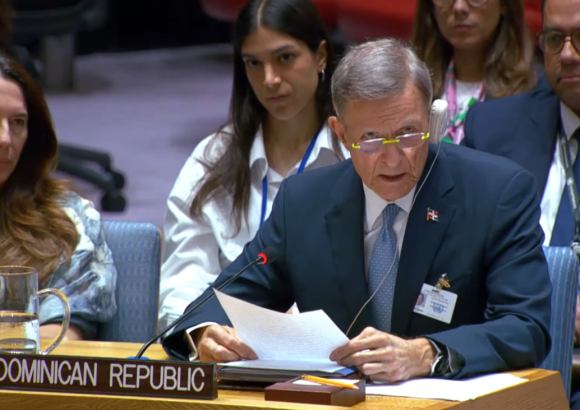
Speaking before the United Nations Security Council at a high-stakes session focused on the escalating Haitian security crisis, Dominican Republic Foreign Minister Roberto Álvarez has delivered a clear, urgent appeal for the world body to extend two critical mandates: that of the Gang Suppression Force (GSF) and the UN Support Office in Haiti. Álvarez stressed that moving full steam ahead with already agreed-upon international measures is the only viable path to reestablishing widespread security across the violence-battered Caribbean nation.
Álvarez opened his remarks by acknowledging tangible milestones delivered under UN Resolution 2793, the framework that greenlit the multinational security mission to Haiti. He noted that critical foundational steps have already been completed: the multinational force has been formally established, its command hierarchy has been put in place, and frontline operational activities have officially kicked off. Despite this early progress, the foreign minister pushed for faster action, calling for the immediate deployment of additional mission personnel and issuing a targeted appeal to nations with strategic airlift capacity to contribute much-needed logistical backing to the effort.
A core pillar of Álvarez’s address centered on the inextricable link between security and democratic renewal for Haiti. He emphasized that no meaningful progress toward free governance can occur until widespread gang violence is brought under control, arguing that “security will make elections possible.” He went on to reaffirm the Dominican Republic’s unwavering backing for the holding of free, inclusive, and internationally credible elections that reflect the will of the Haitian people, a critical step toward long-term political stability.
Álvarez also turned his attention to the enforcement of existing UN sanctions, calling for full and rigorous implementation of UN Resolution 2653. He pushed for far stronger punitive measures that target not only top gang leaders themselves but also the sprawling network of enablers that keep criminal operations running: individuals and groups that finance gang activity, facilitate the flow of illegal arms into Haiti, launder billions in illicit proceeds, or provide political cover and material support to violent criminal factions.
The foreign minister was careful to draw a distinction between short-term security gains and long-lasting stability. While he recognized that the deployed international force is critical to helping Haitian authorities retake control of territory lost to gangs, he stressed that sustained peace can only be achieved by building up Haiti’s own domestic institutions. This includes strengthening the Haitian National Police, overhauling and reinforcing the country’s crumbling judicial system, and shoring up core state functions that have collapsed amid years of crisis.
In closing, Álvarez reiterated the Dominican Republic’s firm commitment to supporting the renewal of the international security mission in Haiti. He outlined the Caribbean nation’s key priorities for the next mandate phase: ensuring the full deployment of the GSF across the country, strengthening enforcement of the existing arms embargo and sanctions regime, and sustaining ongoing efforts to build capacity within Haiti’s national institutions.