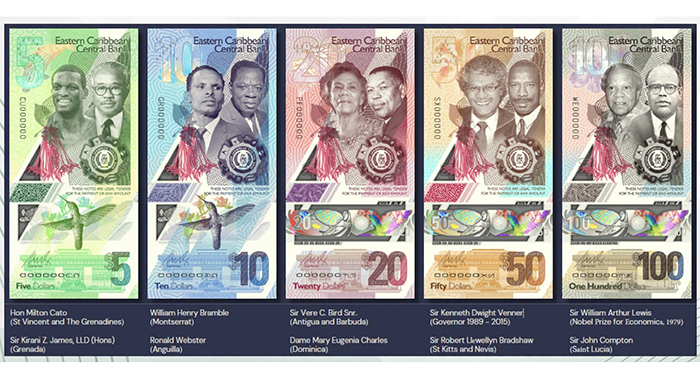
In a landmark step that redefines the regional identity of Eastern Caribbean currency, the Eastern Caribbean Central Bank (ECCB) has revealed redesigned banknotes that replace the late Queen Elizabeth II’s portrait with portraits of influential leaders and national heroes drawn from across the Eastern Caribbean Currency Union (ECCB)’s eight member states. The announcement, made Thursday, marks the culmination of a years-long process of public engagement and institutional planning that will see the EC dollar enter a new era when the new notes enter circulation.
Among the 10 prominent regional figures selected for the redesign, three have deep ties to St. Vincent and the Grenadines. These include Robert Milton Cato, the founding first prime minister of St. Vincent and the Grenadines; John Compton, the late former prime minister of St. Lucia who was born in St. Vincent and the Grenadines; and Sir K. Dwight Venner, who served as the long-serving governor of the ECCB from 1989 to 2015.
The redesigned series covers four commonly used denominations: the $5, $20, $50, and $100 EC notes, each pairing two influential figures that represent the region’s diverse history, contributions and collective progress. The highest $100 denomination features Sir William Arthur Lewis, a Nobel Prize-winning economic scientist, alongside the St. Vincent-born John Compton. The $50 note pairs St. Vincent’s Sir K. Dwight Venner with Sir Robert Llewellyn Bradshaw, a beloved leader from Saint Kitts and Nevis. On the $20 note, Sir Vere Cornwall Bird Sr, Antigua and Barbuda’s first prime minister, shares space with Dame Mary Eugenia Charles, Dominica’s former prime minister and the only woman honored in the new series. A $10 note, which was referenced in planning documents, features Montserrat trade union and political leader William Henry Bramble and Anguilla’s founding politician James Ronald Webster. The lowest $5 denomination pairs St. Vincent’s Robert Milton Cato with Kirani James, Grenada’s trailblazing Olympic gold medalist — the only living person included in the new banknote series.
The path to this historic redesign began in July 2023, when the ECCB’s Monetary Council voted during its 105th meeting to approve the removal of Queen Elizabeth II’s portrait and directed the central bank to gather public input on the new direction. Between July and December 2023, the ECCB carried out extensive public consultations across the eight member states, and the results were clear: residents strongly backed the plan to feature homegrown national heroes and foundational nation builders on the region’s currency.
ECCB Governor Timothy N.J. Antoine officially unveiled the new designs, framing the moment as a defining milestone in the decades-long history of Eastern Caribbean currency. In an official press statement, the central bank emphasized that the redesign is far more than an aesthetic update. It is a deliberate choice to honor the unique cultural heritage, collective achievements and enduring legacy of the women and men who shaped the modern Eastern Caribbean. At the same time, the ECCB confirmed that the new banknote series will retain the rigorous security features that have preserved the integrity and public trust long associated with the EC dollar.
The redesigned notes are scheduled to enter general circulation in late 2027, when for the first time since the creation of the EC dollar, the late British monarch’s likeness will no longer appear on the region’s currency. The new series, the bank noted, centers the region’s own shared identity, independent history and trailblazing achievements, cementing the EC dollar’s role as a symbol of Eastern Caribbean self-determination for generations to come.