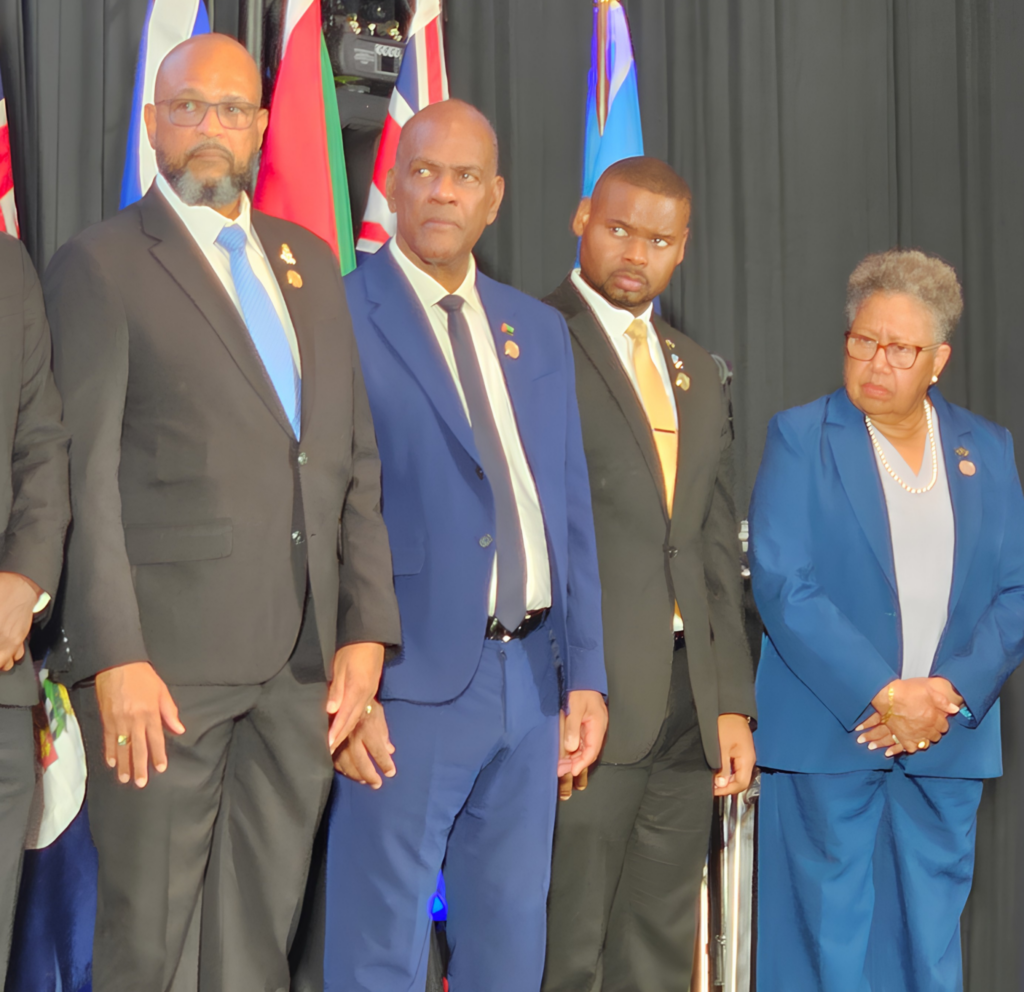
On Sunday, during the opening ceremony of the 51st Regular Meeting of the Conference of Heads of Government of the Caribbean Community (CARICOM) hosted in Saint Lucia, Martinique made history by formally taking its seat as an associate member for the first time. This landmark moment caps a years-long accession process that concluded after multiple key milestones: the French overseas territory signed its accession agreement in Bridgetown in February 2025, ratified the CARICOM Privileges and Immunities Agreement, and its associate membership officially entered into force on June 16, 2026, making Martinique the seventh associate member of the regional bloc.
Geographically, Martinique holds a strategic position in the eastern Caribbean, sitting just 20 miles north of Saint Lucia — close enough that the island can be seen from the Sandals Grande resort, the venue of this year’s heads of government meeting, on clear days. CARICOM Secretary-General Carla Barnett formally extended a warm welcome to the new member during the opening proceedings, marking the start of Martinique’s formal participation in the regional organization.
Serge Letchimy, President of the Executive Council of Martinique, framed the occasion as the opening of a entirely new chapter for the island’s regional engagement. Reflecting on the multiyear journey to membership, he noted the unique challenges of integrating into the Caribbean regional framework while remaining part of French and European institutional structures. “It took many years for us to be accepted into CARICOM. This shows how difficult it can be to belong to two institutional frameworks at once. But today, we are here,” Letchimy stated.
Emphasizing that accession itself is just the starting point rather than the final goal, Letchimy called for rapid concrete action to turn membership into tangible benefits. “This should not be seen as an end in itself. It is only the beginning. We must now move into action. Businesses, financing and investment must now come on board,” he added.
Outgoing CARICOM Chairman and Prime Minister of Saint Kitts and Nevis Dr. Terrance Drew aligned with this view, noting that Martinique’s accession reflects the core founding purpose of the regional bloc. “We believe that together we are stronger. We have a number of institutions that benefit us, and that would be difficult for each country to establish on its own, but together we are able to make them a reality for the benefit of our people,” Drew explained.
For Martinique, formal associate membership provides a structured, institutionalized framework to deepen engagement with its immediate Caribbean neighbors, a shift from past informal cooperation. Letchimy laid out an ambitious agenda for the island’s tenure in CARICOM: he plans to leverage Martinique’s new positioning to deliver tangible cross-border projects, expand bilateral and regional economic exchanges, strengthen policy coordination, boost people’s mobility across the region, and attract increased investment. His long-term vision positions Martinique as a strategic connectivity hub linking the Caribbean region to the Americas, Europe, and Africa.
Closing his remarks, Letchimy emphasized the cultural and geographic roots of Martinique’s integration: “We are reconnecting with our common home: the Caribbean. A door has been opened. It truly exists. We must now use it.”