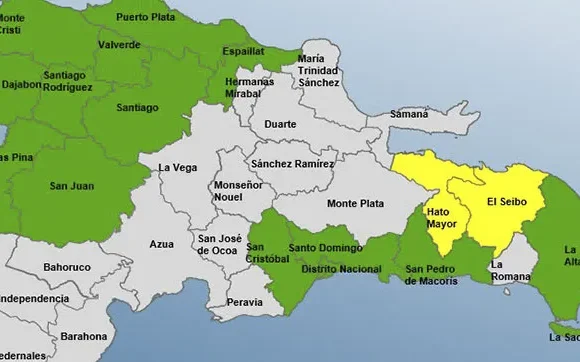
SANTO DOMINGO — Officials in the Dominican Republic have expanded emergency weather warnings to cover 16 of the country’s provinces this Friday, as a dual weather system of a trough and an incoming tropical wave continues to bring unstable atmospheric conditions across large swathes of the national territory.
Two distinct alert levels are currently in effect across the affected regions. Fourteen provinces and the capital’s National District have been placed under green alert, the lower of the two activated warning levels. These areas include Santiago, Puerto Plata, Santo Domingo, Elías Piña, Espaillat, Valverde, San Juan, Dajabón, San Cristóbal, Monte Cristi, La Altagracia, San Pedro de Macorís, and Santiago Rodríguez. By contrast, two eastern provinces — Hato Mayor and El Seibo — face a higher-risk yellow alert, requiring stricter preparedness measures for incoming severe weather.
In its latest official meteorological bulletin, the country’s Emergency Operations Center (COE) warned that the coming hours are expected to bring moderate to intense rainfall across multiple regions, alongside sudden thunderstorm activity and a risk of isolated hailstorm events.
Meteorologists with the COE clarified that the current period of heightened rain risk stems from the interaction of two separate weather systems. A low-pressure trough sitting in the upper levels of the troposphere combines with the slow movement of a tropical wave positioned just south of the Dominican Republic’s coastline. Together, these two phenomena create ideal conditions for the formation of sustained, heavy rainfall across the country.
In response to the developing hazardous conditions, COE has issued a public call for precaution. The agency specifically urged residents living in high-risk zones — particularly low-lying areas near rivers, seasonal streams, and steep ravines that are prone to flash flooding — to remain vigilant, check for updated official weather warnings regularly, and prepare all necessary emergency steps to protect their lives and property ahead of any potential weather-related disaster.