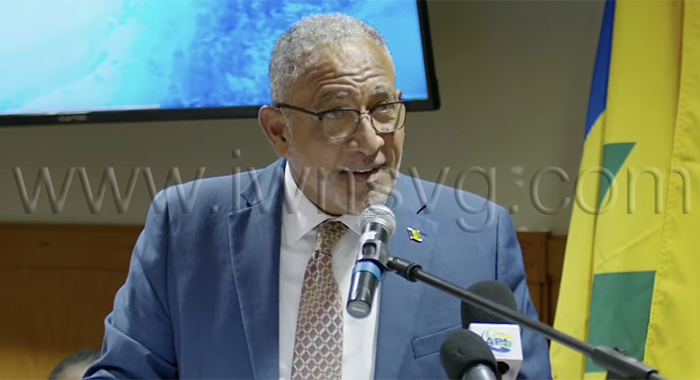
At the “From Recovery to Transformation and Resilience” Development Partners Roundtable hosted in Kingstown, St. Vincent and the Grenadines Prime Minister Godwin Friday has delivered a urgent call for a fundamental restructuring of the global development finance system, arguing that the long-standing “one size fits all” model tied exclusively to national income levels is unconscionable and actively failing small island developing states (SIDS) across the globe.
Friday pushed for the United Nations and leading international financial institutions to adopt the Multidimensional Vulnerability Index (MVI) as the new operational standard for determining access to concessional, low-interest financing, aligning his country’s stance with the unified position of CARICOM and the global Alliance of Small Island States.
“It is unconscionable that Caribbean small states, which contribute less than 1% of global greenhouse gas emissions, are forced to borrow at double-digit commercial interest rates to rebuild after climate-fueled disasters, while developed nations access capital at far lower costs,” Friday told attending diplomats and representatives of multilateral and bilateral development agencies. He emphasized that arbitrary income-based metrics fail to account for small islands’ extreme exposure to climate catastrophes and inherent geographic isolation, two structural challenges that severely strain fiscal capacity. With climate projections forecasting more frequent and intense extreme weather events across the Caribbean, Friday stressed that reform cannot wait: “So action is not an option. The timing is what’s required, and that timing is now.”
The prime minister grounded his appeal for systemic change in the string of consecutive catastrophic shocks that have pummeled St. Vincent and the Grenadines (SVG) in recent years: the global COVID-19 pandemic, the 2021 eruption of the La Soufriere volcano, 2024’s Hurricane Beryl, and the inflationary spillover from ongoing global geopolitical conflicts. The cumulative impact of these events, he explained, has forced the SVG government to ramp up public spending to protect lives and rebuild critical infrastructure, driving public debt to more than 113% of gross domestic product. Without a shift in the global financing model, Friday warned, debt levels will only continue to rise. Despite their widely acknowledged vulnerability, he added, SIDS do not seek to be defined or limited by this reality: survival from one crisis to the next is not enough; the goal must be structural transformation of national economic foundations.
Tying his push for fairer global financing to a domestic agenda of structural economic reform, Friday outlined three core transformative priorities for his government. First, the country is moving full speed ahead with a green energy transition, aiming to cut its costly dependence on imported diesel, which drags down household budgets and national competitiveness. SVG remains firmly committed to its target of sourcing 60% of its energy from renewables by 2030, through a shift to solar power and utility-scale battery storage to replace aging diesel generators. “I know it’s ambitious, but you gotta think big,” Friday noted.
Second, the government is addressing a persistent skills mismatch that disproportionately excludes young people and women from quality formal employment. Large-scale infrastructure projects including port modernization and the construction of the new Arnos Vale Hospital have revealed a large gap between the technical skills held by local workers and the demands of growing sectors of the economy, with the majority of certified tradespeople currently imported. To close this gap, SVG is overhauling its vocational and technical education systems to directly align workforce development with the current and future needs of the private sector and the broader national economy.
Third, the government is strengthening fiscal discipline through a formalized legal framework. Working with international technical partners, SVG is updating and activating a modern fiscal responsibility framework to guide medium-term debt reduction. Measures including comprehensive public expenditure reviews, enhanced tax compliance, and automated social protection delivery are already underway to ensure all public spending is transparent and effective, with plans to codify the fiscal framework into national law.
In wider discussion at the roundtable, Friday connected his calls for financing reform to a growing regional debate across the Caribbean about the difference between incremental coping and meaningful long-term progress. He referenced a widely shared analogy from Bahamian Prime Minister Philip Davis, drawn from researcher Michael Mann, that describes regional development as “walking up the down escalator”: many projects are completed, but meaningful transformation of on-the-ground conditions often remains out of reach. Friday argued that both national governments and international development partners must refocus their efforts on coordination and measurable impact, rather than just counting completed activities.
Friday also announced a policy shift away from historical state dominance of key economic sectors, noting that the current fiscal context leaves no viable alternative to expanding private sector leadership in national development. The government has already signaled its clear commitment to this shift to domestic private stakeholders. Under the new governance model, the role of government is not to single-handedly build the economy and deliver it to citizens, but to mobilize all available domestic and international talent and resources to accelerate progress. “There is a lot of goodwill around the place. How do we coordinate this, bring this all together … so we could move forward more quickly?” he asked.
Repeatedly stressing that neither SVG nor other Caribbean small islands can achieve this transformation alone, Friday warned that a single extreme weather event can erase a decade of hard-won development progress. “While we hope for better days, and we think of better fortunes that may come, we can’t rely on those vicissitudes,” he said. “We must plan, we must have partners in place, and be capable and willing to adapt and to adjust to these crises.”
The two-day roundtable, convened in partnership with the UN Resident Coordinator’s Office, also featured a detailed presentation of SVG’s Growth and Stabilisation Plan from Ambassador Kevin Hope. The plan sets ambitious targets: reduce public debt to 60% of GDP by 2035, double long-term economic growth, and cut both poverty and unemployment to single-digit rates. Representatives from attending international partners including the UN, Caribbean Development Bank, World Bank, CAF, EU, Canada, Germany, China, UK, CARICOM Development Fund, UNICEF, UNFPA, WFP, PAHO, and GIZ broadly endorsed the government’s strategic direction, while calling for stronger cross-sector coordination, integration of regional priorities, and explicit targeted support for the poorest and most vulnerable populations.