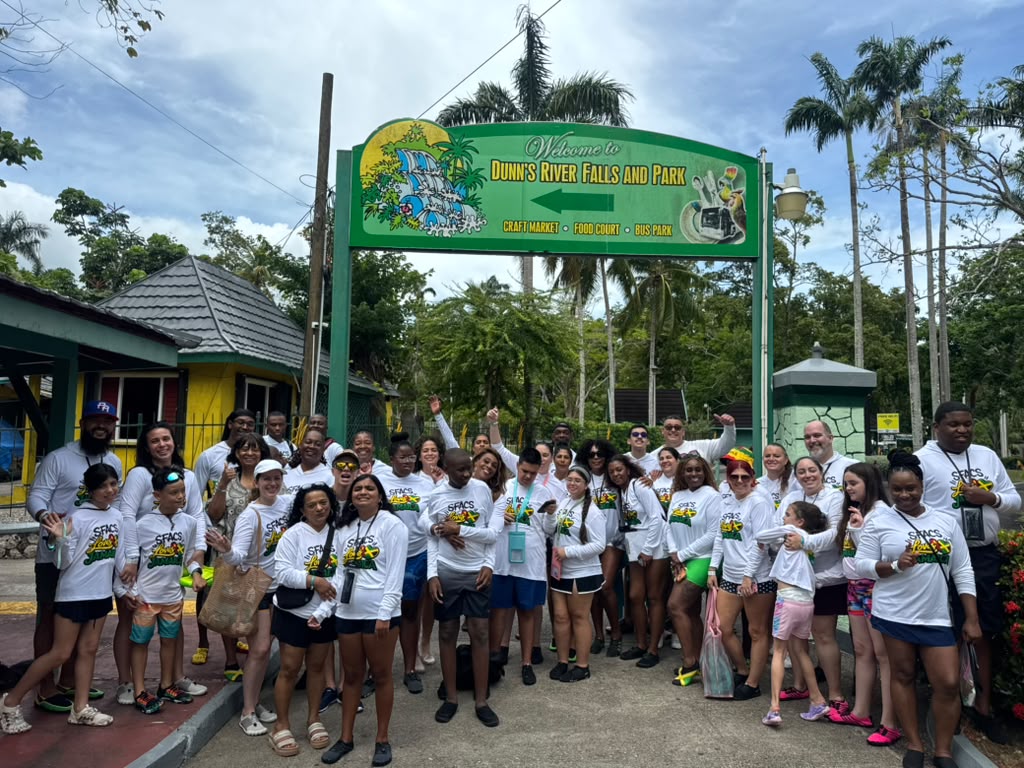
For far too long, young people on the autism spectrum have been sidelined from the kind of transformative international travel experiences that their neurotypical peers often take for granted. Now, one specialized charter school in South Florida is working to close that gap, launching a landmark four-day educational trip to Jamaica designed to build independence, boost confidence, and give autistic students access to the same life-enriching opportunities available to other young travelers.
The trip, which touched down on Jamaican soil on Friday, brings together a group of 20 students, their family members, and staff members from the South Florida Autism Charter School (SFACS). Over the course of their stay, the group will be hosted at Iberostar Resort, where they will get to explore many of Jamaica’s most iconic attractions, including the world-famous Dunn’s River Falls in Ocho Rios, St. Ann, where the group posed for photos on Saturday, June 6, 2026.
Dr. Tamara Moodie, founder of SFACS and a Jamaica native, shared the core vision behind the unique initiative in an interview with Observer Online. She explained that the trip addresses a longstanding barrier for autistic youth and their families: travel is often dismissed as too challenging due to common sensory sensitivities, behavioral needs, and complex logistics that come with planning a trip outside of one’s routine. As a result, many autistic students rarely get the chance to travel internationally, while their parents rarely get the chance to slow down and enjoy quality time with their children in a new, welcoming setting.
Moodie noted that the selection of Jamaica as the trip destination was no accident. For many of the participating students, this trip marks their first ever international journey, and for some, it is even their first time traveling on an airplane. Jamaica’s geographic proximity to South Florida made the logistics of travel far more manageable for students with support needs, while still offering all the cultural enrichment and excitement of visiting a new country.
Beyond geography, Moodie pointed to Jamaica’s well-earned reputation for warm, patient hospitality as a key draw. As someone who has traveled back to the island regularly with her own family, she has long experienced the welcoming culture of Jamaican people firsthand. She trusted that the island’s tourism industry would provide the level of care, acceptance, and accommodation that her students and their families needed to feel comfortable and supported throughout their trip.
The initiative was originally planned several months in advance, but organizers had to postpone the departure date following the arrival of Hurricane Melissa. The delay ended up shrinking the group size significantly from initial plans – the original group was nearly three times larger than the current cohort – but Moodie expressed relief and excitement to finally turn the long-planned idea into a reality for the participating families.
For Moodie and the SFACS community, this trip is far more than a simple vacation. It is a chance to challenge misconceptions about what autistic young people can achieve, by giving them the space to step outside their daily routines, explore a new culture, meet new people, and build lasting shared memories with their families. Most importantly, it is an opportunity to prove that autistic students can thrive in international travel experiences that many once assumed were out of their reach.