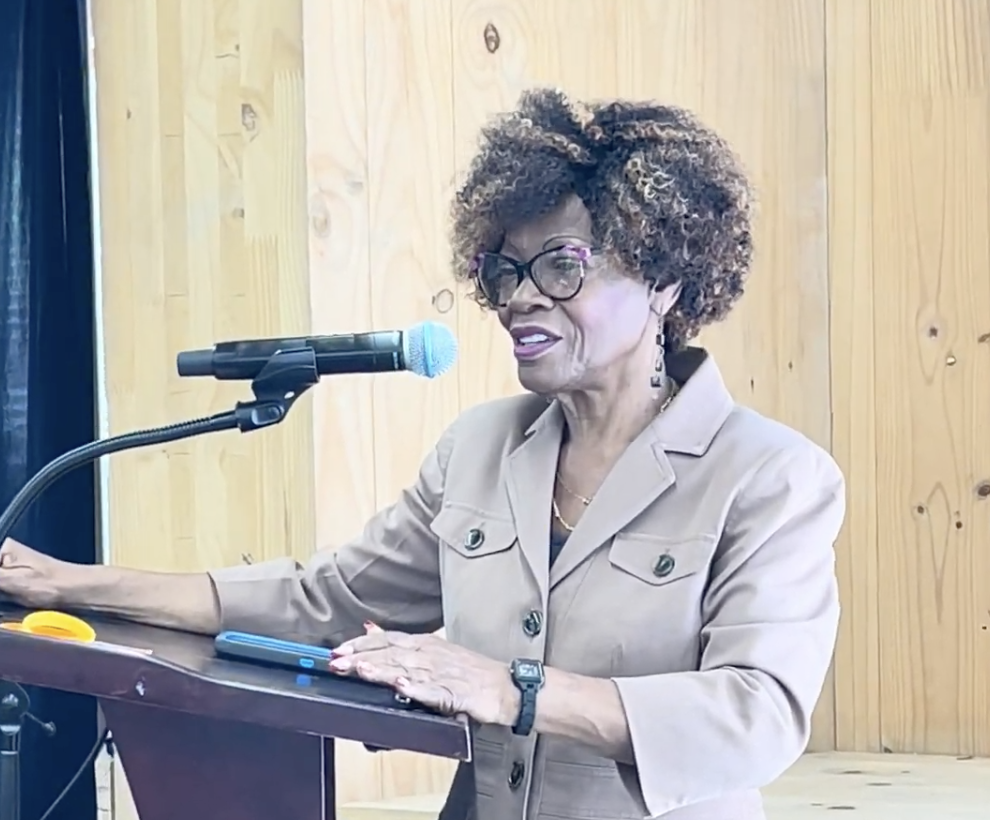
As Barbados deepens its international cultural and educational collaboration networks, a seasoned senior education leader is making a final push to reshape how the country approaches student success, arguing that young people with talents outside traditional academics deserve the same resources and support to thrive as their academically gifted peers.
Idamay Denny, a former deputy chief education officer who led the Barbadian government’s flagship education reform initiative and currently serves as a strategic policy advisor for the Ministry of Education Transformation, shared her vision Wednesday during a cultural exchange showcase at the Oceana Innovation Hub. The event brought together students from New York’s Performing Arts Technology High School (PATHS) and two local Barbadian secondary schools, St Leonard’s Boys’ School and Coleridge and Parry School, for cross-cultural collaborative performances and skill-sharing.
Denny, who is set to officially retire from her government post this Friday, told attendees that the energy and creativity on display at the showcase reinforced her longstanding argument for overhauling education investment priorities. “What I saw here this morning reinforces what I tell the people in the ministry about investing in our students in terms of transformation,” she said. “We have to give you things that when you wake up in the morning, you want to get to school, and activities like what we saw here this morning are those kinds of activities.”
The showcase itself is a core component of a formal partnership between the Ministry of Education Transformation and the non-profit initiative I WILL GRADUATE, which hosted the PATHS student band on the island for a week of cultural exploration and collaborative learning with local young people. A reciprocal trip for Barbadian students to visit New York is already planned for the coming months.
A central pillar of Denny’s advocacy is challenging the outdated perception that creative fields like music and the arts are secondary extracurriculars rather than viable long-term career pathways. She emphasized that today, creative industries represent one of the most reliable routes to sustainable, well-paying employment for young people — a far cry from the norm when she was a student.
“Once upon a time when I was a girl going to school, nobody thought that music was going to be the thing that was going to carry you somewhere in life. We saw that as a little extra thing by the side. But nowadays, music is one of the biggest pathways to sustainable employment,” she explained.
Denny pointed to standout performances from PATHS students during the showcase to illustrate how the creative industries are evolving and opening doors for underrepresented groups. Highlighting a young female trumpet player who took the stage, she noted that the historically male-dominated professional music space is becoming far more inclusive. “Once upon a time then we saw bands… All men. But can you see from her that we can have some real good women playing in these bands. I will not be surprised if God allows me to live another 10 years to turn on my TV one day and see her playing in a band. She’s that good. Her heart is in it.”
She also reserved praise for a young PATHS vocalist, telling the audience she has the raw talent to become a global entertainment star. “When I saw you, I thought I would see you in one of those shows X Factor, The Voice… all of those things where people go and their whole career gets made in that moment while they’re there performing. I could see you on one of those shows winning and then becoming a big-time star.”
Across all her remarks, Denny stressed that schools must expand their definition of success to recognize and nurture skills beyond core academic subjects. “Yes, we want you to go to school and we want you to do well academically, but we don’t want you to think that academics is all. There are other things. You have other talents and we want to provide the mechanisms; we want to provide the infrastructure for you to do well with all those talents that you have,” she said.
Even as she prepares to leave her formal government role, Denny made clear she has no plans to step away from advancing arts-integrated education and international exchange. “This is only the beginning,” she said. “As I said, I am leaving this job… But I won’t be gone from this because I want to see this develop.”
She added that centering non-academic talent has been a core goal of her work shaping the ministry’s ongoing education transformation agenda. “We know that we have children who are not the best academically… We know there are children who have other talents. We know there are children who want to do other things. Why don’t we put the infrastructure in place to help those children do those things?”
The exchange also offered a powerful example of how creative collaboration builds soft skills like leadership that traditional classroom learning often struggles to foster, Denny noted. During the event, a student from St Leonard’s Boys’ led a workshop teaching visiting PATHS students how to play the traditional Barbadian steel pan — an experience Denny called a clear display of emerging leadership.
“That was leadership. We want children to develop leadership skills. It doesn’t only come from learning English and History and Science; it comes from this sort of activity too,” she said. “When I saw the boys from St Leonard’s standing beside their counterparts from PATHS, guiding them into how to play the scale on the steel pans, I saw leadership in action. These children are bright, brilliant children, but we don’t feel so. So we have to expand what we call brilliance.”
Closing her remarks, Denny thanked the PATHS delegation for selecting Barbados as the host for the exchange initiative and reaffirmed her commitment to supporting the growing partnership, including the upcoming reciprocal student trip to New York. “I am going to spend some time helping to develop this collaboration,” she said.