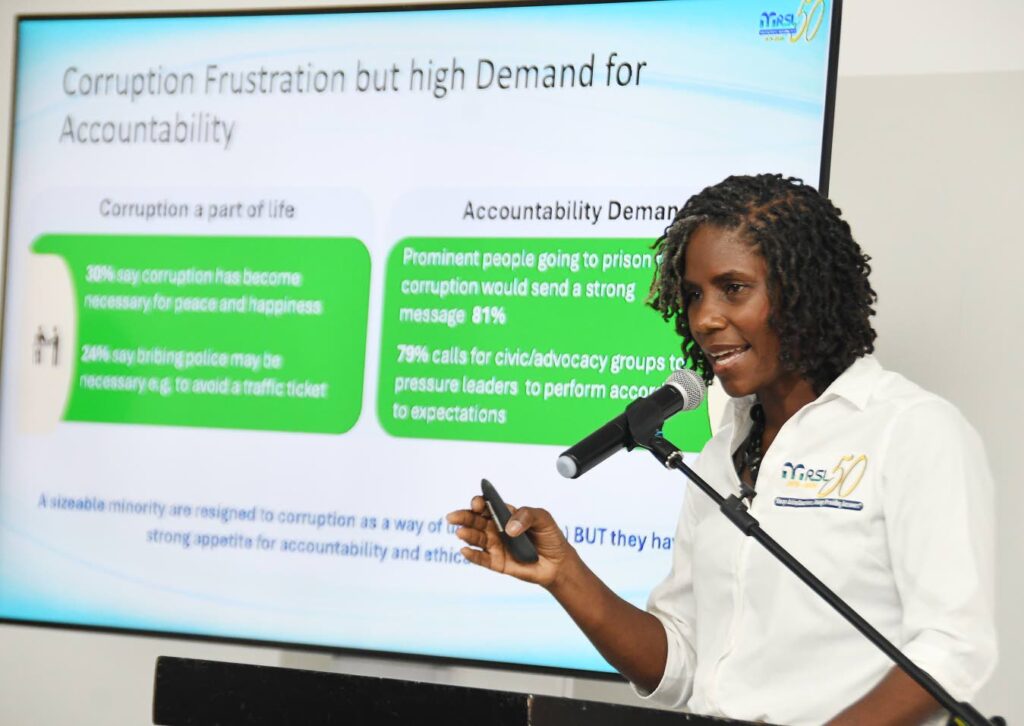
A newly released nationwide survey mapping public opinion across Jamaica has uncovered profound public discontent with systemic inequality, the growing normalization of corruption, and widespread desire for migration among a large share of the population, even as core traditional values remain deeply rooted in Jamaican society. Carried out by Market Research Services Limited (MRSL), the poll gathered responses from 1,102 residents across all 14 of Jamaica’s parishes to capture the current “hearts and minds” of the Jamaican people.
The data paints a nuanced portrait of a society grappling with clashing forces: deep frustration over unequal access to opportunity and distrust in public institutions on one hand, and persistent commitment to foundational values of family, education and mutual respect on the other. Kisha-Kaye Anderson, MRSL CEO and the study’s presenter, noted that many Jamaicans are navigating rising fear, social divisions, and an expanding moral “grey area” shaped by daily life pressures.
Key findings from the survey underscore the scale of public discontent: 81 percent of respondents agreed that Jamaican society is fundamentally unequal, while 42 percent stated they would leave the country immediately if given the chance to relocate abroad. When asked about corruption, 30 percent of those surveyed said corrupt behavior has become “necessary for peace and happiness” in Jamaica, and nearly one in three admitted that breaking the law is sometimes acceptable to get ahead economically.
Unveiling the results at a St Andrew forum held at S Hotel on Monday, MRSL Executive Chairman Don Anderson emphasized that the data reflects a nation caught between enduring traditional values and mounting socio-economic pressure. “It’s heartening to know that we reject wrongdoing, but pressure — life pressure — sometimes makes the area grey,” he explained, noting that only small minorities of Jamaicans view theft, violence or lawbreaking as broadly acceptable under most circumstances.
Across all demographic groups, the survey confirmed that family remains the highest-priority value for Jamaicans, followed closely by education, personal independence, and religious and spiritual faith. But discussion of the findings quickly expanded into a broader debate over systemic failures in Jamaica’s social structures, with prominent attorney and businessman Howard Mitchell arguing that decades of political and economic progress have not been matched by needed social reform.
“I strongly believe that Jamaica needs social reform,” Mitchell said during the post-presentation panel discussion. He referenced the words of former Jamaican leader Norman Manley, who called on post-independence generations to reform and reconstruct both the nation’s economic and social systems. “I think we’ve made progress in the economic reconstruction. We have failed in our social reform and reconstruction,” Mitchell added. He argued that the widespread frustration and shifting moral attitudes captured in the survey stem from unresolved, longstanding issues around national identity, systemic inequality and collective self-worth, noting that “no society can be successful without the deliberate shaping of the values and the attitudes of the members of that society” around a shared vision for the future. For Mitchell, the greatest value of the survey is that it opens a critical national conversation about how Jamaicans see themselves and their country.
Historian Verene Shepherd connected many of the survey’s key findings to Jamaica’s colonial and post-emancipation history, particularly the ongoing national quest for dignity, stable family structures and mutual respect. She explained that under chattel slavery, enslaved African families were systematically destroyed through capture, human trafficking, and forced separation on plantations across the Americas. In the wake of emancipation, rebuilding the Black family became a central national priority, a legacy that explains why family remains the most valued institution in Jamaica today, she argued.
The study’s finding around respect also sparked significant discussion: researchers found Jamaicans are far more likely to prioritize receiving respect than giving it, with lower-income respondents identifying this as a particularly pressing concern. Shepherd traced this dynamic to deep-rooted classism and systemic inequality, echoing the survey’s finding that 81 percent of Jamaicans see systemic inequality as a core national problem. “If 81 per cent of people indicate a strong belief in the systematic inequality in the systems of Jamaica, then we have a problem,” she said, “We have to find a way to fix that.”
The survey also highlighted growing public anxiety over personal safety and eroding social trust. Nearly half of respondents said they would stay silent if they knew someone was at risk of harm, rather than speak up and put their own safety at risk. While a large majority of Jamaicans reject vigilante justice, bribery and violence, the poll found that sizeable minorities view these actions as acceptable in specific circumstances.
One of the most striking findings centered on public attitudes toward corruption and accountability: while large numbers of Jamaicans expressed frustration that corruption has become normalized in daily life, 81 percent agreed that high-profile public figures being sent to prison for corruption would send a powerful, positive message to the nation about accountability.
Panel participants also focused heavily on the role of education in reproducing inequality, with both Mitchell and Shepherd arguing that Jamaica’s school system continues to widen social gaps and disconnect many young people from their cultural and national history. Shepherd noted that while access to education has expanded across the country, deep inequities in school infrastructure and resourcing persist, with some schools enjoying state-of-the-art facilities while others are severely under-resourced. She also questioned whether current curricula adequately teach Jamaican children about their African heritage and national identity, noting “Our children are disconnected from the kind of past to which they should be connected.”
Migration desires also emerged as a key trend, particularly among young Jamaicans and women. Despite nearly 70 percent of respondents reporting they feel proud to be Jamaican, many still confirmed they would leave the island for better economic and social opportunities elsewhere. Don Anderson summed up the conflicting mood captured across the survey, reiterating that while Jamaicans broadly hold fast to traditional rejection of harmful behavior, daily life pressure continues to push more people into that expanding moral grey area.