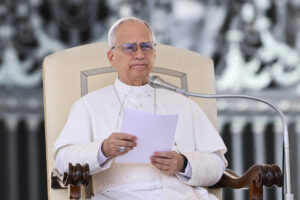
On a historic Monday at Vatican City, Pope Leo XIV — the first pontiff from the United States — presented his much-anticipated first encyclical *Magnifica Humanitas* (Magnificent Humanity), a landmark teaching document positioning ethical AI governance as a core priority of his papacy. In this sweeping manifesto addressing the accelerating development of artificial intelligence, the pope delivered a urgent call to “disarm AI” while warning that the unregulated rise of the technology is enabling dangerous “new forms of slavery” across the globe.
Central to the encyclical is a rebuke of the global arms race for increasingly powerful algorithms and massive datasets, which the pope argues is driven solely by the pursuit of geopolitical hegemony and commercial monopoly rather than collective human good. The pontiff was joined at the in-person presentation by leading AI stakeholders including Christopher Olah, co-founder of major U.S. AI firm Anthropic, a company currently locked in a high-profile legal dispute with the U.S. military over its refusal to allow its technology to be repurposed for lethal autonomous weapons systems and mass surveillance.
Olah acknowledged at the event that AI companies operate within incentive structures and regulatory frameworks that often push priorities that conflict with ethical, public-facing action. He welcomed collaborative input from global institutions outside the tech sector, including the Catholic Church, to steer the development of AI toward more equitable outcomes, noting that the existential and ethical questions raised by advanced AI far exceed the scope of the small research community that currently guides its progress. Pope Leo accepted this invitation to partnership, affirming his confidence that cross-sector collaboration can help humanity shape a AI future that serves, rather than subjugates, people.
In crafting the encyclical, the pope explained he consulted a broad cross-section of stakeholders: AI scientists, engineers, elected leaders, parents, and educators, hearing both urgent warnings from critics and the unheard voices of those exploited by AI supply chains. He stressed that AI must be liberated from ideological frameworks that turn the technology into a tool of domination, social exclusion, and death, drawing a sharp line against AI-powered lethal weaponry, arguing it is never morally acceptable to delegate life-or-death killing decisions to algorithms. This position aligns with a longstanding pattern of public conflict between Pope Leo and the White House over the ongoing Iran war and the Trump administration’s recent invocation of “just war” theory to justify the conflict. The pope wrote in the encyclical that this traditional framework is outdated, emphasizing that no algorithm can erase the moral harm of war.
Citing United Nations data projecting the total global value of AI could hit $4.8 trillion by 2033 — a 25-fold increase in just 10 years — Pope Leo noted that nearly all this growing wealth is concentrated in the hands of a tiny elite. He clarified that the call to “disarm AI” does not mean rejecting the technology entirely, but rather dismantling the “armed competition” mindset that drives its current development. “To disarm does not mean rejecting technology, but preventing it from dominating humanity,” he wrote, adding that AI should be designed as human-centric, universally accessible, and open to ongoing public debate.
The text draws on a rich array of cultural references spanning millennia, from the ancient Greek philosopher Plato to Ludwig van Beethoven’s Ninth Symphony, and even includes a nod to a character from J.R.R. Tolkien’s *The Lord of the Rings*. It was officially signed on May 15, marking the 135th anniversary of Pope Leo XIII’s 1891 encyclical that established the Catholic Church’s modern social doctrine amid the upheaval of the first Industrial Revolution.
In one of the encyclical’s most striking passages, Pope Leo called out the hidden exploitation that underpins the AI sector, observing that “nothing in the world of AI is immaterial or magical.” Every seamless, instant response from AI chatbots and tools relies on the invisible exploitation of millions of workers: from content moderators forced to view traumatic, violent content to child laborers extracting the rare earth minerals that power AI infrastructure. “They are scarced, injured and worn down so that computational flow may continue uninterruptedly,” the pope wrote, adding that greater efficiency and technological innovation can never excuse a deliberately hidden chain of exploitation. He also called for urgent action to reduce AI’s large carbon footprint and protect the environment, described as humanity’s “common home.”
In an unprecedented addition to the document, Pope Leo issued a formal apology for the Catholic Church’s historical role in the transatlantic slave trade and its past theological justifications for chattel slavery, calling the injustice “a wound in Christian memory.” “For this, in the name of the Church, I sincerely ask for pardon,” he wrote.
The release of *Magnifica Humanitas* follows years of systematic study of AI-related technologies by Vatican bodies. The Holy See first launched its public engagement with AI ethics back in 2000 with the *Rome Appeal for an AI Ethic*, which called for all new technologies to uphold fundamental human dignity. AI and ethics analysts widely expect the new encyclical to carry similar global influence to Pope Francis’s 2015 environmental encyclical *Laudato Si*, which sparked mass global activism and policy change on climate action.