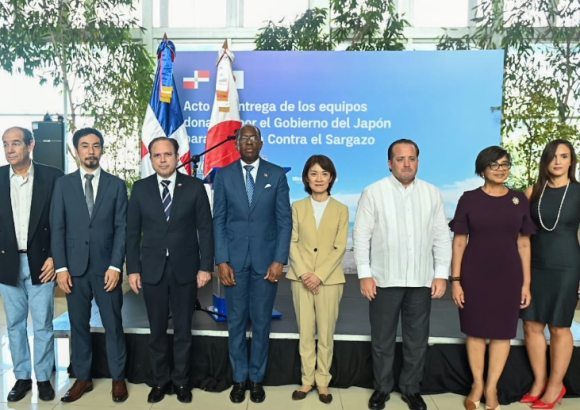
A new chapter of environmental cooperation between Japan and the Dominican Republic has officially begun, as Tokyo handed over a fleet of heavy machinery to help the Caribbean nation address the worsening sargassum crisis that has plagued its coastlines and critical tourism industry.
The official handover ceremony took place at the Dominican Republic’s Ministry of Tourism, with top local government officials leading the event. Attendees included José Ignacio Paliza, Minister of the Presidency, and Carlos Peguero, Vice Minister of International Cooperation, who formally accepted the donation on behalf of the Dominican government.
This support comes through Japan’s well-established Non-Reimbursable Financial Cooperation Program, an initiative that provides grant-based assistance to partner countries facing pressing social and environmental challenges. The donation package comprises 17 pieces of purpose-built heavy equipment: six heavy-duty dump trucks for transporting collected seaweed, five mechanical street sweepers to clear sargassum from coastal access areas and promenades, and five tractors to assist with large-scale containment and collection operations along the Dominican Republic’s extensive coastline.
Dominican authorities have emphasized that the new equipment will fill critical gaps in the country’s current sargassum response capacity. For years, massive influxes of free-floating sargassum have washed up on Dominican beaches, decaying on shore and damaging fragile coastal habitats, driving away tourists, and cutting into revenue from the tourism sector – the single largest engine of economic growth and employment in the country.
Tsuda Fumiyo, Japan’s Chargé d’Affaires in the Dominican Republic, used the occasion to underscore the strategic value of the collaboration. She noted that the partnership goes beyond just addressing an immediate environmental problem; it advances shared goals of long-term environmental sustainability and strengthens the institutional capacity of Dominican agencies tasked with coastal management. The handover marks another milestone in the deepening bilateral relationship between the two nations, centered on mutual support for sustainable development and economic resilience.