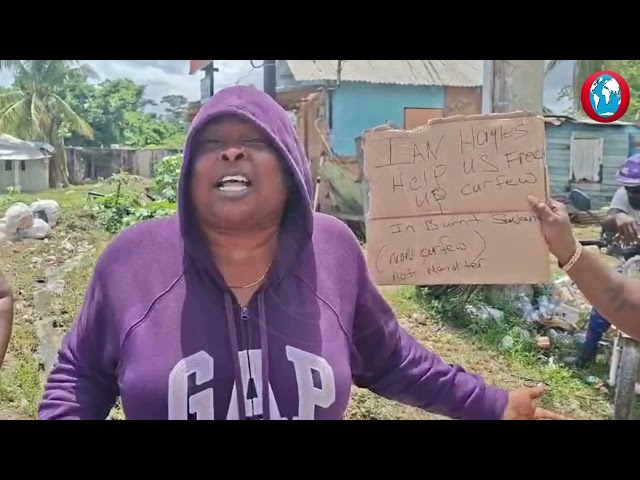
In the tight-knit community of Burnt Savannah, Westmoreland, simmering frustration over a months-long curfew boiled over into public protest on Friday, May 15. Local residents and small business owners have taken to the streets to decry the restrictions, which they claim have destroyed their livelihoods, subjected community members to aggressive police harassment, and exposed a total lack of attention from national leadership in the wake of a recent natural disaster.
The curfew, which has been in continuous effect for more than two months, restricts all public activity through 6:00 pm from Wednesday to Sunday each week, leaving only the two slowest business days of the week – Monday and Tuesday – for evening operations. Community members are pushing for an extension of curfew hours to midnight, a small adjustment that would allow them to recoup much-needed income after severe economic disruption. Many local families are still struggling to rebuild their lives and finances in the aftermath of Hurricane Melissa, covering ongoing childcare costs and basic living expenses even as the curfew slashes their earning potential.
The demonstration was directly triggered by a violent incident that unfolded on the night of May 14, during a candlelight vigil held to honor Clayon “Taj” Campbell, a local community member who died in a recent motorcycle crash. Relying on unconfirmed local reports that the curfew had been lifted for the evening, residents gathered to pay their respects to Campbell and support his grieving family – only to be confronted by a large contingent of Jamaican Constabulary Force (JCF) officers who moved to shut the event down at 7:00 pm.
Kalia Forrester, a community spokesperson speaking on behalf of the protesters, described the chaotic scene to reporters. After seeing just two police vans arrive initially, additional units surrounded the gathering from both sides, boxing attendees in. Even after Campbell’s mother appealed to the crowd to cooperate fully with police orders and residents began cleaning the site to leave, officers escalated tensions by deploying pepper spray into the crowd, Forrester alleged. The chemical agent triggered a stampede that left multiple people injured, including an 8-year-old child who was directly sprayed. Attendees further claimed officers chased fleeing residents with machetes and later harassed the father of the injured 8-year-old at his home.
Beyond the curfew’s economic harm, the most heated grievance among residents centers on the aggressive and dehumanizing treatment they say they have endured from law enforcement during the restrictions. “That is not how they should deal with it, they are talking to us like we are animals,” Forrester said.
Community members are also demanding formal clarity on the curfew’s legal status, noting that the JCF has failed to publish any official notice of the Burnt Savannah restrictions on its social media channels – the standard protocol for announcing such measures in Jamaica. According to residents, police simply arrived unannounced one evening and informed the community the curfew had been implemented over unspecified recent murders, with authorities claiming unmarked back roads connecting Burnt Savannah to neighboring Georges Plain and Frome were being used by criminal groups to move through the area.
Residents push back hard against this justification, pointing out that the unregulated back roads cited by police remain unpatrolled and unblocked even during curfew hours, and that violent crime including murder has continued uninterrupted since the restrictions were put in place. They argue the curfew does nothing to improve public safety and instead unfairly targets local small business operators, who rely on evening trade and community events to earn a living.
Many local business owners depend on popular community gatherings such as the recurring Bar Hop party series to generate enough income to cover household costs and school fees for their children. These events have been completely banned under the curfew. Residents also point to inconsistent enforcement of the restrictions: some local establishments are allowed to operate late into the night with no interference, while others are aggressively forced to close, leading to accusations that the policy is intentionally designed to cut off income for certain community members rather than reduce crime.
Forrester added that residents have even been threatened with violence for gathering in groups, claiming officers have stated they will open fire on large assemblies and that if residents want to host community events, they must travel outside the area to Savanna-la-Mar or Grange Hill.
Compounding these grievances is widespread anger over the Jamaican government’s failure to deliver disaster relief support to Westmoreland in the months after Hurricane Melissa hit the region. “Our Prime Minister has turned a blind eye to us. Westmoreland hasn’t really gotten anything for the Hurricane Melissa relief. So we have to help ourselves,” Forrester explained. With little outside aid, local families have leaned entirely on small business revenue to rebuild – a lifeline that the curfew has now cut off.
“When we are under curfew from six in the morning till six in the evening, how are we going to cope? How are we going to take care of our children?” Forrester asked.
As frustration reaches a breaking point, protesters are calling directly on Prime Minister Dr. Andrew Holness to intervene in the situation. They demand the full removal of the curfew, an end to excessive use of force against community members, and the implementation of targeted, effective policing that actually addresses root crime concerns rather than punishing local residents and business owners. As of press time, Jamaica’s Observer Online has not received any comment from the Westmoreland Police Division on the residents’ allegations.