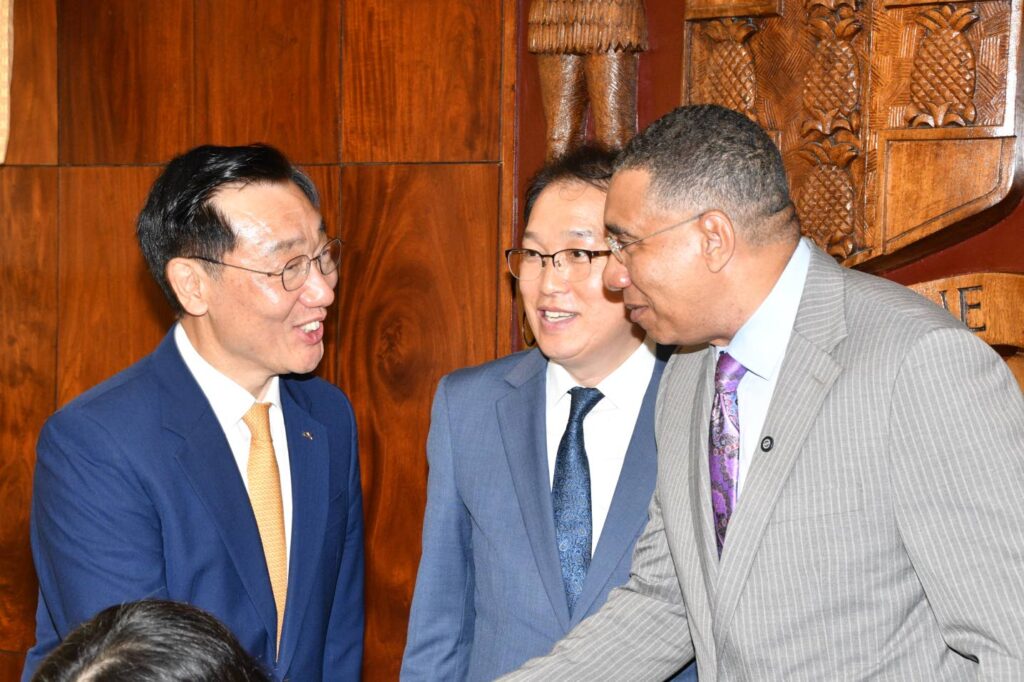
On Tuesday, Jamaica and South Korea officially kicked off a transformative multimillion-dollar initiative designed to modernize Jamaica’s outdated land administration system, cutting red tape to help thousands of Jamaicans secure formal titles for the land they occupy and work on.
At the launch ceremony held at the Office of the Prime Minister in St Andrew, Jamaica’s Minister of Land Titling and Settlements Robert Montague revealed that just 55 percent of all land parcels across Jamaica currently hold formal, registered titles. He framed the project as a catalyst for nationwide prosperity, noting, “You should all have your names entered in the titles book. If you do that, prosperity will run from Morant Point to Negril Point.”
Jamaican Prime Minister Dr. Andrew Holness outlined the core motivations driving the collaboration, highlighting a suite of expected benefits that extend beyond streamlined titling: expanded financial access for citizens and the government, increased systemic transparency, reduced interfamily land disputes, and a more inclusive formal economy. For decades, Holness explained, Jamaicans have grappled with a land administration process that is slow, opaque, and prohibitively difficult to navigate. “We are determined to change that. We are building a system that is faster, more accurate, more accessible, and more responsive to citizens, investors, planners, and communities,” he said.
Holness emphasized that formal land titling creates cascading economic benefits across all segments of society: working families can access mortgage loans to build or improve homes, smallholder farmers can use their land as collateral for agricultural investment, and outside investors can pursue development projects with clear legal certainty. Drawing on South Korea’s own successful land reform history, he noted that in the 1950s, South Korea overhauled its agricultural land tenure system, eliminating absentee landlordism and transferring ownership to active cultivating farmers. Jamaica now seeks to build a similar equitable, effective framework to resolve a long-standing national gap: thousands of Jamaicans have lived, worked, and raised families on the same plots of land for decades, some more than 50 years, without any formal proof of ownership.
“This gap between possession and title is not a bureaucratic inconvenience only, it is a barrier to finance, security, to inheritance, and to the formal economy. A land title is more than a document, it is a platform for opportunity. This project is about building that platform at scale,” Holness added.
Officially named the Land Administration Capacity Enhancement Project, the initiative is a three-party collaboration between Jamaica’s National Land Agency (NLA), the Korea Land and Geospatial Informatix Corporation, and the Korea International Cooperation Agency (KOICA), which is providing a $9 million grant to support the work. The project’s central goal is to accelerate Jamaica’s land registration rate by upgrading both the sector’s digital infrastructure and workforce expertise. It will roll out in three sequential phases over the coming decade.
The first phase, running from 2026 to 2027, will lay institutional groundwork for the new Land Administration Innovation Centre (LAIC), which will be based at 84 Hanover Street. This phase will focus on building the centre’s capacity to deliver specialized training for future land administration professionals through intensive, hands-on preparation courses. From 2028 to 2029, the second phase will expand the LAIC into a fully functional national training hub, offering specialized technical courses, field-based practical training, instruction in geographic information systems, advanced data management, and ongoing trainer development. Beginning in 2030, the NLA will take full operational control of the LAIC, with continued targeted technical support from South Korea under a train-the-trainer model designed to embed long-term expertise within Jamaica. Myoengso Eo, President and CEO of the Korea Land and Geospatial Informatix Corporation, emphasized that robust land administration is a foundational pillar of national development. “[It] serves as the foundation for the development of roads, railways, airports, urban planning, tax, etc. Korea has achieved a rapid economic growth based on effective land management,” he explained.
Project organizers outline a broad range of expected outcomes from the initiative: faster land registration processes, legally secure property ownership, increased public revenue from land-related taxes and fees, more orderly national development, creation of skilled local jobs, and accessible digital land services for all users. Joongkeun Oh, Chargé d’Affaires at the Embassy of the Republic of Korea in Jamaica, framed the project as a testament to the two countries’ deep collaborative partnership. “Providing this foundation for economic self-reliance remains a testament to the sincerity of our collaboration,” he said.
Oh added that the combination of new digital infrastructure and a trained local workforce will empower Jamaica to systematically leverage its land resources to advance two key national goals: achieving greater food self-sufficiency, and generating the critical geospatial data energy companies need to design efficient, modernized national energy grids. He also confirmed that South Korea, in partnership with the United States, stands ready to support Jamaica by facilitating consultations with major international financial institutions including the World Bank and the Inter-American Development Bank to unlock additional financing for the project’s implementation. “We are prepared to collaborate closely in exploring practical financing and implementation strategies for this advanced system integration,” he said.
Across all stakeholder discussions, the project is consistently framed as a partnership built for long-term Jamaican self-reliance, designed to drive sustainable national progress by strengthening local public institutions, building domestic expertise, and establishing a resilient, inclusive land administration system for decades to come.