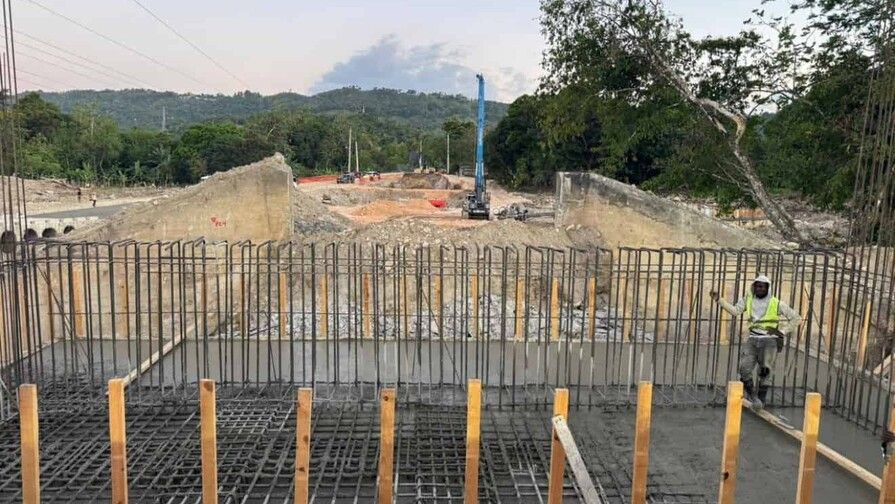
Santo Domingo — After the original Camú River bridge on the Dominican Republic’s critical Tourist Highway collapsed earlier this year amid extreme weather, authorities have reopened connectivity between the major northern cities of Santiago and Puerto Plata via a newly completed temporary detour, as crews race to finish construction on a more resilient permanent replacement.
The temporary two-lane concrete ford, which opened to traffic on Monday afternoon, runs parallel to the site of the new permanent bridge currently under development in Yásica. The detour project was fast-tracked to address crippling transportation disruptions that have plagued the Santiago-Puerto Plata corridor since the original structure failed in April. This highway is not only a popular scenic route for visitors but also a core artery for regional commerce, logistics, and daily travel for local residents, making the restoration of through traffic a top priority for national authorities.
Construction teams are working around the clock, seven days a week, to cut down completion time for the permanent bridge, MOPC (Dominican Republic’s Ministry of Public Works and Communications) officials confirmed. As of the latest update, foundation work for the bridge’s abutments and support piers is fully finished, manufacturing of the structure’s key steel beams is more than 40% complete, and reinforcement framing and concrete pouring operations are progressing simultaneously across the entire job site.
The original 135-meter crossing collapsed in April when heavy tropical rainfall and widespread flooding generated unusually powerful currents that eroded and overwhelmed the structure’s supports. In a precautionary move that avoided loss of life, public safety officials had already closed the bridge to all traffic before it gave way, meaning no injuries or fatalities were reported when the collapse occurred.
In the months following the collapse, the disruption to regional movement was severe. Motorists and commercial cargo carriers were forced to divert onto much longer alternate routes through the town of Navarrete, leading to widespread congestion, sharply increased travel times, and higher operational costs for logistics companies. Local tourism businesses, which rely on easy access between Santiago’s inland hub and Puerto Plata’s coastal resort destinations, also reported significant impacts, alongside residential communities that depend on the corridor for access to work, education, and essential services.
Within days of the collapse, the Dominican government ordered immediate demolition of the damaged structure and approved a contract for a fully new bridge, engineered to meet updated, more rigorous flood-resilience and safety standards. The new 135-meter span is designed as a long-term solution for this strategic transportation link, which supports billions of pesos in annual economic activity across the northern coast’s tourism and trade sectors.
Parallel to construction efforts, the National Office of Seismic Evaluation and Vulnerability of Infrastructure and Buildings (ONESVIE) has launched a formal technical investigation to determine the root causes of the original bridge’s collapse. Public works leaders have repeatedly stressed that the replacement bridge project remains a top national infrastructure priority, given its outsized importance to the economic vitality of the Dominican Republic’s northern region.