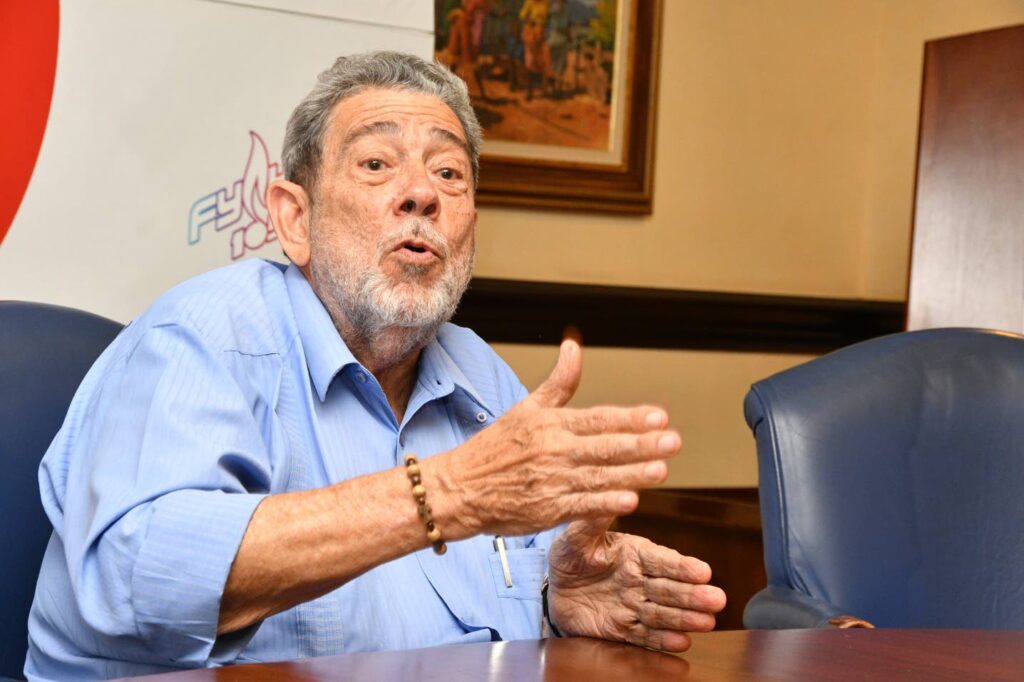
One of the Caribbean’s most seasoned elder statesmen has publicly urged both Guyana and Venezuela to respect the International Court of Justice’s upcoming verdict on their long-running territorial dispute over the resource-rich Essequibo region, a decades-long standoff that has twice escalated to the brink of armed conflict in recent years.
Dr. Ralph Gonsalves, the former prime minister of St. Vincent and the Grenadines who already stepped in to de-escalate tensions between the two South American nations in 2023, shared his position during a public appearance at the Jamaica Observer Press Club’s sitting last week. It was Gonsalves who brokered a landmark face-to-face meeting between then-Venezuelan President Nicolas Maduro and Guyanese President Irfaan Ali in December 2023, when tensions over the disputed border territory spiked sharply after a series of provocative moves from Caracas.
“I am hopeful that whatever the result of the ICJ, that both sides will abide by the determination of the ICJ. But even after there is a determination by the ICJ I would expect that there would be discussions between Venezuela and Guyana for matters which arise out of the decision,” Gonsalves told the outlet’s editors and reporters. He added that regardless of the court’s final ruling, open dialogue will remain critical to preventing further unrest: “I don’t know what all the dimensions of the ruling of the ICJ would be but I can envisage that if there is any matter which is left undecided, that it may well still call for conversations.” Gonsalves also noted that the Caribbean Community (Caricom) broadly shares the goal of a peaceful, rule-based resolution, and confirmed he stands ready to resume his role as a neutral intermediary between the two governments if called upon. “What I want to see is peace between two important neighbours, and what I want to see is that justice is determined in accordance with the principles of international law adjudicated,” he said.
Last Monday marked the official start of a week of public hearings at the ICJ, the United Nations’ highest judicial body, over the decades-long territorial row. In his opening address to the court’s panel of judges, Guyana’s Foreign Minister Hugh Hilton Todd framed the case as an existential issue for the small Caribbean nation, noting that more than 70% of Guyana’s current sovereign territory is at stake in the dispute. “For the Guyanese people, it is tragic even to think about having our country dismembered by stripping from us a vast majority of our land, together with its people, its history, its traditions and customs, its resources and precious ecology,” Todd told the court.
Venezuela’s lead representative to the hearings, Samuel Reinaldo Moncada Acosta, rejected Guyana’s framing outright during his address Wednesday. “The characterisation by Guyana of an alleged threat to its territorial integrity or to its sovereign territory constitutes a flagrant misinterpretation, a deliberately misleading presentation of both facts and law,” Acosta told the court. He reaffirmed Caracas’ long-held position that Venezuela’s historical claims to the Essequibo region “are inalienable,” and stressed that the South American nation remains committed to defending its claims through peaceful means. Acosta also reiterated Venezuela’s longstanding refusal to recognize the ICJ’s jurisdiction over the case, a position Caracas has held since proceedings began.
The origins of the dispute stretch back to the 1890s, when a border was drawn between the two territories under British colonial rule, when Guyana was still a British dependency. Currently, Guyana administers the 62,000-square-mile Essequibo region, which makes up more than two-thirds of Guyana’s total territory and is home to roughly 125,000 of the country’s 800,000 residents. But Venezuela has claimed the entire region, which stretches along the western bank of the Essequibo River, since the early 20th century. Caracas argues the 1899 border agreement is invalid, and maintains the true border should follow the Essequibo River further east, aligned with the territorial boundaries that existed under Spanish colonial rule in 1777, as outlined in a 1966 agreement signed shortly before Guyana gained full independence. The dispute intensified dramatically a decade ago, when energy giant ExxonMobil discovered massive offshore oil deposits in the region, catapulting Guyana to hold the largest crude oil reserves per capita in the world.
Tensions spiked again in 2023, when Maduro made a series of public and political moves to assert Venezuelan claims over the region, leading Gonsalves to broker the emergency Argyle International Airport summit in St. Vincent between Maduro and Ali. The two leaders signed the historic Argyle Declaration following the summit, in which they formally committed to avoiding any direct or indirect use of military force in the dispute. The truce held into 2024, but tensions flared again earlier this year when Venezuela’s National Assembly approved legislation to formally designate Essequibo as Venezuela’s 24th federal state, a move that was immediately rejected as illegal and invalid by Guyana and the wider international community. Caracas followed that move by announcing it would include the new “state” in upcoming gubernatorial elections scheduled for May 25, 2025, prompting Georgetown to formally request immediate intervention from the ICJ to block the move. While the ICJ’s rulings are legally binding on all parties to the dispute, the court holds no independent enforcement power to compel compliance from member states.