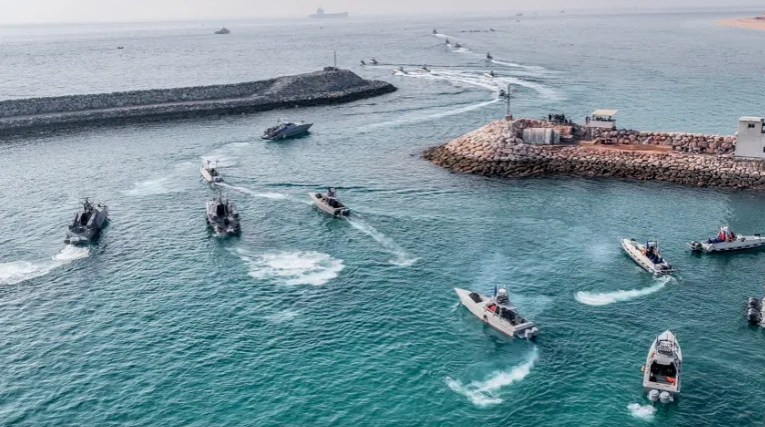
Fresh regional tensions have flared in the strategically critical Gulf of Oman after Iranian naval forces seized a tanker reportedly flying the Barbadian flag, prompting Barbadian foreign officials to highlight a worrying global trend: ship owners deliberately using falsified flags to conceal their true identities and evade international sanctions.
According to Iranian state media reports, the Islamic Revolutionary Guard Corps Navy carried out a targeted special operation to take control of the vessel, identified as the *Ocean Koi*, in the gulf. Iranian media, quoting an official military statement, accuses the tanker of undermining Iran’s national interests and disrupting its oil exports by taking advantage of heightened regional volatility. The *Ocean Koi* was previously placed under United States sanctions back in February, and Tehran confirmed after the seizure that the vessel was escorted to Iran’s southern coastline and turned over to national judicial authorities.
But in Bridgetown, Barbados’ capital, senior foreign ministry officials push back on the claim that the tanker is legally registered in the country. Acting Foreign Minister Kerrie Symmonds told local outlet Barbados TODAY that his office has not received any formal notification of the incident. “I am unable to confirm the veracity of this claim and of course cannot even be sure that, if true, the ship is not sailing under a false flag which, unfortunately, is now a developing trend with vessels or ships’ owners who are evading sanctions and are trying to obscure their true identity and nationality,” Symmonds stated.
This latest incident comes just months after another Barbados-registered vessel was attacked in the nearby Strait of Hormuz, a vital chokepoint that carries roughly 20 percent of the world’s daily oil trade. In March, the Barbados Maritime Ship Registry (BMSR) confirmed that the bulk carrier *Ocean Pretty* came under rocket and gunfire attack while transiting the strait, with no warning given before the strike. No crew members were injured in that attack, but the vessel has remained stranded off the coast of the Iranian southern port of Bandar Abbas ever since, waiting for Iranian inspection. The full extent of damage the ship sustained is still undisclosed.
In a bid to reduce risk while traveling through the high-tension region, the crew of the *Ocean Pretty* had raised Chinese flags ahead of the incident, a common tactic used by commercial vessels to lower the chance of attack in the area. However, private security warnings shared among shipping industry groups have repeatedly noted that this precaution does not guarantee safe passage.
Following both incidents, the London-based BMSR has ramped up monitoring of maritime security in the region, which has grown increasingly volatile amid ongoing escalating tensions between Iran, the United States and Israel. The registry has issued formal operational guidance for all Barbados-registered vessels transiting the Strait of Hormuz, and reaffirmed its position under the United Nations Convention on the Law of the Sea (UNCLOS): the strait is classified as an international passage that guarantees free navigation for all commercial vessels, and Iran has no legal basis to unilaterally close the waterway to global traffic. Barbados-flagged vessels retain full legal right to transit the area, the BMSR confirmed.
Despite this affirmation of international legal rights, the registry has issued a strong advisory for ship owners, managers and captains to carry out comprehensive risk assessments before entering the region, and to avoid transiting the strait entirely whenever operationally possible to protect the safety of their crews. The BMSR has not yet issued a formal mandatory marine circular regarding the new *Ocean Koi* incident, but says it will continue to closely track developments in the region and update guidance as needed. Since regional tensions escalated earlier this year, a large number of commercial shipping companies have rerouted their vessels away from the strait entirely, while many others are holding at anchor in nearby waters waiting for conditions to stabilize before proceeding.