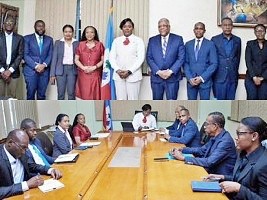
On June 5, 2026, senior Haitian government officials and leaders of the United Nations System in Haiti convened a critical working session focused on advancing the country’s urgent economic stabilization and recovery agenda, laying out clear collaborative next steps to address the Caribbean nation’s ongoing humanitarian and development challenges.
Leading the Haitian government delegation was Sandra Paulemon, Haiti’s Minister of Planning and External Cooperation, who was joined by Guy Roméo Latry, the Ministry’s Director General, and Paul Ruddy Mentor, Paulemon’s Chief of Staff. On the United Nations side, the meeting was hosted by Nicole Kouassi, UN Resident Coordinator in Haiti, alongside her specialized technical team.
The two sides centered discussions on five core priorities, starting with the governance of the UN-Haiti Global Cooperation Framework and the Peacebuilding Fund (PBF) steering committee. Additional agenda items included progress updates on Haiti’s Strategic Development Plan (PSDH), the finalization of the mid-term report for the Doha Development Agenda, and the rollout of Haiti’s national economic stabilization and recovery program.
This flagship recovery program is explicitly aligned with the Haitian government’s top national priorities, which center on enabling the safe return of displaced citizens to their home neighborhoods and the resumption of schooling for children across the country. It also prioritizes expanded access to safe drinking water and the rollout of a suite of essential social initiatives designed to rebuild Haiti’s damaged economic and community fabric.
In her opening remarks to the session, Minister Paulemon clarified the institutional leadership structure for the program: strategic direction is set by the Office of the Prime Minister, while the Ministry of Economy and Finance serves as technical coordinator and carries responsibility for all budgetary oversight.
Intervention zones for the recovery program have been selected through a multi-criteria assessment that weighs a region’s level of vulnerability, existing security pressures, and untapped economic potential. The program’s primary focus areas are fragile urban communities, strategic border transit corridors, and key agricultural basins that play a critical role in advancing national food security and creating much-needed local jobs.
Paulemon underlined the urgent need to mobilize international funding that is coordinated, predictable, and rapidly deployable to deliver tangible, on-the-ground improvements that directly improve the lives of the Haitian people. “The Haitian population cannot afford to wait for relief and recovery,” she emphasized, noting that the program’s goals extend beyond enabling displaced people to return home to rebuilding the lost household capital of vulnerable communities.
During negotiations, the Minister called for a revamped comprehensive cooperation framework between Haiti and the UN that is centered on measurable results and fully aligned with the government’s three core priorities: expanding national security, driving inclusive economic and social recovery, and laying the groundwork for upcoming national elections.
For his part, Guy Roméo Latry stressed that the Ministry of Planning and the United Nations system must reach consensus on clear, concrete deliverables embedded within the overall cooperation framework. He reiterated that the framework must deliver results that are tangible, visible, and measurable to the Haitian public, calling for an impact-first working approach that turns formal commitments into immediate, direct action that benefits local communities.
Paulemon and Kouassi also dedicated discussion to aligning Haiti’s Strategic Development Plan with the government’s current urgent priorities. The Minister called for expanded regular technical exchanges between planning department teams and the UN Resident Coordinator’s Office to align strategic references and eliminate any ambiguity around the strategic foundation for external development support to Haiti.
The working session also yielded tangible progress on two key administrative priorities: negotiators moved closer to finalizing the mid-term report of the Doha Development Agenda, and agreed on preliminary terms for the organizational structure and membership of the Peacebuilding Fund steering committee.
By the close of the meeting, both sides confirmed that the session had successfully consolidated strategic alignment between Haiti’s Ministry of Planning and the United Nations system. Participants recorded meaningful progress on strengthening governance mechanisms for both the Global Cooperation Framework and the Peacebuilding Fund, and established a clear timeline and roadmap for the next phases of implementing the national economic stabilization plan.