The 23rd Pan-American International 10×10 Draughts Championship wrapped up recently in Paramaribo, Suriname, and its closing ceremony delivered far more than just a traditional celebration of top competitors. The event exposed a growing shift in the competitive landscape of regional draughts, combining established dominance from traditional powerhouses with promising breakthroughs from up-and-coming national programs.
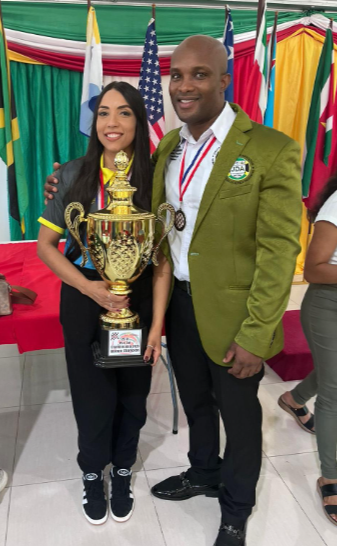
In one iconic moment that summed up the tournament’s shifting narrative, Brazil’s newly crowned Women’s Classic champion Carla Assunção Calasans stood side-by-side with Jamaica Draughts Association (JDA) president Jermaine Delattibudiere, who took home silver. The photo, taken on stage at Paramaribo’s Mind Sport Centre during the official award ceremony, carried quiet symbolism: one country reaffirming its long-held position at the top of the regional rankings, while another marked its intentional, steady climb up the competitive ladder.
Brazil’s reign over the 100-square 10×10 draughts format was reinforced in emphatic fashion at this year’s championship. Calasans put on a masterclass of technical precision and calm under high-stakes pressure to claim the women’s top prize, solidifying her status as the sport’s regional standard-bearer.
Her compatriot, International Grandmaster Allan Igor Moreno Silva, extended his already legendary regional legacy by capturing his sixth Pan-American Men’s Classic title – a rare and remarkable feat that spans more than a decade of elite championship competition. Silva’s dominance did not end there: he also delivered a commanding performance in the Blitz competition to take home a second gold medal, highlighting Brazil’s unmatched depth and consistent excellence at the highest regional level.
The men’s division’s top finishers showcased the high calibre of competition drawing athletes from across the Americas. International Master Angel Rafael Mejía of the Dominican Republic claimed the runner-up spot, while International Master Yevgeniy Sklyarov of the United States took third. Suriname’s own Federation Master Arief Salarbaks and Trinidad and Tobago’s Federation Master Dickson Maughn rounded out the competitive top five.
In the women’s division, two American representatives – Candidate Master for Women Galina Petukhova and International Master for Women Lublyana Turiy – secured second and third place respectively. Calasans claimed the top spot, with Suriname’s Shreya Ragho taking fourth to complete the top tier, a result that underscores both the high level of play and the geographic diversity of this year’s competitor field.
Beyond regional bragging rights, the championship served as a critical qualifying event for the 2027 World Draughts Federation World Championships set to take place in the Netherlands. The top two finishers in both the men’s and women’s divisions have already secured their spots at the global tournament, cementing the Pan-American Championship’s role as more than just a regional contest – it is a key gateway to elite global draughts competition.
Against this backdrop of established excellence, Jamaica’s solid performance at the tournament carries broader strategic significance for the future of the sport in the region, according to Delattibudiere, who also serves as a Deputy Superintendent in Jamaica. He explained that Jamaica’s 10×10 draughts program is still in its early formative stages, with the nation’s first official entry into the Pan-American Championships coming only in 2022 at the event hosted in Santo Domingo.
At that 2022 tournament, Delattibudiere shared, Jamaican competitor Jermaine ‘Wasp’ Hutchinson turned heads with a standout 13th-place finish, while International Grandmaster Wayne ‘Shines’ Reid claimed 24th place. “Both players set an early benchmark for Jamaican competitive participation that we have built on here,” he added.
Delattibudiere noted that his own silver-medal finish at this year’s championship represents consistent progress for the Jamaican program, while also reflecting the steep learning curve that comes with transitioning from the smaller 8×8 draughts format, more commonly played in Jamaica, to the far more complex 10×10 version used in elite international competition.