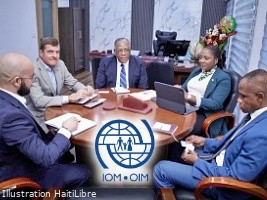
In a high-stakes working meeting held on April 30, 2029, Haiti’s Minister of Planning and External Cooperation Sandra Paulemon sat down with Grégoire Goodstein, the head of the International Organization for Migration (IOM) Mission in Haiti, to push forward with follow-up actions on commitments forged during earlier high-level talks between Paulemon and IOM Director General Amy E. Pope in Washington D.C.
The central focus of this latest gathering was advancing existing and emerging programs tied to two of Haiti’s most pressing humanitarian challenges: managing the country’s growing population of internally displaced persons (IDPs) and addressing the steady flow of forcibly repatriated Haitian migrants who have been in irregular migration situations abroad. Participants zeroed in on a suite of priority initiatives, from reinforcing national IDP and migrant registration frameworks and boosting systematic monitoring of vulnerable affected populations to unlocking long-term sustainable solutions that cover safe return, local resettlement, and community integration for displaced groups.
The talks delivered tangible progress on concrete strategic frameworks designed to upgrade Haiti’s capacity to receive returning migrants, formalize a coordinated institutional presence across affected regions, and deliver targeted support to host local communities that bear the brunt of increased population inflows. Stakeholders are currently finalizing detailed actions to advance the socio-economic reintegration of returnees and displaced people, with a particular focus on developing tailored programming for at-risk youth, a group disproportionately impacted by Haiti’s ongoing mobility and instability crises.
Minister Paulemon used the meeting to reaffirm the Haitian government’s core vision: transforming migration from a source of strain into a catalyst for national development. To deliver on this goal, she outlined plans to activate targeted mechanisms to mobilize Haiti’s large global diaspora, including through expanded support for local entrepreneurship, targeted growth for small and medium-sized enterprises (SMEs), and the formalization of new economic initiatives across key strategic sectors of the national economy.
Paulemon also drew renewed attention to a longstanding systemic challenge: the fragmented nature of many international interventions in Haiti, which have undermined impact and misaligned with national priorities. She called for far stronger coordination and clearer harmonization of interventions across all international partner organizations, anchored explicitly to Haiti’s own national development and humanitarian goals. To operationalize this improved alignment, she stressed the urgent need for a 6 to 12-month collective action or partnership framework, with clearly mapped priority intervention areas and specific, measurable performance indicators to track progress.
In response, Goodstein commended the significant progress already advanced under Minister Paulemon’s leadership, as well as her unwavering commitment to improving coordination of international humanitarian and development aid across Haiti. He explicitly reaffirmed that the Haitian government’s national priorities are the core guiding imperatives for all IOM programming and action in the country.
Goodstein further confirmed IOM’s ongoing commitment to aligning all its interventions in Haiti with the government’s strategic priorities, and reiterated the organization’s intent to maintain close collaborative partnership with Haitian authorities. The shared end goal, he emphasized, is to deliver concrete, sustainable, and measurable outcomes that directly improve the lives of the Haitian population.