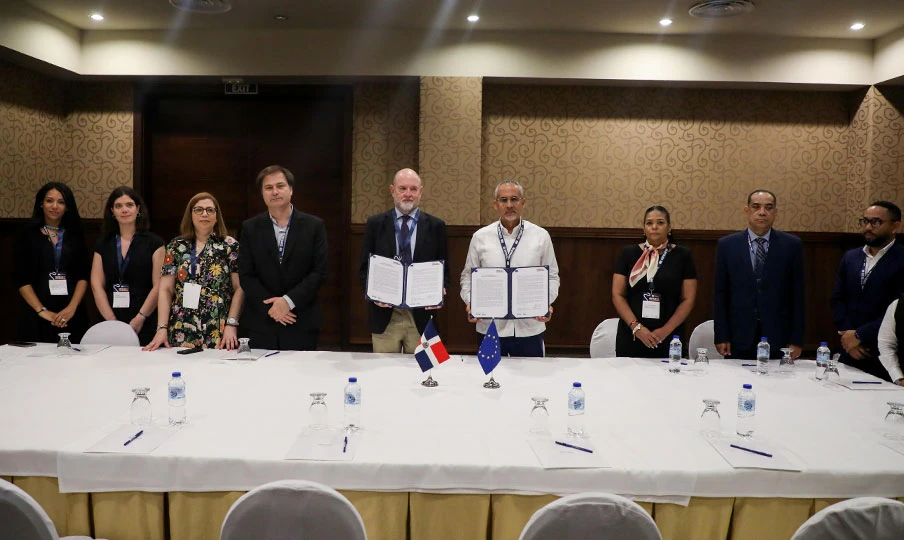
PUNTA CANA — The Dominican Republic’s National Drug Council (CND) has solidified a landmark inter-institutional cooperation agreement with the European Union through the COPOLAD III program, opening a new chapter of coordinated action to advance evidence-based drug policy across the Caribbean and Latin America. Backed by targeted European technical expertise and dedicated financial investment, the partnership is designed to strengthen regional and national capacity to address evolving drug-related challenges.
The formal signing ceremony took place alongside the fourth annual gathering of the COPOLAD III initiative, a high-profile international forum that brought together more than 170 drug policy specialists and official delegates from over 60 nations spanning Latin America, the Caribbean and the European continent. The agreement was signed by two key leaders: Alejandro de Jesús Abreu, who serves both as president of the CND and co-president of the EU-CELAC Mechanism, and Olivier Luyckx, head of country programs for Latin America and the Caribbean at the European Commission’s Directorate-General for International Partnerships. A broad delegation of senior Dominican diplomatic and institutional officials also participated in the event, emphasizing that the collaboration marks a critical milestone for collective regional action on drug policy.
Under the new framework, the partnership will roll out three high-priority initiatives tailored to meet the Dominican Republic’s specific needs while creating a replicable model for other regional nations. First, the alliance will conduct a nationwide, nationally representative survey of drug use among university students, generating actionable data to inform future policy design and ensure all regulatory and intervention efforts are rooted in real-world evidence. Second, the partnership will invest in expanding and strengthening the Dominican Republic’s Drug Policy Training School, which equips national and local decision-makers with the specialized skills and knowledge needed to implement effective drug policy. Third, the initiative will roll out an innovative social support program called the “Wings of Transformation” strategy, which focuses on providing critical resources and support to children whose parents are incarcerated on drug-related offenses. The program will launch as a pilot project at the Baní Women’s Penitentiary Center, with plans to scale the model across the entire country if the initial trial proves successful. Dominican officials noted that the partnership not only advances the country’s domestic drug policy goals but also reinforces its position as a regional leader in collaborative, holistic approaches to addressing drug challenges.