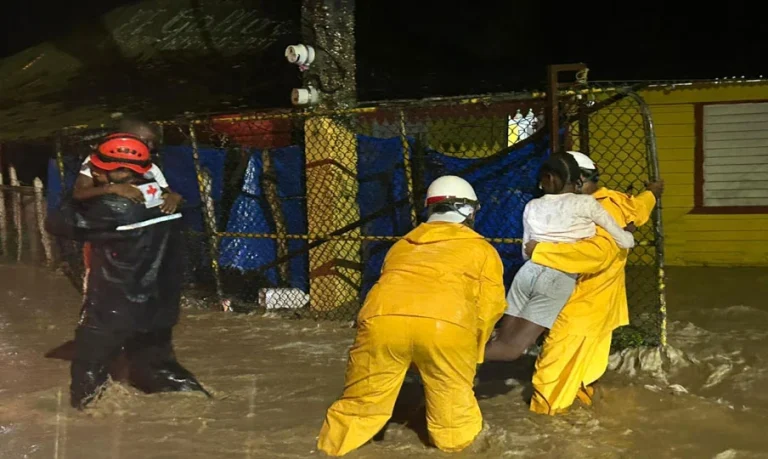
Heavy, sustained rainfall has triggered destructive flooding across low-lying, high-risk communities in multiple Dominican Republic provinces, prompting the Dominican Red Cross to roll out full-scale emergency response operations to protect vulnerable residents. The national humanitarian organization has mobilized a full contingent of rapid-response teams, trained volunteers, and technical specialists across the affected regions, with two core missions: delivering immediate support to households impacted by the floodwaters, and maintaining constant surveillance of areas at the highest risk of worsening disaster conditions.
One of the hardest-hit areas so far is the municipality of Montellano, located in the northern coastal province of Puerto Plata. As the Camú River continues to swell beyond safe levels, response teams are executing organized preventive evacuations for residents in three high-risk sectors: Los Ciruelos, El Saman, and Villa Melesia. Alongside evacuation efforts, teams are distributing essential supplies and providing on-the-ground support to community members who have been displaced or affected by rising water. Local disaster authorities remain on high alert, as hydrological data shows the water flow in the river is continuing to climb, increasing the risk of more severe flooding in the coming hours.
Beyond Puerto Plata, the Dominican Red Cross is sustaining coordinated emergency operations in five additional provinces: Santiago Rodríguez, Espaillat, María Trinidad Sánchez, Duarte, and El Seibo. All operations are carried out in close partnership with the country’s national Emergency Operations Center and other specialized disaster response agencies, to ensure efficient, coordinated delivery of aid across all affected regions. In a public advisory, the Dominican Red Cross has issued a clear warning to residents across at-risk areas: anyone living in proximity to rivers, streams, or zones with a history of repeated flooding is urged to strictly follow all official safety guidance, and to never attempt to cross flooded roadways or swollen waterways, which carry hidden risks of strong currents and structural collapse.