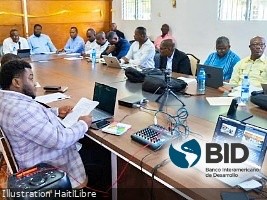
In late April 2026, key stakeholders gathered in Les Cayes, Haiti, for the fourth Steering Committee meeting of the Support Program for the Productivity of Agriculture and Fisheries and the Improvement of Rural Infrastructure for Access to Markets (PAPAIR), a flagship rural development initiative launched in January 2022. Held under the official patronage of Haitian Minister of Agriculture Agronomist Marcelin Aubourg and Ministry Director General Agronomist Pierre-Richard René, the two-day event brought together participants both in-person and via videoconference to review program achievements and map out next steps. With PAPAIR’s original mandate set to conclude in the coming months, discussions between Haiti’s Ministry of Agriculture and the Inter-American Development Bank (IDB) are already underway to explore a potential extension that would allow for the completion of ongoing projects and the long-term consolidation of on-the-ground results. The Steering Committee, which includes representatives from the Program Implementation Unit, IDB, departmental agricultural directorates across Haiti’s South, Grand’Anse, North, and North-East regions, partner institutions, and local farmer and fisher organizations, used the meeting to outline a revised strategic direction for remaining activities in 2026. All decisions reached at the gathering will be formally submitted to IDB for review as part of the official extension request. Opening the meeting, Minister Aubourg emphasized that even amid widespread economic and social challenges across Haiti, PAPAIR has delivered tangible, encouraging outcomes for rural communities. Echoing this assessment, Yannick Saint Paul, IDB’s representative to the meeting, confirmed the bank’s satisfaction with the program’s progress, noting that current results align fully with the institution’s initial expectations. Saint Paul also reaffirmed IDB’s long-standing commitment to supporting Haiti’s efforts to reduce widespread food insecurity and expand sustainable domestic agricultural production, a stance that was widely endorsed by all participating stakeholders. A breakdown of the program’s current achievements reveals widespread impact across four key target departments and 21 municipalities. To date, more than 15,600 of the 21,819 targeted smallholder farmers have directly benefited from program interventions. Program teams have established 336 dedicated agricultural demonstration plots, upgraded or rehabilitated nearly 20 municipal agricultural offices, and constructed new water storage tanks and irrigation infrastructure to reduce producers’ vulnerability to drought and erratic rainfall. In the area of farmer capacity building, 947 participants have already completed training through the program’s field school network, out of a total 3,300 planned trainee slots. For Haiti’s fisheries sector, which falls under the program’s second and fourth components, 65 local fisher associations across the four target departments are already receiving sustained organizational and technical support to improve sustainability and livelihoods. On the institutional development front, the program has completed construction of the new Aquin Communal Agricultural Office, and a 252-square-meter modern administrative building for the Southern Departmental Agricultural Directorate (DDAS) is currently 92% complete. The new facility, which includes upgraded office space, a conference room, and modern amenities, is designed to dramatically improve working conditions for departmental agricultural staff and boost overall administrative efficiency. Under the program’s rural infrastructure component, 24 kilometers of rural access roads have already been rehabilitated across Haiti’s North and North-East departments. These upgrades are expected to cut producer transport costs, reduce costly post-harvest losses, improve smallholders’ access to regional markets, and stimulate local economic activity across rural communities. The program has also provided specialized training to Ministry of Agriculture executives, departmental agricultural staff, and local government officials to strengthen their capacity to monitor infrastructure implementation and conduct long-term maintenance after project completion. By the close of the meeting, attendees approved a series of key resolutions to guide the program’s remaining activities, or any potential extended mandate. Priorities include expanding capacity building support for fisher and farmer associations, increasing the involvement of departmental agricultural directorates and Haiti’s National Seed System in regulating and supporting local seed suppliers, formalizing systems for the Ministry of Agriculture to retain project-trained staff to ensure long-term activity continuity after the program ends, strengthening departmental ownership of intervention planning and monitoring, and rolling out additional targeted skills training to improve the overall quality of program interventions. The event concluded with guided field visits to ongoing project sites in the municipalities of Les Cayes and Torbeck. Attendees had the opportunity to inspect progress firsthand, including the ongoing DDAS building expansion, and hold direct discussions with the engineering teams leading construction and infrastructure works across the region.