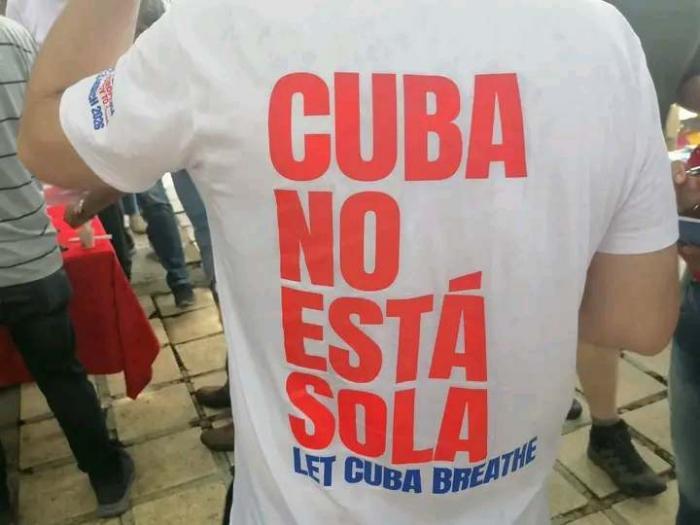
Kicking off its multi-stop tour of Cuba’s southeastern region on April 27, 2026, the second annual May Day International Solidarity Convoy has brought tangible aid and heartfelt global support to local communities across Granma, Santiago de Cuba and Guantánamo provinces. Made up of pro-Cuba activists and supporters from Italy, France, the United States, Mexico, and Cuban expatriate communities living abroad, the convoy’s 10-day itinerary combines aid deliveries, cultural visits, and direct engagement with local residents to highlight global opposition to the decades-long U.S. blockade against the island nation.
The delegation’s first stop was Santiago de Cuba’s University of Medical Sciences, where members met with institutional leadership, faculty, and students. In remarks to the gathering, Michele Curto, president of the Italian Agency for Cultural and Economic Exchange with Cuba and director of the joint venture BioCubaCafé, reaffirmed the international community’s unwavering commitment to the Cuban people amid ongoing external pressures. “We have come to reaffirm our commitment to the noble Cuban people, who are now under constant threat,” Curto stated, adding later that a growing global movement of Cuba supporters stands with the island: “There are many more of us who love and defend Cuba; you are not alone, and we will prevail.”
The meeting became an emotional reunion for many in attendance. Dr. Abel Tobías Suárez Olivares, rector of the University of Medical Sciences, recalled his own deployment to Turin, Italy, as part of Cuba’s international medical brigade that responded to the crisis at the height of Europe’s COVID-19 pandemic. Ileana Núñez, a Cuban soprano who has resided in Italy for decades, was also on hand for the gathering – she had served as a translator and liaison between Dr. Suárez and local patients when the brigade worked in Italy’s COVID-19 red zones. The reunion unfolded as a warm exchange of hugs and shared memories, with Dr. Suárez emphasizing the transformative impact of the convoy’s visit: “Your visit shows that we are not alone in this battle and that solidarity is always capable of breaking the blockade.”
Beyond the exchange of experiences, the convoy has organized a large shipment of targeted solidarity aid for Cuban health and education institutions, including life-saving medications, critical medical equipment, school supplies, and photovoltaic solar panels. The first donations were officially handed over Thursday to the University of Medical Sciences and Santiago de Cuba’s Antonio Vegues César South Children’s Hospital. Juan Carlos Vaillant Despaigne, delegate of the Cuban Institute of Friendship with the Peoples in Santiago, called the gesture far more than a material contribution: “We deeply appreciate this gesture, which goes beyond the material and touches our souls.”
Following the Santiago opening events, delegation members traveled by bus to key stops across the region, with the explicit goal of connecting directly with Cuban communities most impacted by the U.S. blockade. One of the early stops was the historic Santa Ifigenia Cemetery, where the international delegates paid tribute to Cuba’s most iconic national figures: they honored founding father Carlos Manuel de Céspedes, national mother Mariana Grajales Cuello, national hero José Martí, and former Commander-in-Chief Fidel Castro Ruz, who is credited with building lasting bridges of friendship between Cuba and the global community.
In Matahambre, a town that suffered severe damage from Hurricane Melissa in October 2025, the convoy delivered solar panels to the local Family Doctor and Nurse Clinic to ensure the facility can maintain consistent operations amid ongoing energy challenges. The delegation also dropped off new teaching materials for the town’s elementary school and sports equipment for the local basic secondary school, taking time to interact with students and educators during the visit.
Curto, who leads the cross-border coffee initiative BioCubaCafé, met with local coffee growers in the region to discuss their work. Many of these smallholder producers cultivate coffee using sustainable agroecological practices, and they have recently benefited from new government policies designed to boost the traditional export sector. Curto’s meeting offered an opportunity to hear first-hand about the ongoing challenges producers face due to the tightened U.S. blockade, which restricts access to imported farm machinery and critical fertilizers.
Further stops along the tour included the Porfirio Valiente Polyclinic in Alto Songo, where delegates observed how the facility delivers consistent patient care even amid widespread shortages caused by the blockade. One local general practitioner noted that while the facility faces supply constraints, it retains its most valuable asset: “the powerful human capital, so professional and shaped by the Revolution.” The convoy also delivered medications and medical consumables to the Emilio Bárcenas Rural Hospital in Segundo Frente, a mountainous municipality. Opened in 1961, the hospital provides urgent care, emergency services, and inpatient care to the local rural population. The tour wrapped up its first week with a meeting with local agricultural producers, who detailed the widespread economic harm caused by the intensification of the U.S. blockade.
As the convoy continues its journey through southeastern Cuba through the end of the week, organizers say the initiative remains focused on two core goals: delivering critical support to communities in need, and demonstrating that global solidarity continues to transcend political divisions to stand with the Cuban people.