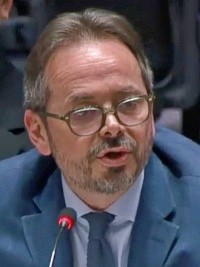
In a video address to the international community on April 23, 2026, UN Secretary-General Special Representative Ruiz Massieu outlined the stark dual reality currently defining Haiti: a rare moment of tangible institutional progress paired with an ongoing, devastating security emergency that continues to uproot millions of lives.
Massieu framed the current moment as a striking Haitian paradox: while the country’s state institutions are slowly rebuilding their administrative function after years of collapse, large swathes of national territory remain deeply scarred by pervasive gang-related violence. He gave credit to the administration led by Prime Minister Alix Didier Fils-Aimé for successfully maintaining basic state continuity through a period of extreme instability. A key step forward highlighted by the envoy is the National Pact for Stability, signed by a broad cross-section of Haitian civil society, which signals a widespread commitment to forging a homegrown, Haitian-led solution to the years-long national crisis.
The most significant milestone on the political path to normalcy, Massieu noted, is the successful completion of national political party registration — a process that has not been fully carried out since 2016. This foundational achievement paves the way for what the international community universally recognizes as the only legitimate end to the crisis: the holding of free, credible national elections that will restore full constitutional order to Haiti. Beyond this regulatory progress, the resumption of weekly Cabinet meetings inside Haiti’s National Palace, a practice that had been suspended for three years due to instability, marks a symbolic and practical step toward the state reclaiming control of central public spaces in the heart of Port-au-Prince.
Coordination between Haitian national authorities and international support partners has also reached an unprecedented level of alignment, according to the UN envoy. The recent appointment of all key leadership positions at the United Nations Office for Security and Justice in Haiti, paired with strengthened operational coordination with Haiti’s national Gang Repression Force (FRG), has created a more unified front against armed groups.
Even with these notable political gains, Massieu stressed that the overall security landscape remains deeply alarming. Recent targeted massacres in the Jean-Denis region and ongoing coordinated attacks across Haiti’s Southeast department prove that armed gangs retain both the capability and mobility to wreak widespread harm on civilian populations. As of the latest UN projections, the ongoing violence has displaced more than 1.45 million Haitians, who now live in overcrowded displacement camps or rely on host families for shelter. By the end of 2026, UN humanitarian estimates project that 6.4 million Haitians — more than half the country’s population — will require life-saving humanitarian assistance.
To build lasting, sustainable peace in Haiti, Massieu argued that the international response cannot focus solely on security crackdowns. Reviving the country’s National Commission for Disarmament, Demobilization, and Reintegration is a critical priority, he said, as it creates a safe, viable path out of armed groups for young people who were forcibly recruited by gangs. Complementing this effort, the planned creation of specialized judicial units focused on prosecuting mass atrocities and transnational financial crime is designed to finally break the cycle of impunity that has enabled systemic violence in Haiti for decades.
Massieu emphasized that Haiti currently stands at a critical window of opportunity that cannot be wasted. Drawing on a traditional Haitian proverb that notes shared burdens are lighter to carry, he called for sustained, unified international support to help Haitian institutions carry forward the progress they have made. The year 2026, he urged, must become the turning point where hard-won political progress finally translates to tangible, everyday security and improved living conditions for all Haitian citizens.