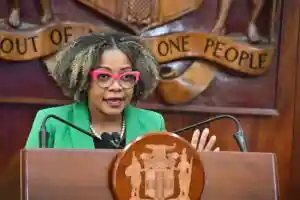
KINGSTON, Jamaica — In the wake of a string of high-profile violent incidents involving Jamaican secondary school students that have sparked widespread public outcry and social media debate, Education Minister Senator Dr Dana Morris Dixon is pushing back against a pervasive cultural stereotype that has dominated public conversation: the assumption that students caught engaging in dangerous, sometimes criminal misconduct are overwhelmingly products of broken or socioeconomically disadvantaged households.
Speaking Wednesday at the regular weekly post-Cabinet press briefing held at Jamaica House, Morris Dixon directly challenged this widespread narrative, noting that many of the young people involved in the recent incidents that have dominated headlines actually come from stable, privileged family backgrounds.
The minister’s comments come amid a sharp spike in public concern over youth violence in Jamaican schools and communities, following three separate serious incidents that have underscored the scale of the growing crisis. Most recently, a male student from Seaforth High was stabbed to death in Morant Bay this week, after a schoolyard dispute spilled off campus and escalated into fatal violence. Three suspects have been taken into custody in connection with the killing.
Earlier in March, a 17-year-old student at Ocho Rios High School was charged with the murder of 16-year-old classmate Devonie Shearer. According to official police reports from the St Ann’s Bay division, the attack unfolded around 3 p.m. on March 4, when the accused used a metal chair to strike Shearer in the head. The injured teenager was rushed to a local hospital for emergency treatment, but succumbed to his wounds while receiving care. Witness testimony directly implicated the 17-year-old suspect, who turned himself in to authorities later that same day and was formally charged the following morning in the presence of a parent.
Most recently, a graphic viral video circulated across social media platforms showing multiple students from Jamaica College, an elite all-boys institution in Kingston, brutally assaulting a fellow student they accused of stealing personal items from peers. Video footage shows the victim pinned by his collar while one attacker repeatedly punches him in the face, and another strikes him multiple times with a leather belt. All students involved in the incident are currently awaiting disciplinary action before the school’s disciplinary committee, and the school’s board has confirmed that the victim in the video admitted to taking items from other students prior to the attack.
Against this backdrop of escalating violence, Morris Dixon emphasized that the Ministry of Education is prioritizing ongoing efforts to address the root causes of youth misconduct. She noted that schools across the island already invest significant resources into guidance counselling and psychosocial support for students grappling with mental and social challenges.
Instead of blaming socioeconomic disadvantage, the minister argued that student violence is a reflection of broader cultural norms that permeate Jamaican society. “Our children are really products of the communities that they’re from, the homes that they’re from, and that we’re seeing in our schools a lot of the realities that we’re seeing in our communities,” she explained. “The schools are not distant from the communities within which they are delivering education services.”
Morris Dixon stressed that harmful conflict resolution patterns visible in schools are directly learned from broader community dynamics, where violence has become a normalized response to disagreement. “This is a problem that is happening across our country and we have to deal with it,” she said. “It is a general problem where we have accepted violence as the way to deal with conflicts.”
Moving forward, the minister confirmed the ministry will be increasing its focus on the psychosocial underpinnings of youth violence, expanding support systems in schools to help students develop non-violent conflict resolution skills and address underlying mental health challenges that contribute to aggressive behavior.