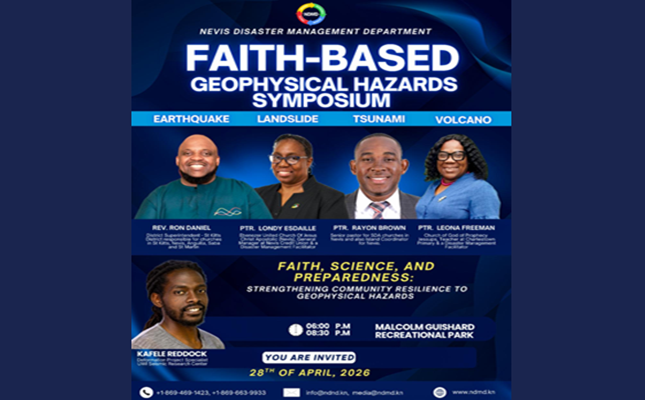
As Caribbean communities continue to prioritize climate and disaster risk reduction, the Nevis Disaster Management Department (NDMD) is set to wrap up the first phase of its groundbreaking Multi-Hazard Awareness Calendar with a landmark Faith-Based Geophysical Hazards Symposium on April 28, 2026.
The two-and-a-half-hour event will be held from 6:00 p.m. to 8:35 p.m. at Nevis’ Malcolm Guishard Recreational Park, bringing together a cross-sector group of stakeholders to advance a collaborative approach to disaster preparedness. Under the official theme “Faith, Science, and Preparedness: Strengthening Community Resilience to Geophysical Hazards”, the symposium caps four months of targeted community outreach that integrated faith institutions and local schools into NDMD’s national hazard education strategy.
Between January and April 2026, NDMD rolled out a month-by-month hazard awareness campaign focused on the four primary geophysical risks facing Nevis: earthquakes, landslides, tsunamis, and volcanic activity. Each month, the department partnered with a local primary school and a regional faith organization to deliver tailored, community-accessible education. January’s earthquake awareness programming was delivered in partnership with Charlestown Primary School and the Wesleyan Holiness Church, while February’s landslide-focused activities were hosted by St. James Primary School and Ebenezer United Church of Jesus Christ Apostolic. March’s tsunami awareness initiative paired St. Thomas’/Lowlands Primary School with the Seventh-day Adventist Church, and April’s volcano outreach was led by Joycelyn Liburd Primary School alongside the Church of God of Prophecy.
This model was built on the core recognition that schools and faith-based organizations are uniquely positioned as trusted community hubs that can drive sustained education, shape preparedness behaviors, and connect with residents far more effectively than top-down government outreach alone. Unlike traditional disaster awareness campaigns that often end with public awareness events, the NDMD’s strategy is designed to embed disaster preparedness into existing community institutions, creating long-term resilience rather than short-term awareness.
The upcoming April 28 symposium will serve as a convening space for reflection, consolidation, and scaling of this collaborative model. Attendees will include local faith leaders, primary school educators, national disaster management officials, international development partners, and regional scientific experts. The agenda is designed to both deepen public understanding of Nevis’ geophysical hazard profile and equip community stakeholders with actionable preparedness tools.
A central goal of the event is to formalize the role of faith-based organizations as core partners in national disaster communication and community resilience efforts. These organizations are integrated into existing NDMD infrastructure, including the network of District Disaster Chairs and Disaster Communications Ambassadors (DCA), which are designed to strengthen “last-mile” communication — ensuring that preparedness messaging reaches even remote, hard-to-access communities — and coordinate local emergency responses when hazards occur.
The symposium’s varied program will highlight the intersection of faith, science, and public policy. Attendees will hear faith-led presentations that connect scriptural teachings to hazard awareness and proactive preparedness, alongside NDMD-led sessions covering national disaster communication systems and local community preparedness planning. Organizers will also formally introduce the newly expanded community-level disaster leadership structure that embeds faith and education partners into disaster planning. A featured segment will highlight ongoing resilience-building collaboration between NDMD and international development organization Mercy Corps, and the UWI Seismic Research Center will deliver a technical update on regional geophysical monitoring efforts. The event will close with an interactive public question-and-answer session to address local residents’ specific concerns.
In its official press release announcing the symposium, NDMD emphasized that the event is far more than a one-off public education activity. Instead, it represents a deliberate, long-term step toward institutionalizing a community-centered approach to disaster communication that leverages the strengths of faith leadership, scientific expertise, and government governance to build a safer, more disaster-resilient Nevis for all residents.