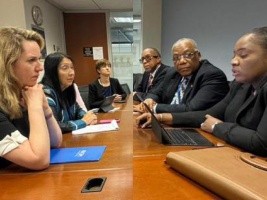
On April 21, 2026, high-level diplomatic discussions took place in Washington D.C. between Haiti’s top planning official and leadership from the International Organization for Migration (IOM), centered on addressing Haiti’s deepening migration challenges and aligning international support with the country’s national development priorities.
Sandra Paulemon, Haiti’s Minister of Planning and External Cooperation, convened the meeting with an IOM delegation headed by Director General Amy E. Pope. The delegation also included Michele Sison, director of IOM’s Washington-based global office, and Laura D’Elsa, Senior Advisor on Multilateral Partnerships.
Haiti is currently grappling with a cascading set of interconnected crises that have reshaped its migration landscape: rising rates of internal displacement driven by instability, mounting pressure from large-scale forced returns of Haitian migrants from other countries, and growing strain on local communities that host displaced populations. Opening the talks, Paulemon publicly commended IOM for its unwavering commitment to supporting Haiti through these turbulent times, and laid out the Haitian government’s vision for future collaboration.
Paulemon emphasized that any joint work between Haiti and IOM must center the Haitian government’s stated national priorities, particularly those outlined in the country’s National Pact for Stability and the Organization of Elections. She called for far better coordination of international interventions across the country, stressing that all programming must align with the pact’s core economic and social recovery objectives.
Three core practical priorities anchored the discussions: expanding protection and support for internally displaced Haitians, strengthening reception services and assistance for returning migrants especially along border regions, and upgrading Haiti’s national migration management infrastructure.
A key gap Paulemon highlighted during the meeting is the persistent geographic imbalance in existing international aid: the vast majority of current interventions are concentrated in Haiti’s capital, Port-au-Prince, leaving the country’s strategically critical border regions vastly under-served. She underscored that these border territories play an irreplaceable role in Haiti’s long-term economic and political stability, making increased investment there non-negotiable.
Beyond addressing immediate migration challenges, Paulemon outlined a new development-focused vision that leverages the country’s diaspora to revitalize border economies. She noted that border zones are uniquely positioned as strategic hubs for cross-border investment, trade, and local value creation, and that deeper integration between the Haitian diaspora and these regional economies could unlock significant growth. To turn this vision into action, she proposed launching targeted pilot projects to support diaspora-led small and medium-sized enterprises, revitalize underperforming cross-border markets, and build out robust local value chains in key sectors including agriculture, trade, and logistics.
For these initiatives to deliver long-term impact, Paulemon stressed that they must be embedded into existing national development pipelines, aligned with the Ministry of Planning’s existing monitoring and implementation frameworks, and backed by coordinated funding and support from the broader international community to ensure coherence and the ability to scale successful projects.
The talks also covered opportunities for enhanced trilateral cooperation between Haiti, IOM, and the neighboring Dominican Republic. Key areas of potential collaboration include joint management of migrant returns, improved protection for vulnerable migrants on both sides of the border, and more streamlined coordination at official border crossings. Paulemon noted that stronger cross-border collaboration in these areas would boost the effectiveness of humanitarian response across the island and improve overall migration governance for both nations.
Closing the meeting, Paulemon reaffirmed the Haitian government’s unwavering commitment to deepening its longstanding partnership with IOM, built on a foundation of mutual trust and shared responsibility for addressing Haiti’s most pressing challenges.