BEIRUT, LEBANON – Just three days into a fragile 10-day truce that halted weeks of intense cross-border conflict between Israeli forces and Iran-aligned Hezbollah, Israel has confirmed it has ordered its military to operate with full force against perceived imminent threats in southern Lebanon, and continues carrying out house demolitions in border communities that Israel claims were used as militant outposts by Hezbollah. The unilateral operations have thrown the already uncertain durability of the ceasefire into question, leaving displaced Lebanese residents divided over whether to return to their war-scarred hometowns or remain farther north.
The ceasefire, which came into force on Friday, marked the first major pause in fighting that erupted on March 2 between the two sides, a conflict that has claimed nearly 2,300 lives in Lebanon and forced more than one million people from their homes. Even before the truce took effect, it followed the first high-level direct talks between Lebanese and Israeli officials in decades, raising tentative hopes for a long-term de-escalation. Those hopes have been dampened, however, by Israel’s ongoing military activity along the border.
Israeli Defense Minister Israel Katz announced Sunday that he and Prime Minister Benjamin Netanyahu had issued formal orders for the Israel Defense Forces (IDF) to maintain full operational freedom on both the ground and in the air, even during the ceasefire period. “This order stands to protect our soldiers deployed along the Lebanon border from any emerging threat,” Katz said. The instructions also mandate the military to demolish any booby-trapped structures or roadways, and raze all residential homes in border contact villages that Israel says functioned exclusively as Hezbollah terror outposts.
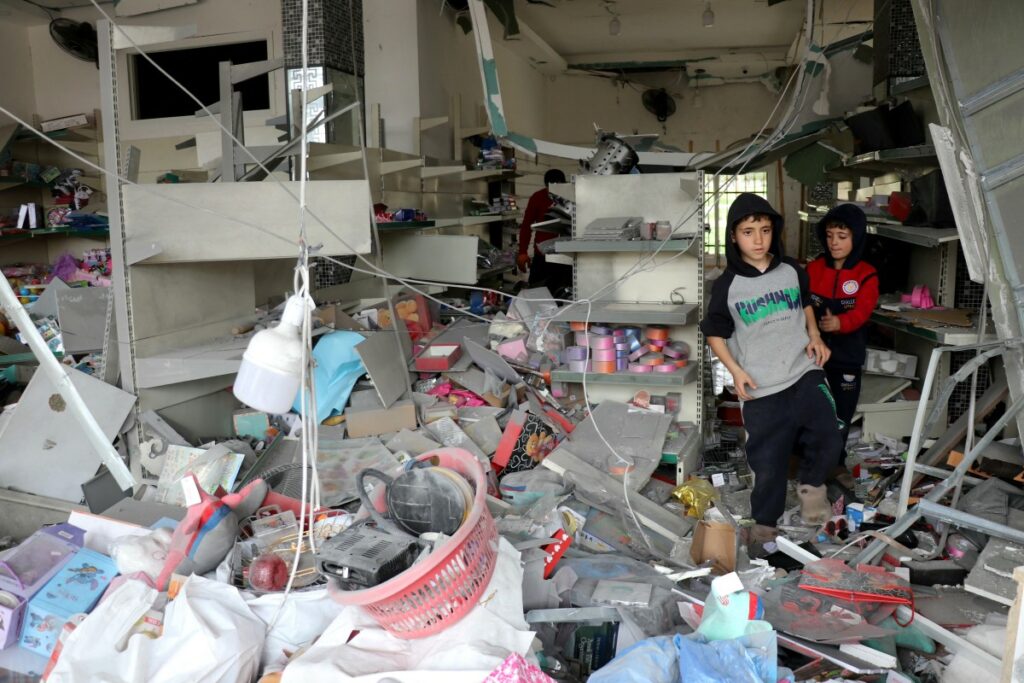
Lebanon’s state-run National News Agency (NNA) confirmed Sunday that demolition operations were already advancing across multiple southern border towns that saw heavy fighting prior to the ceasefire. In Bint Jbeil, a community located just three miles from the Israeli border that was the site of some of the worst clashes, the outlet reported that Israeli forces were continuing to destroy what remained of damaged and abandoned residential properties a full day after initial demolitions began. Demolitions and controlled detonations were also underway in the border towns of Mais al-Jabal and Deir Seryan, while the town of Kunin came under Israeli artillery shelling Sunday, according to NNA.
Over the weekend, the IDF announced it had established a so-called “Yellow Line” buffer zone in southern Lebanon, a security arrangement modeled on the same separation line Israel has enforced in the Gaza Strip between areas under its control and territory held by Hamas. On Sunday, the military released an official map marking its new forward defense line and a wide red zone stretching the entire length of the Israel-Lebanon border, where it says operations will continue to dismantle Hezbollah’s military infrastructure and eliminate threats to Israeli communities in northern Israel.
The continued Israeli military activity during the truce has drawn sharp condemnation from the international community. Turkish Foreign Minister Hakan Fidan denounced the operations Sunday as deliberate “Israeli expansionism,” accusing Israel of working to create a permanent “fait accompli” on the ground that alters the border status quo even before formal ceasefire negotiations can move forward.
The situation on the ground for displaced Lebanese residents remains deeply fragmented. On Sunday, AFP correspondents across southern Lebanon documented mixed movements: in the village of Srifa, some residents who had fled the fighting were seen moving their belongings – including mattresses and household appliances – back into their homes. In Dibbine, a resident inspected the severe damage his home sustained during weeks of combat, while other families retrieved only essential belongings from their properties before heading back north out of the conflict zone. Many residents remain openly skeptical that the 10-day truce will hold, choosing to wait for further diplomatic progress before committing to returning permanently.
Lebanese military officials announced incremental progress in restoring basic connectivity to the south over the weekend: a key road connecting the city of Nabatiyeh to the Khardali area has been reopened, and the Burj Rahal-Tyre bridge has been partially reopened for traffic. Israeli airstrikes targeted most bridges across the Litani River, which runs roughly 30 kilometers north of the Israeli border, cutting off most of southern Lebanon from the rest of the country for weeks prior to the truce.
Diplomatic efforts to solidify the ceasefire are set to advance this week, with French President Emmanuel Macron set to host Lebanese Prime Minister Nawaf Salam in Paris on Tuesday. The French presidency said the meeting is intended to reaffirm France’s full commitment to upholding the current truce and supporting Lebanon’s full territorial integrity. Macron will also press Lebanese authorities to hold accountable those responsible for a deadly attack on United Nations Interim Force in Lebanon (UNIFIL) peacekeepers on Saturday, which killed one French service member and injured three others. Both France and UNIFIL have blamed Hezbollah for the attack, a claim the militant group has formally denied.
Before heading to Paris, Salam will first travel to Luxembourg on Tuesday to meet with European Union foreign ministers to discuss the crisis, according to the prime minister’s office.