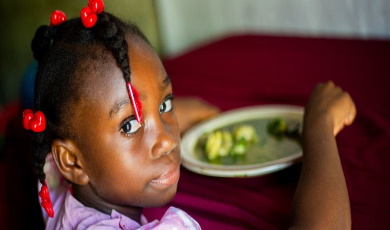
NEW YORK — As Haiti grapples with a decade-long collapse of social and economic stability, the United Nations World Food Programme (WFP) has issued a stark new alert: more than 5.8 million Haitians — nearly 52 percent of the entire national population — are now trapped in crisis-level food insecurity or even more catastrophic conditions.
Of this vulnerable group, over 1.8 million people have already fallen into emergency food insecurity, a classification that means they can no longer cover their most basic caloric needs and have exhausted nearly all of their limited savings, assets and coping strategies to survive.
Right now, WFP is stretched thin delivering life-sustaining support to roughly 2.7 million Haitians across the country. The organization’s programming includes emergency food distributions for displaced and acutely hungry populations, school meal programs to keep children in education, targeted social protection payments for the most vulnerable households, and capacity-building support to local small-scale farmers to boost domestic food production.
Despite these ongoing efforts, WFP’s leadership in Haiti is sounding the alarm that current progress is precarious at best. Wanja Kaaria, WFP’s Country Director for Haiti, warned that soaring global and domestic fuel prices, paired with skyrocketing staple food costs, could erase any small gains made in recent months in a matter of weeks. For families already teetering on the edge of collapse, these price spikes would push millions deeper into hunger and destitution.
The current emergency did not emerge overnight. WFP officials report that Haiti’s food security crisis has steadily deteriorated for almost 10 years, driven by a toxic combination of persistent armed gang violence, prolonged political instability, crippling economic recession, and repeated climate disasters including catastrophic hurricanes that destroy crops and infrastructure. More recently, escalating gang attacks have added a new layer of crisis, fueling widespread displacement that further disrupts food supply chains and pushes vulnerable communities from their homes.
Just in recent weeks, coordinated attacks in Haiti’s South-East department forced more than 1,300 people to flee their homes, marking the first large-scale displacement event recorded in that previously relatively stable region. Across the entire country, the total number of internally displaced Haitians now tops 1.4 million. Hundreds of thousands of these displaced people are living in overcrowded, unsanitary emergency shelters, most concentrated in the capital Port-au-Prince, where access to clean water, sanitation and food is already severely limited.
To prevent the crisis from expanding into a full-scale famine, WFP is calling for urgent international action and funding. The organization says it requires $332 million over the next 12 months to maintain its existing life-saving operations and expand support to reach the growing number of hungry Haitians. The broader UN-coordinated humanitarian response plan for Haiti, which totals $880 million to cover all emergency needs across the country, is currently less than 20 percent funded, leaving massive gaps in aid delivery.
In closing, WFP emphasized that addressing the hunger crisis is a foundational step toward restoring any semblance of long-term stability to Haiti. “Peace cannot take root when families go to bed every night not knowing where their next meal will come from,” the agency noted, stressing that investment in food security is as critical to peacebuilding as efforts to resolve political conflict and end gang violence.