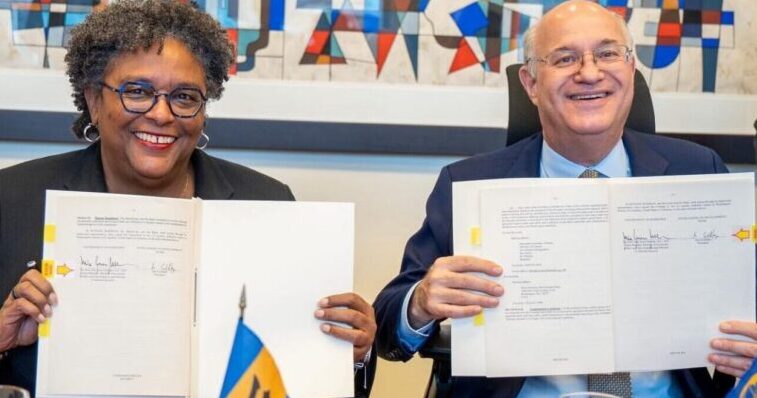
As one of the world’s 15 most water-scarce nations, Barbados is moving forward with a transformative, multi-year upgrade of its crumbling national water network, backed by an $80 million investment from the Inter-American Development Bank (IDB). The funding agreement was formally signed Thursday, during Prime Minister Mia Mottley’s attendance at the International Monetary Fund and World Bank’s annual spring meetings in Washington D.C.
This initial $80 million investment marks the first phase of a broader $200 million financing package the IDB approved in December 2025, designed to boost the resilience of Barbados’ potable water systems. An additional $4 million in grant funding is also earmarked for climate-focused components of the initiative, addressing growing climate-related pressures on the island’s water supplies.
For decades, Barbados has grappled with persistent failures across its water infrastructure: ageing pipelines, rampant unaccounted-for water loss, and inconsistent service that has disrupted daily life for households and hindered operations for local businesses. Prime Minister Mottley emphasized the urgent need for this investment during the signing ceremony, noting that between 40% and 50% of all treated water pumped across the island is lost before it reaches end users, due to leaky, outdated infrastructure.
“Water is at the centre of Barbados’ future economic development,” Mottley said, reframing the funding not as a loan, but as a critical investment in the country’s long-term resilience.
The five-year program centers on a sweeping upgrade of Barbados’ water distribution network. Of the initial $80 million allocation, $55 million is dedicated to replacing roughly 100 kilometers of ageing, deteriorating water mains. Government data reveals that less than 5% of the island’s existing mains have been replaced to date, leaving the vast majority of the network prone to breakdowns and massive efficiency losses. An additional $20 million will target non-revenue water — the portion of water lost before reaching consumers — through modern leak detection technology, upgraded bulk metering, real-time system monitoring, and network sectorization, all designed to channel more treated water to households and businesses.
Beyond physical infrastructure upgrades, the initiative also invests in strengthening the institutional and operational capacity of the Barbados Water Authority. A $2.5 million allocation supports institutional strengthening, including workforce training, updated planning tools, and enhanced monitoring systems aligned with the country’s long-term water management goals, specifically the national Water Resources Management Plan and Water and Sanitation Master Plan. Another $2.5 million is set aside for program execution, covering staffing, independent audits, ongoing monitoring and evaluation, and adherence to environmental and social safeguards.
IDB projections estimate that once the first phase is complete, the program will improve water service reliability and continuity for more than 150,000 residents, and support over 2,000 local businesses — including key players in the island’s critical tourism sector. On a national level, all Barbadians will benefit from improved long-term water management systems and enhanced preparedness for ongoing climate-related water challenges.
Mottley praised the IDB as a consistent, trusted partner to her administration, noting that the collaboration extends far beyond financing. “Since coming to government, the IDB has walked every step of this journey with us,” she said. “It is not just the financing. The technical assistance matters too, particularly at a time when the country must confront a very real skills deficit while still pushing ahead with urgency and purpose.”
The Mia Mottley administration has framed the project as a fundamental shift in Barbados’ approach to water infrastructure. Moving beyond decades of piecemeal, reactive fixes, the program targets the root causes of the island’s water crisis to build a more sustainable, resilient system for future generations.