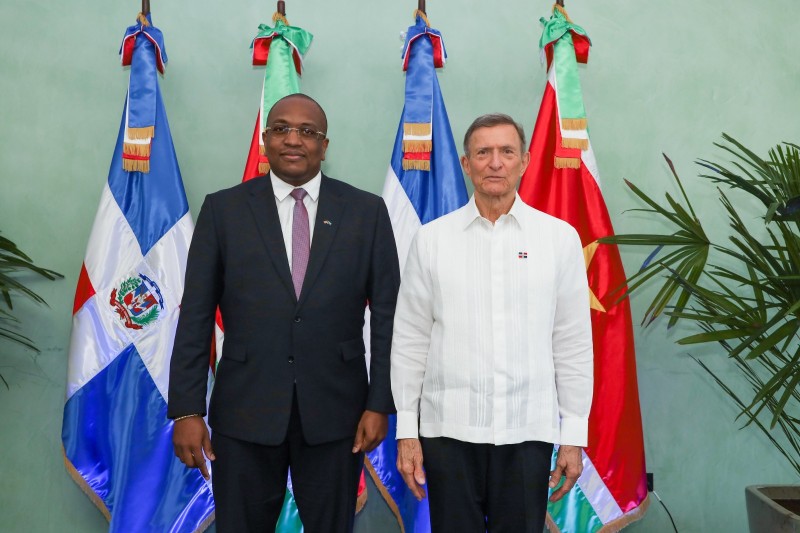
SAINT DOMINGO — During a high-stakes official gathering hosted in the Dominican Republic’s capital, foreign ministers Roberto Álvarez of the Dominican Republic and Melvin Bouva of Suriname have jointly raised urgent alarms over the rapidly deteriorating humanitarian and security crisis unfolding in neighboring Haiti, labeling the Caribbean nation’s spiraling insecurity a critical threat to entire regional stability.
The two top diplomats made their remarks following closed-door bilateral talks, where the dire situation in Haiti took center stage on the meeting’s agenda. Currently, Haitian armed gangs hold de facto control over roughly 90 percent of Port-au-Prince’s metropolitan area, with their territorial influence continuing to spread outward into additional regions of the already fragile country. This sprawling gang dominance has dragged Haiti into one of the deepest periods of instability in its recent history, leaving basic governance and public safety all but collapsed in large swathes of the nation.
Against this bleak backdrop, Álvarez and Bouva issued a joint appeal to the global community, calling for scaled-up, coordinated action to deliver a comprehensive, long-lasting resolution to Haiti’s crisis. They underlined two non-negotiable pillars of any effective intervention: upholding fundamental human rights for all Haitian people, and directly confronting the violent criminal networks that have usurped state authority across most of the country. The ministers emphasized that delayed or fragmented action will only exacerbate the crisis, with spillover effects that risk destabilizing neighboring countries and the wider Caribbean region.
Beyond the discussion of Haiti’s emergency, the meeting also marked a milestone in bilateral relations between the Dominican Republic and Suriname. The two countries signed a formal joint declaration that reaffirms their longstanding close ties, and codifies their shared commitment to core democratic values, the rule of law, and universal human rights.
In addition to the declaration, the two sides reached a series of agreements to deepen collaboration across multiple priority sectors. These include tourism expansion, educational exchanges, cross-border trade, foreign direct investment, energy development, and collective climate action. The cooperation framework is designed to advance shared goals of sustainable development, strengthen national food security, generate new formal employment opportunities, and create a more favorable environment for private sector growth in both nations.