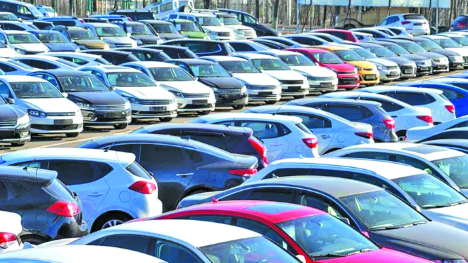
Against the backdrop of a growing national push for self-employment and alternative income streams, the Caribbean island nation of Barbados is now devoting more of its limited foreign exchange reserves to importing passenger cars than to critical pharmaceuticals and commercial shipping, new data and senior officials have confirmed. As of 2024, imported motor vehicles rank as the third-largest category of goods entering the country by total import spending, according to data from the Observatory of Economic Complexity (OEC), a leading international platform that compiles and visualizes global trade and economic activity data for analysts across public, private and academic spheres.
OEC figures show that Barbados spent $111 million on car imports in 2024. Only two categories – refined petroleum at $520 million and crude petroleum at $234 million – exceeded that total. By contrast, the nation spent just $42.9 million on imported packaged medications and $42.5 million on passenger and cargo ships, marking car import spending as nearly 2.6 times higher than spending on either of those two critical categories. Total national imports for 2024 reached $2.58 billion, while overall export revenue for the year amounted to just $443 million, highlighting the country’s ongoing trade imbalance that puts additional pressure on foreign exchange reserves.
Treca McCarthy-Broomes, chief licensing officer for Barbados, shared exclusive new insight with Barbados TODAY on the underrecognized driver of this trend: the booming culture of entrepreneurship and side-hustling that has swept the country in recent years. As of the latest count, the total number of registered vehicles on Barbados’ roads has surpassed 181,500, a figure that has grown steadily alongside the push for alternative income generation. Many Barbadians are turning to second jobs and small business ownership to cover rising living costs, from supporting children and aging parents to paying monthly bills, and that demand for extra income has directly translated to more vehicle purchases.
“Persons are seeking side-hustles…other forms of revenue, and they are seeking to get permits, or they open up small businesses and they are buying vehicles to use as hirers or taxis or commercial vehicles. You will find that a lot of that is occurring,” McCarthy-Broomes explained in the interview. “The push for entrepreneurship, you are really seeing the results of the push for entrepreneurship.”
She added that multiple new patterns of vehicle ownership have emerged tied to this economic shift, including groups of family members or siblings pooling resources to purchase a single commercial vehicle together, which they then register for commercial hire to generate shared income. Even as new vehicle purchases for commercial use rise, many vehicles bought for this purpose remain unsold at dealerships and stored on private lots, pastures, and under roadside trees, a visible marker of the gap between growing demand for commercial vehicle permits and market absorption. McCarthy-Broomes noted that while entrepreneurship is not the only factor driving vehicle growth, it is a far more significant contributor than previously acknowledged.
This surge in registered vehicles has exacerbated a long-running traffic management crisis that the Barbadian government is still working to address. Officials have proposed constructing new highway flyovers as one core infrastructure solution, and the government has already held a series of national public consultations dubbed “The Way Forward” to gather community input on solving gridlock. Ideas collected from the public span a wide range of policy areas, from improved infrastructure and updated urban planning to reformed school transportation systems, investment in alternative transit modes, expanded public transport services, targeted measures to reduce overall vehicle volume on roads, strengthened safety enforcement, and upgraded road quality standards.
In addition to tackling congestion, the Barbados Licensing Authority has partnered with the Barbados Police Service and local insurance industry to crack down on the parallel problem of uninsured vehicles operating on public roads, a growing issue that has accompanied the rise in overall vehicle numbers.