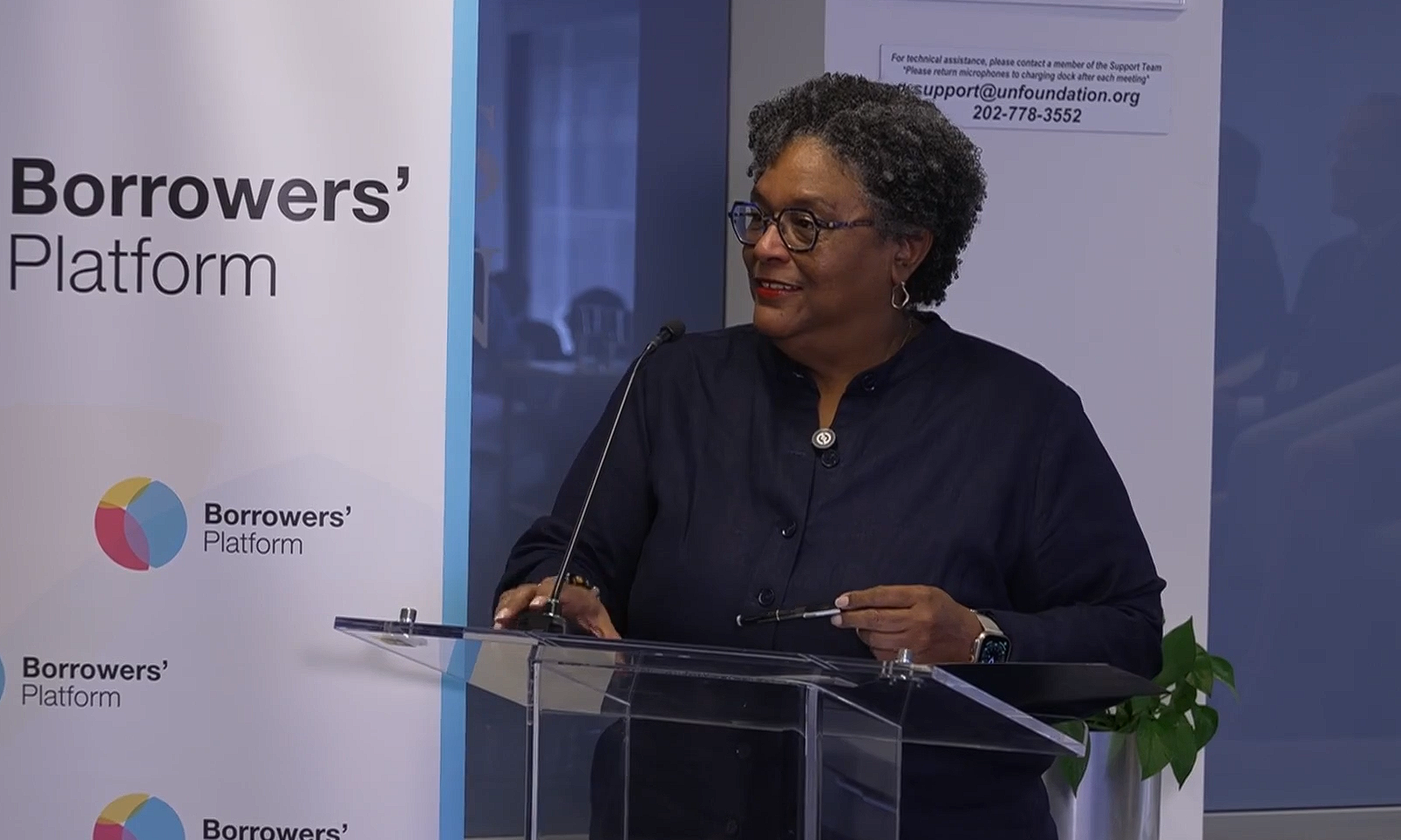
As developing nations rally to challenge a long-unbalanced global financial order they argue is systematically stacked against low-income and vulnerable economies, Barbados has formally thrown its name forward to host the secretariat of the landmark new Borrowers’ Platform. Prime Minister Mia Mottley made the announcement Wednesday during the annual Spring Meetings of the World Bank and International Monetary Fund in Washington D.C., where the initiative was officially launched on the conference’s sidelines.
First agreed by member states at the 2025 Fourth International Conference on Financing for Development, the Borrowers’ Platform was designed to tackle deep-rooted systemic inequities by strengthening coordination, amplifying collective representation, and delivering targeted technical support for borrowing countries across the Global South. The launch comes at a moment of soaring debt vulnerability across developing economies, with the initiative focused on advancing more responsible debt sustainability practices and pushing for fairer financing outcomes that serve the needs of low-income nations rather than wealthy global stakeholders.
In her announcement, Mottley emphasized that Barbados’ lived experience with the harms of the existing global financial system makes it the ideal host for the platform’s administrative core. “We make formal our interest as Barbados to host the Secretariat of the Borrowers’ Platform because we have walked it, we have lived it, we are breathing it and we are prepared to continue to advocate for the change in rules and circumstances such that countries can find their way as independent sovereign nations to be able to finance development for their people,” she stated.
Mottley framed the new platform as a make-or-break step toward correcting systemic failures that disproportionately disadvantage small and economically vulnerable states. She argued that the current global architecture is structured to favor powerful, wealthy nations, leaving low-income countries locked in a cycle of growing inequality: “We have ended up in this position largely because we have a system that does not favour the weak, nor the different. Without reform, global inequalities will continue to widen. The rich are getting richer and the poor are getting poorer.”
She also pushed back against the dominant global approach to sovereign borrowing, noting that countries facing debt distress are too often penalized rather than supported through structural challenges. “Countries need assistance. They are not begging. They need space. They need assistance,” she said, calling for a far more balanced, human-centered approach to international debt management.
The platform is designed to deliver tangible benefits to participating nations: it will deepen South-South cooperation, boost global debt transparency, provide customized technical and advisory support to developing economies, and raise the collective voice of borrowing countries in high-stakes global financial governance discussions. Mottley stressed that the initiative must expand rapidly beyond its founding 28 member states and be backed by strong, principled leadership to deliver meaningful change. “I do believe that the chief executive officer ought to be appointed as soon as possible if we are going to see further progress,” she said, adding that the ideal leader would combine “credibility but conscience.”
Warned that the confluence of overlapping global crises leaves no time for incremental action, Mottley noted “We are running against the clock.” The cumulative shocks of the COVID-19 pandemic, the ongoing war in Ukraine, and escalating geopolitical tensions have already pushed many vulnerable economies to the brink of debt collapse, she explained. For Mottley and the participating developing nations, the platform represents more than a coordination body: it is an opportunity for Global South countries to take ownership of their own financial futures. “We have come not to ask for permission. We have come to execute in the interests of the people whom we have been elected to serve,” she said.