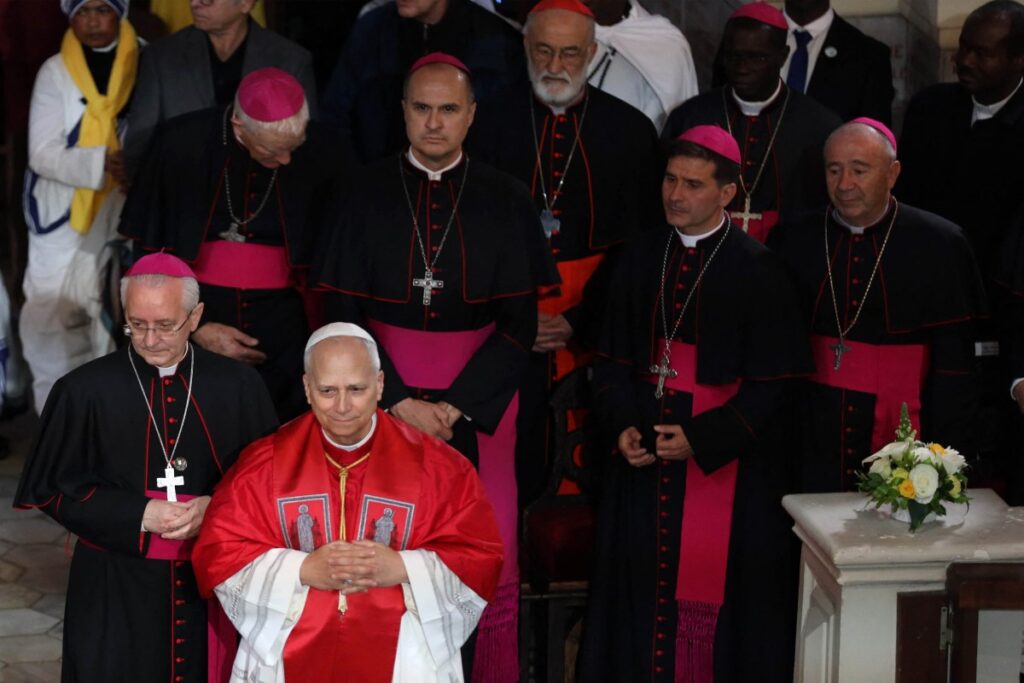
On Monday, as Pope Leo XIV traveled to Algiers for the first stop of a multi-nation African apostolic tour, a public dispute erupted between the pontiff and former U.S. President Donald Trump over the ongoing Middle East conflict, overshadowing the spiritual and diplomatic aims of the trip.
Before the papal plane departed Rome, Trump launched a series of sharp criticisms against Pope Leo, who had publicly called for an immediate end to the war ignited by the joint Israel-U.S. military strike on Iran in late February. The U.S. leader doubled down on his attacks hours later, insisting he had nothing to apologize for, and claimed the pontiff’s stance on Iran was factually wrong. “He was very much against what I’m doing with regard to Iran, and you cannot have a nuclear Iran,” Trump stated, adding that he is “not a big fan of Pope Leo” and accusing the pontiff of recklessly engaging with the Iranian government.
Speaking to reporters aboard his aircraft en route to Algiers, Pope Leo pushed back against the criticism, rejecting any desire for political confrontation with the Trump administration. “I have no intention to debate with Trump, I am not a politician,” the pontiff clarified. He emphasized that his calls for peace flow directly from the core mission of the Catholic Church: “The Gospel says… blessed are the peacemakers. I believe that the Church has a moral duty to speak out very clearly against war and in favour of peace and reconciliation.” Pope Leo added pointedly that he does not fear condemnation from the Trump administration, and will not shy away from proclaiming the Gospel’s message of peace.
Italian Prime Minister Giorgia Meloni quickly stepped in to condemn Trump’s attacks, describing them as “unacceptable.” “It is right and normal for [Leo] to call for peace and to condemn all forms of war,” she stated.
Beyond the transatlantic dispute, Pope Leo’s two-day visit to Algeria carries deep personal spiritual meaning for the pontiff. Algeria is the birthplace of Saint Augustine of Hippo, the 4th and 5th-century Christian theologian whose writings have shaped Catholic thought for millennia, and whose spiritual order the pope himself belongs to. In his very first address after being elected pope in May 2025, Leo identified himself as a “son” of Augustine, and frequently references the theologian’s work in his teachings.
In his opening address at the Algerian Martyrs Memorial in Algiers on Monday, the pontiff paid tribute to the thousands of Algerians killed during the country’s 1954-1962 war of independence from France, and used the occasion to call for cross-national forgiveness and reconciliation. The remarks come at a time of rising diplomatic tensions between Algiers and Paris, and follow a recent private meeting between Pope Leo and French President Emmanuel Macron at the Vatican. “In this place, let us remember that God desires peace for every nation,” the pontiff said.
The ongoing dispute with the Trump administration is not new: Pope Leo has previously criticized Trump’s threats against Iranian civilians as unacceptable, and decried the U.S. administration’s “inhuman” treatment of migrants crossing the southern U.S. border. Trump has responded in kind, calling Pope Leo “WEAK on Crime, and terrible for Foreign Policy”, and has claimed that cardinals elected Leo solely because of his American citizenship. In a recent controversial social media post, Trump shared an AI-generated image that depicted him as Jesus Christ, before deleting the post amid widespread backlash. Iranian President Masoud Pezeshkian condemned the post as an “insult” and “desecration of Jesus” on the social media platform X.
During his flight to Algiers, Pope Leo reiterated that his work is fundamentally different from secular political statecraft. “We’re not politicians, we’re not looking to make foreign policy as he calls it with the same perspective that he might understand it,” the pontiff said.
On Monday, the pontiff also toured two of Algiers’ most iconic religious sites: the Great Mosque of Algiers, which boasts the world’s tallest minaret, and the Basilica of Our Lady of Africa, which overlooks the Bay of Algiers, a landmark that reflects the country’s long history of coexistence between Muslim and Christian communities. On Tuesday, Pope Leo will travel to Annaba, the modern city built on the site of the ancient Roman city of Hippo where Saint Augustine lived and worked for most of his career. He plans to hold a private prayer service at a chapel honoring 19 priests and nuns murdered during Algeria’s brutal 1992-2002 civil conflict, but will not visit the Tibhirine monastery where seven monks were kidnapped and killed in 1996, a killing that remains unresolved decades later.
Pope Leo’s 10-day African tour will also include stops in Cameroon, Angola and Equatorial Guinea, covering more than 18,000 kilometers between April 13 and 23. While in Algeria, three international human rights organizations have publicly called on the pontiff to address the ongoing repression of religious minority communities in the country. While Algeria’s constitution formally guarantees freedom of worship for all faiths under regulated conditions, human rights groups have documented consistent patterns of harassment and discrimination against minority religious groups in recent years.