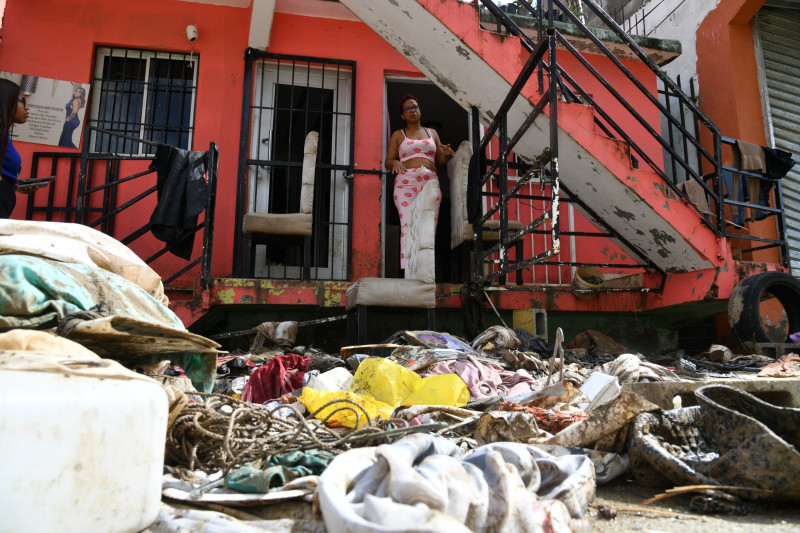
On the early morning of April 7, after hours of intense sustained rainfall, catastrophic flash flooding swept through neighborhoods across the National District and West Santo Domingo, leaving thousands of residents displaced, their homes and livelihoods destroyed in a matter of hours.
For many families, the disaster unfolded in the dead of night, forcing them to flee their rising properties with only their children clutched in their arms and no prearranged safe shelter to turn to. Many still struggle to process the sudden loss of everything they spent years building.
In the La Yuca neighborhood’s Las 800 zone, named for the local ravine that breached its banks, dozens of households lost nearly all their possessions. Electrical appliances including refrigerators, televisions and radios were completely ruined, while beds, sofas, dining sets, stored food and entire wardrobes were left waterlogged and caked in thick mud. Even days after the floodwaters receded, affected residents recount the experience with raw anguish, recalling crying frightened children and the total disorientation of having no emergency plan in place.
As residents work to clear meters of mud and standing water from their homes and wash the few belongings they managed to salvage, many have described overwhelming feelings of helplessness over the limited official support they have received. For days after the flood, the only government intervention was municipal street cleaning, with a single truck of prepared meals arriving later for distributed pickup. Local community groups and educational institutions have stepped in to fill the gap in aid.
The Republic of Costa Rica School, which is supporting 112 displaced families from the area, has launched a donation drive targeting state agencies and local residents. Already, community members have donated clothing and shoes for school-aged children from affected households. School principal Regina Rodríguez explained that the campus has been converted into an official donation collection center. “Once we have gathered most of the donations, families will be able to come to our school auditorium to pick up canned goods, shoes, sheets and other essential supplies that they need right now,” she said.
During an on-site visit to affected zones, observers documented dozens of submerged vehicles abandoned along flooded streets, alongside municipal crews from the National District City Council and technicians from the Santo Domingo Water and Sewer Corporation (CAASD) working to clear mud that was blocking pedestrian access to local thoroughfares.
Many local residents linked the extreme flooding to poorly planned drainage infrastructure work in the area. “I have lived here for more than 30 years, and my home has never flooded anywhere near this bad,” said Mary, a local resident whose entire home inventory was damaged by the floodwaters. “This all happened after they started construction on the local drainage ditch.” Community representatives have formally requested that the mayor’s office provide replacement mattresses for the hundreds of residents who lost theirs in the flood.
In the Las Plantitas area of the Los Girasoles Segundo neighborhood, piles of waterlogged personal belongings stacked outside front gates and mud-caked clothing dragged out to air are the new normal for residents after the nearby ravine overflowed. Affected families report that while a single supply truck carrying beds and food did arrive, only a small number of households received assistance, leaving those living closest to the ravine with no support at all. Residents have also issued urgent calls for water trucks, noting that running water has been cut off in the area for 15 days, leaving them unable to even wash mud out of their flood-soaked clothing.
“I’m hanging everything out to dry unwashed because there’s not a drop of water to be had, and no one is bringing us any,” explained Ana Ramona Sánchez, a Los Girasoles Segundo resident whose entire home was flooded overnight. “Last night, I stayed trapped on my bed behind a locked door holding back floodwater until the waters receded at dawn.”
At the local Colegio Profesora Margarita Báez, the flood damaged critical student academic records, with many that could be recovered laid out in school yards to dry out. The school lost all of its computers, speakers and other electronic equipment. Principal Alejandrina Severino also linked the disaster to unregulated construction. “Water flooded the main office and all downstairs classrooms because construction is being done directly in the ravine, and loose construction debris trapped floating trash, which blocked the water from draining,” she said.
In the Hato Nuevo and San Miguel neighborhoods of Manoguayabo, flooded streets left residents with total loss of household belongings. Many long-term residents described this rainfall as the most severe they have ever witnessed, noting that even in past storm events, flooding was never severe enough to force families to flee into the night with small children. “We kept moving from house to house trying to stay dry, until every one filled up with water,” recounted Elaina Martínez, who fled with three young children including a newborn. “The Emergency Operations Center (COE) sent a boat to evacuate us to the main avenue, where we could go stay with relatives. It was absolutely horrifying.”
Today, beds, furniture and waterlogged clothing line the curbs outside Manoguayabo homes, discarded after being destroyed by mud and floodwater. Many residents are openly grieving as they clean up the few possessions they can salvage.
In Los Alcarrizos, the heavy rains caused the Lebrón Creek to burst its banks, triggering catastrophic flooding that swept several people away in fast-moving currents. Local community members managed to pull the trapped residents to safety before emergency crews arrived. “It was an absolute disaster,” recalled Carolina Rojas, who was injured when a nail pierced her foot as she fled. “Around 2 a.m., the creek rose in seconds, flooding every house in the area. Two elderly people were swept away by the current, and we managed to pull them out with a rope. They’re still in the hospital now. Nothing like this has ever happened here before, but these rains destroyed everything, and you just saw people running, clutching their children to get out.”
In the wake of the disaster, displaced families have been staying with neighbors and extended relatives out of fear of further flooding, only beginning to return to their properties after the COE removed the province of Santo Domingo from its official flood alert list.