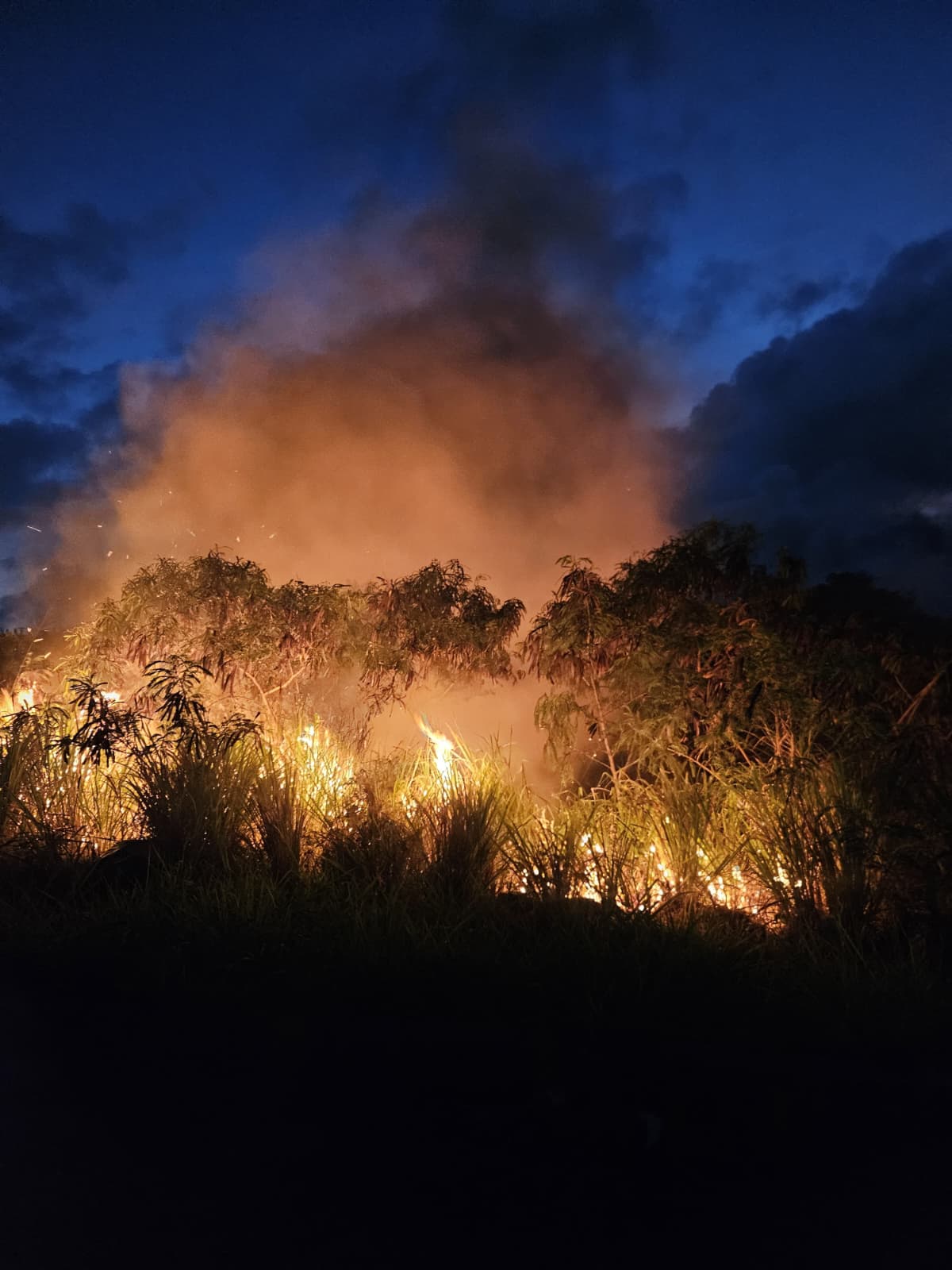
Each dry season, residents of St George and St John parishes brace for smoke, ash, and disruption. This year, however, a relentless wave of blazes that blanketed both communities in toxic haze this week has pushed frustrated locals to speak out, demanding officials finally address the root causes of the annual crisis instead of only responding to emergencies after they break out.
At the center of the problem lies vast stretches of abandoned and under-managed agricultural land across the island’s rural agricultural heartland. For decades, dozens of fallow plantations once used for sugar cane and vegetable cultivation – including the Pool, Henley, Wakefield and Todds properties, formerly owned by the defunct insurance conglomerate CLICO – have been overrun by invasive, fast-growing species: cow itch vine and river tamarind. These dense, dry plants act as perfect fuel for seasonal brush fires, creating massive blaze zones that spread quickly and generate thick, acrid smoke that drifts into residential and commercial areas.
For long-time St George resident Brad Harper, the severity of this year’s fires hit him unexpectedly while driving through Middleton. What he first assumed was a mechanical fault in his car’s air conditioning system quickly revealed itself to be dangerous air pollution. “The smoke was very irritating to the sinus,” he recalled. “I was driving with the AC on, and at first I thought something was wrong with the vehicle, so I checked all the instruments and everything looked fine. It wasn’t until I rolled down the window that I realized just how hazy the outside air had become.” That evening, a return trip to the area with a friend confirmed his worst fears: conditions had grown even worse, with smoke thick enough to cause persistent respiratory irritation. Having lived in the region for most of his life, Harper said he has never seen smoke levels this high, even as local fire chiefs have already acknowledged a steady increase in the frequency and scale of these fires in recent years.
The blazes are far more than a minor inconvenience: they pose a direct, daily threat to vulnerable community members. Susan, an asthmatic woman in St George, described this week’s smoke as suffocating, with a strange oily quality that triggered persistent coughing fits. “It wasn’t pleasant because the ashes and the smoke from the ashes had me coughing a lot, and I’m asthmatic too,” she explained. “It feels like burning tires, that thick black smoke. Then after it fades, everything gets covered in a white coating of ash. It’s not good at all.”
Local small businesses have also suffered direct financial losses. Taylor, who owns a mini-mart in St Judes, St George, was forced to close her shop early and throw away contaminated stock after soot and ash blew into her store, covering fresh produce and other goods. “It was really bad,” she said. “It even got on the vegetables. We had to pack up early because the ashes and dust were blowing right past the place. It’s terrible for people with sinus issues. They’ve got to get rid of the cow itch – it’s affecting all of us, even small children. I just hope they find a way to stop these huge smoke plumes from impacting our daily lives.”
In St John, local farmers have a front-row seat to the growing crisis. Maria Simpson, who farms land in Wakefield, says the constant cycle of fires means emergency fire crews are spread thin across the parish, with new blazes breaking out almost daily. “This is ridiculous,” she said, gesturing to the charred, blackened horizon stretching across the former plantation. “Every single day there’s at least one fire truck out from the station. If you have one fire here, another breaks out behind it, and you hear sirens nonstop. This is a real public health crisis. It’s unbelievably hard.”
Simpson points out that the common practice of controlled burning to clear cow itch only makes the problem worse during the dry season. When the invasive plants are burned, dry particles of cow itch blow across the region, worsening respiratory irritation, and the infestation has already grown out of control, alongside unmanaged brush and even wild monkey populations on the abandoned land. Instead of reactive burning, she says officials should focus on early intervention: “Deal with them from early. If they could remove the plants before they start to flower and spread, that’d be real good.”
For long-time St John resident Mavel Knight, the fires came right to her doorstep this week, forcing her to lock herself inside her Massiah Street home from mid-afternoon through the entire night as a blaze on Donkey Hill poured smoke into her neighborhood. “Last night there was so much smoke because there’s just so much unmanaged bush, that’s what creates all that smoke,” she said. “I had all the windows closed. To be truthful, I didn’t open the house at all. I told my daughter I was buckling down, I wasn’t moving, I kept the door locked.”
The frustration with years of inaction is most palpable in Cherry Grove, where resident Marcia Clarke says the community has been stuck in a repeating cycle of cleaning ash and dealing with coughing fits for decades. She traces the problem directly to failed land management: what were once productive sugar cane fields are now neglected tinderboxes waiting to ignite. “Yesterday, I had to wash my clothes three times,” she lamented. “And then you have to close all the windows in the house. Years ago, when this area out front was sugar cane, we didn’t have this problem. But from the time the grounds got out of hand, this is what we get. We’ve told our member of parliament, but nothing ever happened. It’s terrible up here in St John.”
As this week’s smoke begins to clear, residents of both parishes are left with the same unresolved problem, and their call for action has never been louder. With local fire services pushed to their breaking point and community public health at severe risk, locals are demanding a comprehensive, long-term plan to manage overgrown abandoned farmland and break the annual cycle of devastating seasonal bush fires. Until that plan arrives, as Simpson puts it, residents remain trapped in a “ridiculous” cycle of fire, smoke, and disruption.